AIPSN Statement on ISRO and Private Sector in Space in India

Click here for pdf of statement

AIPSN Statement on

ISRO and Private Sector in Space in India

14 Sept 2026

Recent pronouncements by the government and the chairman of IN-SPACe, the agency set up to oversee and promote commercialization of the space sector, have added to the fears of scientists, engineers, and concerned organizations about the direction in which ISRO is being steered.

Of particular concern is the growing role envisaged for the private sector in space-related activities in India and what appears to be shrinking responsibilities for ISRO, which is now mandated to transfer all technologies pertaining to rocket launchers and satellites to private and other non-government private entities (NGPE). Such apprehensions have also recently been expressed by serving ISRO personnel in a letter to the Chairman of ISRO. These are not knee-jerk reactions against privatization or involvement of private players in space or other strategic sectors. Rather, these concerns relate to India’s place in the global space ecosystem and for self-reliant advancement of India’s interests within it in an increasingly knowledge- or tech-based future. They also do not arise from misconstrued ‘narratives,’ as the IN-SPACe Chairman believes, but from the very framework of the Indian Space Policy of 2023 and its rollout as per official sources.

Transfer of rocket manufacturing technologies from ISRO has already begun with the Small Satellite Launch Vehicle (SSLV), thankfully to defense PSU giant Hindustan Aeronautics Limited (HAL). Transfer of mature technologies for the larger PSLV, ISRO’s workhorse, or for the even larger GSLV LVM-3 to any private entity would entail a long learning curve and higher risks, except possibly for a few companies. PSUs like Bharat Dynamics, which already produces the Agni missile, may be a safer bet. PSUs should not be excluded from the process of technology transfer from ISRO.

The idea of shifting the manufacture of rocket launchers with proven repeatability out of ISRO for commercial purposes may be understandable if the logic is to free up ISRO for the more challenging and strategic core tasks ahead, such as expeditions to the Moon or Mars, setting up and operating an Indian space station, crewed missions, scientific collaborations with other countries, and development of related technologies. ISRO was never intended or structured to be a factory and has never been one. Even now, industry partners manufacture over 80% of rocket booster parts outside of ISRO. The private sector and PSUs would probably play important roles in all the above core tasks as well. Technology transfer by ISRO should follow usual commercial practices such as licensed production with appropriate fees and charges for tech transfer, training, hand-holding, and backup, while ISRO retains ownership and IP rights over the technology for technology upgradation and improved versions. ISRO should also retain the ability to make and use these rocket boosters and related technologies for its use when required, e.g., for defense purposes.

A few private sector entities with several decades of experience and capacity-building have indeed established themselves in advanced manufacturing and engineering and could well assist in broadening the base of the space industry. ISRO has historically worked with many such entities and SMEs. Some space sector start-ups may also independently develop innovative and viable technologies and manufacturing capabilities. But all that is a far cry from the current haste to shift manufacturing and some launch functions and related infrastructure to the private sector. The current rationale for promoting the private sector does not take a fresh look at relations between the public and private sectors but seems based on the tired ideological belief that the private sector does everything better than the public sector, an idea disproved in numerous cases in strategic sectors, especially as regards technology development. Many issues need to be considered.

ISRO launches an average of 5-7 missions per year, having struck an unusual record of 17 launches in 2018. Even current demand for public security uses is much higher, and the problem does not lie with ISRO capability but with chronic understaffing and funding by the government. Assuming that somehow launch cadence or frequency goes up substantially with private sector involvement, if not up to the rather ambitious 50 launches a year by 2030, that does not make for a booming commercial business for private rocket manufacturers spread over several different booster types.

The same issue arises in respect of launches. A recently published international study has shown that launch costs in India are several times that of the US or other countries. Exact numbers may be debated, but the main factor correctly identified is that, while recurring operational expenses for each launch may be low in India, as often cited, the low annual number of launches results in a high per-launch cost when infrastructure, manpower, and other fixed costs are taken into account. When the new SSLV spaceport in Kulasekarapattinam in Tamil Nadu is handed over to a private sector player as decided, it should be ensured that the new player bears all fixed costs as well and does not just cover operational costs alone and skim profits off the top.

In the global space market today, about 78% of the value lies in commercial user services such as broadcasting, telephony, internet data, and so-called ‘reach applications’ such as aggregators, delivery services, logistics, etc., while only about one-third of that is realized through infrastructure, launch, and payload hardware. India’s space policy emphasizes a shift from supply to demand, but this shift is currently absent. Most of the vaunted start-ups are in supply-side innovations. So are the technology and infrastructure transfers from ISRO to the private sector. The significant gap in India lies in market demand. Where are the commercial applications, the business ventures that will use all the space-based data? Until now, ISRO has been doing yeoman service for the nation by generating data for resource exploration and mapping, weather, including cyclone observation and forecasting, broadcasting, and telephony, and, except for the last mentioned, government has been the main user. Commercial operations are supposed to be the private sector’s domain, and this is the main role they should be playing in the space sector, which would drive up launch frequency and hence rocket as well as payload manufacture. Will the forthcoming Space Activities Bill address this problem with adequate protection from intrusion of inimical foreign interest and venture capital for start-ups and through FDI?

ISRO has a lot on its plate, which the nation badly needs for development. India needs a new heavy rocket for crewed and interplanetary missions, reusable rocket boosters, defense satellites that are urgently required due to recent conflicts, a complete navigation system including India’s own GPS-equivalent, advanced technologies for the space station and crewed programs, lunar exploration, and more. India’s space policies should strongly support these and provide adequate funding and support to ISRO, which has been seriously lacking over the years. Technology transfer for manufacturing to PSUs or capable private sector entities through licensed production or similar appropriate arrangements between ISRO and the private sector will then make sense. Hopefully, the private sector generates the necessary commercial applications and businesses, their supposed core competences, without waiting for government funds for that too.

AIPSN is opposed to transferring public wealth to private monopolies, shrinking regular employment while expanding contract labor, and providing public-sector technology free for private profit. Moving towards a form of privatization that gradually renders ISRO—built with the tax money of crores of people, the hard labor of generations, and a lifetime of dedication by scientists—less relevant is unacceptable, as it would be a serious loss to the country’s scientific capability and public interest. ISRO’s technology is the wealth of the nation. Its infrastructure is the creation of the people’s money. Its real strength is the collective labor of scientists, employees, and workers.
 

AIPSN solidarity with ISRO employees – Save ISRO

Click here for pdf of statement

AIPSN solidarity with ISRO employees

Save ISRO

14 Sept 2026

Over the past few decades, ISRO has established India as a leader in space science and technology. Its scientists, technologists, and staff have worked tirelessly to achieve national objectives—from placing Indian and foreign satellites into orbit and executing the Mars and Chandrayaan missions to now working towards establishing an Indian space station. These achievements, which were unthinkable a few decades ago, have earned respect both internationally and among ordinary citizens.

Recent announcements by the government and the Chairman of IN-SPACe—the agency established to oversee and promote the commercialisation of the space sector—have sparked intense public debate. Nine employee organisations, representing thousands of workers at the Indian Space Research Organisation (ISRO), jointly sent a formal letter to ISRO Chairman V. Narayanan. The associations formally questioned recent statements suggesting that ISRO would eventually phase out launch vehicle manufacturing and transition into a “residual R&D boutique”. This policy shift has amplified the concerns of scientists, engineers, retired ISRO personnel, advocacy organisations, and citizens regarding the direction in which ISRO is being steered.

Unwarranted political intervention and policy changes have already caused significant strain, with 100 scientists leaving ISRO within a three-month period. These reactions are not mere knee-jerk opposition to privatisation or the involvement of private players in space and strategic sectors. Rather, these concerns centre on India’s standing in the global space ecosystem and the self-reliant advancement of national interests in an increasingly tech-driven future. Nor do these anxieties stem from misconstrued “narratives”—as the IN-SPACe Chairman suggests—but from the structural framework of the Indian Space Policy 2023 and its official implementation.

Since independence, the nation has reached a consensus that the scientific community should receive full academic freedom and financial support to serve the country. Where structural impediments have restricted research and technological development, the government’s responsibility is to address those gaps. However, since 2014, political intervention has increased alongside a shift towards handing over public sector assets to private interests. Public-Private Partnerships (PPP) have, in effect, led to the syphoning of public assets for private gain. It is deeply alarming that this approach is now being directed at ISRO.

For decades, ISRO has served the nation with distinction. It is now our duty as citizens of India to defend this vital institution, resist these damaging shifts, and stand in firm support of our scientific community.


SOLIDARITY STATEMENT on STUDENT-YOUTH PROTESTS   

Click here for pdf of statement in English

Click here for pdf of statement in letter head 

27 July 2026

SOLIDARITY STATEMENT on STUDENT-YOUTH PROTESTS   


   The All-India People’s Science Network (AIPSN) of 40 organisations/movements across 25 states, stands shoulder‑to‑shoulder with the students’ and youth protests for justice and accountability in higher education, especially regarding centralised examinations NEET, NET and the NTA. We congratulate all the protesters for securing the resignation of Education Minister Dharmendra Pradhan, who presided over the testing fiasco. We welcome the demands raised for examination reforms.

   We salute the courage of all the protesters at Jantar Mantar and the ‘Sansad March’ despite brutal police repression by lathi charges, tear gas, unprecedented use of pellet guns and stun batons, internet shutdowns, and arrests.

  We fully support the demands for withdrawal of all cases filed during the protests and compensation to families who lost children to suicides driven by the examination scam. We also demand a judicial inquiry into police excesses.

  AIPSN notes with concern that the High-Powered Task Force on Examination Reform announced today includes no educationist. This seems to reduce the critical demand for reforming the content, format and accessibility of entrance and eligibility examinations, to a narrow window of technical issues related to security, surveillance and cyber-intelligence.  AIPSN calls upon the students’, youth, teachers’ and other organisations it has participated with in the struggle, to ensure that these are brought on board for deliberations on this vital agenda. 

 Ever since NEP was announced, AIPSN has fought against centralisation and commercialisation of education, by opposing the NEP, NTA, and now the VBSA Bill replacing the UGC. The NEET/NTA fiasco is no accident. Centralised, single‑stage examinations based on multiple-choice-questions (MCQ) feed a coaching mafia, push students into high‑fee private colleges, and put students from under-privileged backgrounds at a severe disadvantage. The NTA is a private society answerable only to the minister not the Parliament, and we have seen its utter incompetence and lack of academic autonomy and professional probity. The conduct of examinations is outsourced to profit‑driven agencies often complicit in organised corruption and the leakage of papers. AIPSN demands that NTA be scrapped outright.

  AIPSN has long called for states to reclaim their constitutional role in education through developing State‑centred curricula and admission procedures. We urge that states collaborate with academic institutions and design admissions based on regional contexts and needs, school board marks, social justice and inter‑regional equity. We express our empathy and deep solidarity with the students and families that have suffered the consequences of this distorted examination system as we stand by them in the continuing struggle for a fair and equitable system.


Asha Mishra.            Dr. Satyajit Rath  Prof. P. Rajamanickam 

General Secretary    President.           Convener, Hr Edn Desk

AIPSN Statement on NEET 2026 “Paper Loot” Inflicting Injustice and Suffering on Students

The pdf of statement is available in link below

English

22 May 2026

AIPSN Statement on

NEET 2026 “Paper Loot” Inflicting Injustice and Suffering on Students 

We are witnessing a devastating farce being played out on our youth, as they persevere to work towards entrance into higher education programmes. Recently the NEET entrance examinations have been cancelled under a dark cloud of complaints of extensive ‘paper leaks’. The ongoing CBI investigations have revealed a sinister scenario of an organised network which sells question papers under the garb of coaching, “guess papers” and “mock tests”. With surprising audacity, the Director of the National Testing Agency (NTA) continues to deny any ‘paper leak’; we might tend to agree, it’s certainly not an accidental leak, it’s a carefully organised paper loot propped by huge money. In view of the federal nature of education and the diverse nature of our country, State Governments must have a say in the admission process and allotment to students. AIPSN calls for the dismantling of the National Testing Agency and NEET

In 2024 and again in 2026, reports emerged of paper leaks in the NEET UG Examination (medical undergraduate admissions), pushing the future of 22.79 lakh students into greater uncertainty and anxiety. Investigations have revealed organised multi-state networks operating across Maharashtra, Haryana, Bihar, Uttar Pradesh, Rajasthan, Kashmir, involving paper setters, coaching centres, courier services, ‘solver gangs’ and others. The NEET cancellation case is one among a long series of examinations that have witnessed malpractices and paper leaks, such as sSSC CGL examination (2017-18), which exposed the vulnerability of computer-based examinations; CBSE (2018), where Class 10 Mathematics and Economics papers were leaked before examinations; Railway Recruitment Examinations (2009, 2013, 2014, 2024, 2025); UGC-NET examination cancellation (2024).

Since its establishment in 2017, the National Testing Agency (NTA) has proved incapable of maintaining the integrity and sanctity of important examinations such as NEET UG and UGC-NET. These recurring scams indicate the emergence of an organised network involving paper setters, corrupt officials, coaching centres, printing presses, cyber networks that often operate with impunity and political patronage. The consequences of such corrupt practices are severe, including loss of trust in public institutions, false promises leading to severe indebtedness of families, mental stress and growing frustration among students, weakening of recruitment credibility, the entry of corrupt persons with false credentials into sensitive professions like medicine and teaching, which indeed poses a potential danger to people’s lives.

In 2024 many malpractices had become apparent; apparent more than 1500 examinees were allotted grace marks, while 67 candidates secured the first rank with full marks. In 2026, NTA has failed miserably and the ongoing CBI investigations unravel large scale malpractices in the NEET UG entrance examination, which may be the tip of the iceberg. Reports suggest that leaked papers were sold with impunity for amounts ranging from rupees 15 to 30 lakh or even more, and even ‘bookings’ for the “guess paper” were made several months in advance.. .There are questions about no implementation and no fear of the Public Examinations (Prevention of Unfair Means) Act enacted in 2024.

The NTA conducts major examinations such as NEET UG, JEE Main, UGC-NET, CUET-UG & CUET-PG, CMAT, GPAT, NCET and SWAYAM. and has become a matter of serious concern for the country. Collectively, the NTA is entrusted with the future of over 80 lakh candidates every year (approximately 24 lakh for NEET-UG, 12-14 lakh for JEE Main, over 30 lakh for CUET, several more lakhs for UGC-NET and others). Such a huge responsibility has been assigned to an agency that is not a public statutory body established by an Act of Parliament, but a society registered under the Societies Registration Act, 1860). Even while it generates huge funds through admission fees, it is not accountable to the Parliament or the CAG audits. Moreover, NTA is not academically equipped for the major tasks it undertakes and its repeated failures are seriously impacting our youth and large segments of society. In fact, a major portion of NTA’s operational work depends on outsourced agencies, contractual personnel, deputed officers, temporary examination staff and technology partners.

AIPSN Concerns and Views 

AIPSN would like to recall that the Medical Council of India announced the introduction of NEET UG in 2010, replacing the then AIPMT (All India Pre Medical Test) and various state-level examinations, for implementation from 2012 onwards. Following this announcement, several states, including Andhra Pradesh, Karnataka, Gujarat, West Bengal and Tamil Nadu, strongly opposed the proposed transformation, citing huge variations between the syllabus proposed by the MCI and their respective state syllabi, the impracticality of conducting a centralised entrance examination in a multicultural society like India. Consequently, the CBSE and MCI deferred NEET by a year.

Further, on 18 July 2013, the Supreme Court of India quashed the National Eligibility-cum-Entrance Test (NEET) for admissions into all medical and dental colleges (in the case of Medical Council of India vs. Christian Medical College). The apex court ruled that the Medical Council of India could not conduct a unified examination. However, the judgment was later recalled by a five-judge Constitution Bench on 11 April 2016, and NEET was restored. Tthe Supreme Court of India should come forward to order a judicial enquiry over the repeated incidences of paper leaks and the corrupt nexus involved. Meanwhile, medical admissions this year should be on school marks instead of imposing the burden of a repeat NEET examination.

Earlier, NEET was conducted by the CBSE and is now conducted by NTA in accordance with the National Education Policy, 2020. However, the NTA is neither a fully governmental institution nor an academic body competent to conduct such crucial entrance examinations, which serve as gateways to higher education in medical sciences. Furthermore, the NTA lacks the necessary infrastructure and capability to conduct examinations on such a massive scale. Owing to the very nature of NTA, many had predicted that it would fail and lead to severe scams. This prediction came true in 2024 with the large-scale NEET UG and UGC-NET controversies and the same has been repeated on an even larger scale in 2026.

Several newspaper investigations and probe reports have alleged the involvement of coaching centres, “guess paper” rackets, organised examination networks including examination insiders and persons associated with NTA in repeated NEET paper leak controversies. Rajasthan investigators reportedly recovered a handwritten “guess paper” containing around 150 questions matching the actual NEET examination paper (equivalent to 600 marks out of 720), raising suspicious of a leak network linked to coaching hubs (The Times of India, 12 May, 2026 & India Today, 11 May, 2026). Reports further alleged that leaked NEET material circulated through coaching centres, counsellors, hostel operators, WhatsApp groups in Rajasthan’s coaching hub, Sikar, before the examination (Hindustan Times, 14 May, 2026). Media reports and social media discussions have also questioned the political links of some accused persons

Playing with the future of deserving students must stop right now. Conducting such highly competitive entrance examinations, subsequently cancelling them due to reported paper leaks and corruption, and then conducting re-examinations for nearly 23-24 lakh students is extremely burdensome not only for students but also for the nation’s resources.

Therefore, All India People’s Science Network (AIPSN) strongly demands :

  • Scraping of the NEET and also the NTA and the handing over of NTA responsibilities to competent public institutions and academics;
  • End the outsourcing of examinations; 
  • Admission through State Level Tests and due weightage to students’ school examination marks; Admission to be decided by the States.
  • No single stage test based on multiple choice questions (MCQ) to decide the abilities and aptitude of students. The multiple stage testing process must identify and select students who will serve communities, not become self-serving mercenaries
  • State governments to organise special courses to help deserving students to take entrance tests, not place them into private coaching classes
  • Ban on private coaching centres for examinations
  • Prosecute and punish through fast-track judicial proceedings all those involved in the selling of “guess papers” based on the question paper ; 
  • Resignation of the Union Education Minister


Asha Mishra Satyajit Rath

General Secretary, AIPSN President, AIPSN


Contact

Prof. P. Rajamanickam +919442915101

Convenor Higher Education Desk AIPSN

Dr. Salim Shah +91 94365 82375

Member, Higher Education D

esk AIPSN

Prof. Anita Rampal, anita.rampal@gmail.com

AIPSN


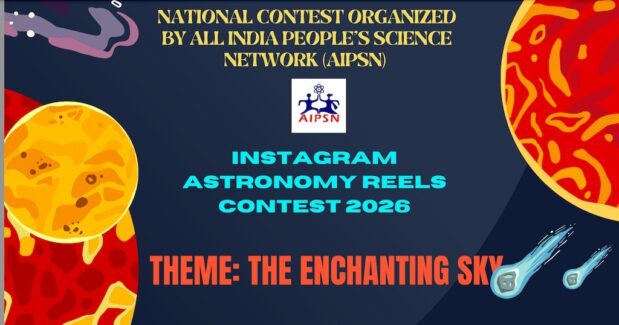
Instagram Astronomy Reels Contest 2026

Instagram Astronomy Reels Contest 2026

Click here to see the Google form for submission


Click here to see the document for rules


National contest organized by All India People’s Science Network (AIPSN)

Instagram Astronomy Reels Contest 2026


Theme: The enchanting sky

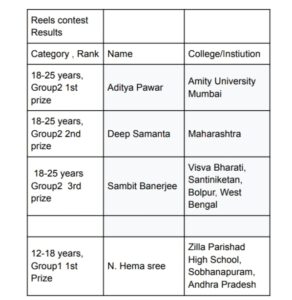
AIPSN invites submissions on this theme. The contest is open to all between 12 to 25 years of age and there is no submission fee. Winners will be announced on National Science Day, 28th February 2026. There will be five prizes in both categories given to the best 5 reels in each, and e-certificates of participation will be given to all participants.

Please read the rules and guidelines carefully before submission. You will not be able to edit your submission.


Rules:

Each participant can submit a single entry.

All entries must be published on instagram and the link of the post should be submitted through the Google form shared by AIPSN.

The contest is open to Indians living in India only.

Deadline for submissions: 17th February 2026 11:59 pm.

Incomplete submissions will not be considered for judging.

The reels should adhere to the theme of the contest.

The decision of the panel of judges will be final.

Use of AI should be duly declared in the instagram post, and is not preferred.

Plagiarism will be checked and plagiarized content will be disqualified.

Reels that hurt the sentiments of any ethnic or religious community will be disqualified.


Submission guidelines:

The reels can be of the duration from 15 sec (min) to 60 sec (max).

The reels should be in instagram friendly format and should be published / republished on instagram between 31 Jan 2026 to 17 Feb 2026.

Instagram reel description should clearly tag @aipsnmedia and include #astroreels2026 as a hashtag.

Submissions can be in English, Hindi or other Indian languages. For reels created in any language other than Hindi or English, it is mandatory to submit the transcript of the reel as a separate file through the form as directed.

The contest is open to participants from the following two categories:

A) 12 to below 18 years of age (posted on instagram by their parents / teachers / legal guardians).

B) 18 to 25 years of age.


How to Submit:

Click on the link: Google form or scan the QR code


Fill the form, upload the necessary documents and your submission.


Click on the Submit button.


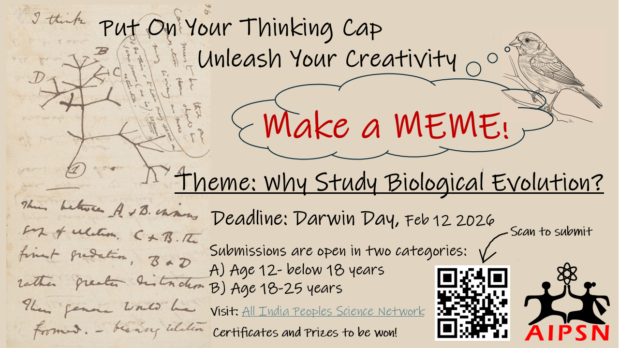
Darwin Day 2026 Meme making contest

Darwin Day 2026 Meme making contest

National meme making contest organized by

All India People’s Science Network (AIPSN)

On the occasion of Darwin Day, 12 Feb 2026


Click here to download the Rules, Regulations and how to submit the meme


 Click here to download  png    pdf  of the flyer 


 Theme: Why Study Biological Evolution?

AIPSN invites submissions on this theme. The contest is open to all, and there is no submission fee. Winners will be announced on National Science Day, 28th February 2026. There will be five prizes in both categories given to the best 5 memes in each, and e-certificates of participation will be given to all participants.

Please read the rules and guidelines carefully before submission. You will not be able to edit your submission.

Rules:

  1. Each participant can submit a single entry.
  2. All entries must be submitted through the Google form shared by AIPSN.
  3. The contest is open to Indians living in India only.
  4. Deadline for submissions: 12th February 2026 11:59 pm.
  5. Incomplete submissions will not be considered for judging.
  6. The memes should adhere to the theme of the contest.
  7. The decision of the panel of judges will be final.
  8. Use of AI should be declared at the bottom of the meme submission, and is not preferred.
  9. Plagiarism will be checked and plagiarized content will be disqualified.
  10. Memes that hurt the sentiments of any ethnic or religious community will be disqualified.


 Submission guidelines:

  1. The memes can be hand drawn or digitally created.
  2. The memes should be in the Square (1080X1080 pixels) or Rectangular (1080X1920 pixels) format only.
  3. Only jpeg/ jpg/ gif/ png/ pdf format submissions will be accepted. Please name the file with your_name_date before submitting so it is clearly identifiable.
  4. Submissions can be in English, Hindi or other Indian languages. For memes created in any language other than Hindi or English, it is mandatory to submit the text of the meme as a separate file through the form as directed.
  5. The contest is open to participants from the following two categories:
  6. A) 12 to below 18 years of age.
  7. B) 18 to 25 years of age.


How to Submit:

Click on the link: Google form or scan the QR code

Fill the form, upload the necessary documents and your submission.

Click on the Submit button.

Note: The maximum file size allowed is 10 MB for the meme and 1 MB for other documents.

AIPSN condemns the US action on Venezuela

Click here to read the pdf of statement


in English  in Tamil


AIPSN condemns the US action on Venezuela


The abduction and arrest of Nicolas Maduro and his wife by the Donald Trump administration is a blatant act of war, a raw demonstration of imperial power and an illegal intervention in another country’s internal affairs. The invasion of one sovereign nation to arrest its elected leader on unproven charges is a gross violation of international law and the United Nations charter. Acting President Delcy Rodriguez who took over charge after Maduro’s abduction has said “The war on drugs is a pretext, and the United States’ true objective is regime change and control of the country’s energy, mineral and natural resources “. It must be noted that Venezuela has the largest proven oil reserves in the world, which the USA is attempting to expropriate. The right of self-determination of countries must be a non negotiable in the modern world order.

The fake charges against the Venezuelan government echo the pretext of weapons of mass destruction used to invade Iraq. It is also very similar to the 1989 US invasion of Panama to capture Manuel Noriega. The accusation against Venezuela of a drug and weapons war against the United States is a fabricated narrative. There is no credible evidence emerging from any international agency, judicial body, or even official government data in the United States to prove so.

The AIPSN unequivocally condemns the unprovoked brazen military invasion and bombing of Venezuela which constitute war crimes. These criminal actions against Venezuela follow the criminal bombings against Iran and Gaza/Palestine by the imperialist USA and its allies in recent months. These actions of the USA dramatically increase the risk of worldwide escalation of war with unforeseen consequences for the whole world. We stand by and support the struggle of the people of Venezuela to defend their country ,in the face of formidable odds, against this American imperialist intervention.


The AIPSN calls upon its member organizations to organize public protests against the US attack on Venezuela.


#AIPSN

Fb

https://www.facebook.com/theAIPSN?mibextid=kFxxJD

Insta

https://www.instagram.com/aipsnmedia?igsh=dGRibjE1ZDQ4bW1l

Website. https://aipsn.net


Twitter @gsaipsn