Position Paper on ISRO and Private Sector in Space in India

Click here to read the AIPSN Position paper on ISRO and Private Sector in Space in India


Click here to read the AIPSN solidarity with ISRO employees Save ISRO 

Click here to read the AIPSN Statement on ISRO and Private Sector in Space in India

AIPSN Position Paper on ISRO and Private Sector in Space in India

29 Sept 2026

Part A: Policy direction and sectoral analysis

A1. Context

Recent pronouncements by the government and by the Chairman of IN-SPACe, the agency set up to oversee and promote commercialisation of the space sector, have added to the fears of scientists, engineers and concerned organisations about the direction in which ISRO is being steered.

Of particular concern is the growing role envisaged for the private sector in space-related activities in India and what appears to be shrinking responsibilities for ISRO, which is now mandated to transfer all technologies related to rocket launchers and satellites to private and other non-government entities (NGEs). Such apprehensions have also recently been expressed by serving ISRO personnel in a letter to the Chairman of ISRO, while nine employee associations have separately written to the Secretary of the Department of Space, seeking clarifications on statements made on behalf of IN-SPACe vis-à-vis the future role of ISRO.

These are not knee-jerk reactions against privatisation or the involvement of private players in space or other strategic sectors. Rather, these concerns relate to India’s place in the global space ecosystem and to the self-reliant advancement of India’s interests within it in an increasingly knowledge- or tech-based future. They also do not arise from misconstrued “narratives”, as the IN-SPACe Chairman believes, but from the very framework of the Indian Space Policy of 2023 and its roll-out as per official sources.

A2. Technology transfer: public-sector and private routes

Transfer of rocket manufacturing technologies from ISRO has already begun with the Small Satellite Launch Vehicle (SSLV), in the first instance to the defence PSU Hindustan Aeronautics Limited (HAL). Under AIPSN’s core position, such transfer to a public-sector entity under public control is distinct from private takeover of launch infrastructure.

Transfer of mature technologies for the larger PSLV, ISRO’s workhorse, or for the even larger GSLV or LVM-3 to any private entity would entail a long learning curve and higher risks, except possibly for a few companies. PSUs like Bharat Dynamics, which already produces the Agni missile, may be a safer bet. AIPSN does not oppose the transfer of mature space technology under licence and on agreed terms to a PSU or highly capable and established ISRO private sector partner, with the technology remaining under ISRO ownership and with ISRO technical oversight and national-security safeguards. However, AIPSN opposes handover of launch infrastructure or outright transfer of technology and manufacturing rights to private monopolies at undervalued prices.

The growing demand for launch vehicles, which ISRO cannot meet with its current facilities, makes the idea of shifting the manufacture of rocket boosters with proven repeatability out of ISRO for commercial purposes understandable—particularly if the logic is to free up ISRO for more challenging and strategic core tasks such as expeditions to the Moon or Mars, setting up and operating an Indian space station, crewed missions, scientific collaborations with other countries, and development of related technologies. To scale up launch-vehicle production, ISRO had mooted a consortium route, and in 2022 NewSpace India Limited (NSIL) awarded a contract (initially reported around Rs 824–860 crore) to a consortium led by Hindustan Aeronautics Limited (HAL) and Larsen & Toubro (L&T) to manufacture five PSLV-XL vehicles end-to-end, with the consortium expected to deliver most of the vehicle systems while ISRO retained some strategic elements (separation systems, certain avionics, mission design, launch operations, etc.). However, senior ISRO officials and employees have said these crucial functions must remain with ISRO, and any such transfer is acceptable only with retention by ISRO of rights over technology and future upgradations, along with appropriate terms and conditions, oversight and pre-flight approval, transparent valuation, and national-security safeguards—not as a route to private monopoly and surrender of technology rights by ISRO. It’s unclear why this realistic, reliable model for scaling up launch-vehicle production is being brushed aside.

ISRO was never intended or structured to be a factory and has never been one. Even presently, over 80% of rocket booster components are made outside ISRO by PSU and private sector industry partners. PSUs and the private sector, where appropriate and under public safeguards, would probably play important roles in all the above core tasks too. Hopefully, technology transfer by ISRO would follow usual commercial practice, including fees for tech transfer, training, hand-holding and back-up, while ISRO retains rights for technology upgradation and improved versions.

A few private-sector entities with several decades of experience and capacity-building have indeed established themselves in advanced manufacturing and engineering and could well assist in broadening the base of the space industry. ISRO has historically worked with many such entities and SMEs. Some space-sector start-ups may also independently develop innovative and viable technologies and manufacturing capabilities. But all that is a far cry from the current haste to shift manufacturing and some launch functions and related infrastructure to the private sector.

However, the argument that ISRO must focus on expeditions to the Moon or Mars, setting up and operating an Indian space station, crewed missions, scientific collaborations with other countries, and development of related technologies and that commercial entities will meet the launch vehicles and satellites is not realistic nor desirable. It is not realistic because, out of the 130-odd launch manifests, nearly half are strategic, much of the remainder is civil, and only 15+ are commercial. Thus, most of the expenditure will come from public funds, and mobilising private capital is not feasible. But, it is feasible with a PSU or other public entity under public control, with transparent valuation, national-security safeguards, and ISRO retaining upgrade rights—not as a route to private monopoly. Thus, if the alleged bottleneck is the current cadence limitation, then ISRO’s idea of a consortium is the best bet.

The current rationale for promoting the private sector does not take a fresh look at relations between the public and private sector but seems based on the tired ideological belief that the private sector does everything better than the public sector—an idea disproved in numerous cases in strategic sectors, especially as regards technology development.

A3. Launch economics and the fixed-cost problem

Many issues need to be considered. ISRO launches an average of 5–7 missions per year. Current demand from the public, including security, is much higher, and the problem lies not with ISRO’s capability but with chronic understaffing and limited government funding. The realistic manifest lists nearly 130 satellites to be launched by 2030 to meet the projected demand. This includes 10+ launches for the Gaganyaan mission, about 6 deep-space missions (including Chandrayaan missions), 32 Earth observation satellites, 64 strategic satellites, and nearly 6 commercial/private satellites.

Nevertheless, claims suggest India will need to build and launch 200-300 satellites over the next six to seven years and ramp up launch frequency to around 50 a year to meet growing demand. These claims lack justification and context. The claims never explain what these 200-300 satellites will do, where the demand is, or who will fund these launches. When OneWeb used Indian launch vehicles to launch its 72 satellites, it did not use 72 separate launch vehicles and 72 launches; it accomplished this with just two launches. The wide projected gap between ISRO’s capacity and launch requirement appears magnified to create optics and a ruse for privatisation, rather than reflecting any insurmountable bottleneck.

The China Satellite Network Group Co., Ltd. (China SatNet), a state-owned enterprise established in 2021 under SASAC (State-owned Assets Supervision and Administration Commission), plans to launch 12,000–13,000 satellites for national broadband as dual-use connectivity. Hundreds of satellites are already in orbit. Shanghai SpaceSail proposes launching 15,000 satellites for commercial broadband and connectivity services. Naturally, China is augmenting its launch fleet to meet these burgeoning launch projections. China does not permit either Starlink or OneWeb.

A consortium called SpaceRISE (led by major European operators SES, Eutelsat, and Hispasat), supported by industrial partners including Airbus Defence and Space, Thales Alenia Space, OHB, and others, is leading the European Union’s IRIS² (Infrastructure for Resilience, Interconnectivity and Security by Satellite) project for a constellation of nearly 350 satellites. The EU is building this infrastructure to avoid critical dependence on a US private company (Starlink) or even a partially European commercial network (OneWeb) during crises or geopolitical tensions. As the launch requirement is comparatively small, the EU is not developing additional launch capacity or commercial launch vehicles.

The Indian telecom industry has no such plans; instead, it is tying up with OneWeb or Starlink as local partners. Neither OneWeb nor Starlink, which are expected to commence operations in India, will depend on Indian launch vehicles. Thus, there is no demonstrated commercial demand established for a large-scale launch requirement. Even assuming the rather ambitious 50 launches a year by 2030, that does not make for a booming commercial business for private rocket manufacturers spread over several different booster types.

The same issue arises in respect of launches. A recently published international study has shown that launch costs in India are several times those of the US or other countries. Exact numbers may be debated, but the main factor correctly identified is that, while recurring operational costs for each launch may be low in India, as often cited, the low annual number of launches results in a high per-launch cost when infrastructure, manpower and other fixed costs are taken into account. When the new SSLV spaceport in Kulasekarapattinam in Tamil Nadu is handed over to a private-sector player as decided, will the new player charge globally competitive rates for launches but still bear all fixed costs and run an overall loss? Or will ISRO continue to bear fixed costs while the private player skims the cream off the top of operational costs alone?

 A4. The missing demand side

In the global space market today, about 78% of the value lies in commercial user services such as broadcast, telephony, internet data and so-called “reach applications” such as aggregators, delivery services, logistics, etc., while only a much smaller share is realised through infrastructure, launch and payload hardware. India’s Space Policy calls for shifting from supply to demand, but this is still missing.

Most of the vaunted start-ups are in supply-side innovations. So are the technology and infrastructure transfers from ISRO to the private sector. The big missing link in India is in market demand. Where are the commercial applications, the business ventures which will use all the space-based data? So far, ISRO has done yeoman service for the nation by generating data for resource exploration and mapping, weather (including cyclone observation and forecasting), and Intelligence, Surveillance, and Reconnaissance (ISR) services, broadcasting, and telephony. Except for the last-mentioned, the government has been the main user.

This is not to say there is no commercial space market in India. As of the beginning of 2026, India has 53 operational civilian satellites: 21 communication, 21 Earth observation, 8 navigation, and 3 science/experimental. Of the 21 communication satellites, NSIL has taken ownership of nearly 10 in-orbit GSAT/CMS communication satellites that were previously under government/ISRO control. It also commissions new “demand-driven” satellites (for example, GSAT-24) that NSIL fully funds and owns from the start. The remaining communication satellites are used for civil and ISR; so are the EOS (they are largely dual-use). Thus, they cannot be/should not be handed over to non-government entities.

Commercial operations are supposed to be the private sector’s domain, and this is the main role they should be playing in the space sector, which would drive up launch frequency and hence rocket as well as payload manufacture. Will the forthcoming Space Activities Bill address this problem, with adequate protection from intrusion of inimical foreign interests’ venture capital for start-ups and through FDI?

A5. ISRO’s core tasks and funding

ISRO has a lot on its plate which the nation badly needs for development: a new heavy rocket for crewed and interplanetary missions, reusable rocket boosters, defence satellites found badly wanting during recent conflicts, a full navigation system including India’s own GPS-equivalent, advanced technologies for the space station and crewed programmes, lunar exploration, and so on.

India’s space policies should strongly support these and provide adequate funding and support to ISRO, which has been seriously lacking over the years. Technology transfer for manufacturing to PSUs or capable and trusted private-sector partners, with appropriate terms and conditions, will then make sense. Hopefully, the private sector generates the necessary commercial applications and businesses—their supposed core competences—without waiting for government funds for that too.

Part B: AIPSN stands in defence of ISRO

B1. Why ISRO must be defended

For several days, a flood of reports and interpretations about the Indian Space Research Organisation (ISRO)—one of the country’s most strategically important central government institutions—has circulated in newspapers and other media. Not only the employees’ associations but also former heads of ISRO have come out in the open to prevent further damage to ISRO. Especially in view of the statements emanating from IN-SPACe and its move to open up the rocket-launching segment to private-sector participation when the Space Policy has not been discussed in Parliament, nine employee associations of ISRO have addressed a letter to the Secretary, Department of Space, seeking clarifications on the statement made on behalf of IN-SPACe vis-à-vis the future role of ISRO.

AIPSN recognises that ISRO has changed everyday life. Today’s ISRO was not built in a day. Activities that began in 1962 at Thumba, Thiruvananthapuram, under the Indian National Committee for Space Research (INCOSPAR), then under the Department of Atomic Energy, formed the foundation of India’s space programme. Satellite technology has reached communications, television, telephony, the internet, weather observation, remote sensing, natural resource monitoring, disaster management, navigation, agriculture, fisheries, and the monitoring of railways and other transport systems—directly shaping the economy and people’s lives.

Designing and building the launch vehicles that place satellites needed for national security and public service into their intended orbits, without complete dependence on foreign technology, is itself a major strategic achievement and proof of scientific self-reliance. ISRO cannot therefore be treated as just another government office. ISRO is one of the main pillars of the country’s scientific capability, technological sovereignty, national security and public interest. Its capabilities were built in an era of limited facilities and resources. Indian scientists, engineers, technical staff and workers advanced the field of space technologies through extraordinary labour and dedication. This is not the achievement of any single scientist or political leader. ISRO is the collective labour of thousands across scientific, engineering, technical, worker and administrative cadres. Generations who worked as one for mission success, without measuring their contribution by pay scale or rank, are ISRO’s real capital.

B2. Importance of who decides

IN-SPACe was set up to promote the private sector in the space economy and, among others, to act as an interface between ISRO and emerging startups for sharing of space infrastructure and premises under the control of ISRO, with due consideration to ongoing activities, establishment of temporary facilities within premises under ISRO control based on safety norms and feasibility assessment and usage of spacecraft data and rolling out of space-based services and all the associated infrastructure for the same. However, surprisingly, In-SPACe has invited expressions of interest (EOI) from private industries or consortia to handle end-to-end realisation, manufacturing, operation, and commercialisation of India’s heaviest rocket, the Launch Vehicle Mark-III (LVM3), as well as Operations and Management of SLC at Kulasekarapattinam. Curiously, the EOI bars PSU and state enterprises from participation. Why so is inexplicable. IN-SPACe is not envisaged to call for an EOI; it must have been either ISRO or NSIL. Why these organisations were sidelined is also not clear.

ISRO has always engaged the private sector in the manufacturing of launch vehicles. However, IN-SPACe routes to privatisation appear to involve (1) selling cheap knowledge and technology developed and (2) hollowing out manufacturing, which means a lack of quality discipline and weakening of the knowledge required for the development of critical technologies.

This criticism is aimed at ensuring technology transfer and ensuring retention of technology and IP with ISRO. Moreover, ISRO’s traditional contracting with PSUs continues to provide public ownership and control. While the contribution of the private sector to ISRO’s requirements has not been opposed in principle by either the former heads or by the associations of employees, the demand is for a wider discussion of the Space Policy, which assigned roles to Inland IN-SPACe. The Space Policy must ensure that what shall be manufactured in-house is done after sufficient discussion internally.

B3. Stagnation in ISRO funding: NavIC and spectrum

The government is starving ISRO of funds and support. Budget allocations have consistently been less than what ISRO sought, and actuals have been less than the budget announcements. It is not unreasonable to suggest that ISRO is being deliberately starved of resources so that its functions can be transferred to private players under the guise of ‘efficiency’ and/or ‘non-performance’.

The case of NavIC (Navigation with Indian Constellation) illustrates this neglect very well. NavIC has considerable strategic importance. NavIC is meant to replace the US-based GPS, whose services the country cannot take for granted, as the Kargil crisis amply evidenced. The NavIC system’s efficacy is critically dependent on the functioning of the atomic clocks that the NavIC satellites carry. Over the last 13 years, almost all NavIC satellites have progressively become dysfunctional, largely because of faulty atomic clocks supplied by an international vendor. ISRO is now developing an indigenous clock, which has been flown on the last few NavIC satellites. The government made no effort to help ISRO replace the non-operational NavIC satellites. Investments in NavIC would have enabled ISRO to strengthen national security.

B4. IN-SPACe misjudging ISRO and the launch-infrastructure question

After IN-SPACe was formed, steps to open ISRO infrastructure to private use have come to be intensified: facilities offered at low cost, use of launch systems, and private access to new launch sites. The subsequent opening of SSLV manufacture and launch facilities to private firms—beyond the earlier transfer to HAL as a PSU—and related measures around launch infrastructure in the Thoothukudi region of Tamil Nadu illustrate the scale of the shift.

In this context, the growth of the private space start-up Skyroot is notable. It was founded in Hyderabad by Pawan Kumar Chandana and Naga Bharath Daka, both former ISRO engineers. The publicity around the successful Vikram-1 launch signalled the new importance given to the private space sector. The launch used ISRO facilities at Sriharikota. Senior ISRO officials and former chairmen attended; the Prime Minister congratulated the venture.

AIPSN is opposed to technologies, human resources and infrastructure developed over decades with public money being used cheaply to grow private companies. This opposition does not extend to transfer to public-sector entities under public ownership and ISRO oversight; such transfer may be acceptable if properly valued, audited and kept under public control. We are concerned about who in the private sector is being allowed to capture the economic benefit of knowledge created in the public sector. Foreign venture capital is driving IN-SPACe’s new routes to privatisation. We wish to ensure that public interest and national security are protected when facilities are given to private firms.

B5. Contract staff or full-time researchers

A major issue in the debate on ISRO’s future is the condition of its workforce. It is often argued that talented scientists leave ISRO for better-paid private jobs because pay and benefits are inadequate. Few attribute this attrition to better pay in the private sector. In fact, when compared with many other central government organisations, regular appointments in ISRO demand high educational qualifications and merit. Even some clerical posts require a first-class degree. Thus, the criticism that pay and promotion opportunities are not commensurate with qualifications and work across all cadres cannot be ignored. Nevertheless, the exodus of expertise appears to be driven by uncertainty about ISRO’s future direction, underfunding, and bodyshopping by the private space industry.

The resignations leave ISRO in a tight spot; meanwhile, fresh recruitment has been minimal. Together, these have created an unprecedented gap between sanctioned strength and employees on the rolls. The number of sanctioned posts across the Department of Space has stayed around 20,000 since 2019-20. Employees, however, have fallen from 17,222 in 2019-20 to 14,637 in 2025-26. Consequently, staffing has dropped from 85.9% to 72.2%, while vacancies have more than doubled from 2,817 to 5,632.

For several years, regular recruitment to many posts, including technicians, has been restricted, and contract and subcontract arrangements have been relied upon more heavily. The labour of tens of thousands of contract workers at ISRO centres has been critical to meeting rising launch demand. Many do not receive the service benefits or job security of regular employees. Many work on fixed daily wages with little social security. This human-resource problem affects the quality and continuity of the country’s space missions. When more than 10,000 technical workers on contract across centres are also counted, the scale of the invisible labour behind ISRO’s successes becomes clear. This is not only a labour issue.

B6. ISRO’s public wealth is not for sale.

When rocket technology, launch systems, research facilities and human capability developed for more than sixty years with public wealth are then opened for private profit, questions of ownership and benefit become unavoidable. Private firms may use ISRO infrastructure. But the return on public money spent to build that infrastructure is not an irrelevant question. To present privatisation as mere “development” without clear answers to these questions is dangerous.

Space technology is unlike ordinary industry. Satellites, launch vehicles, communications, navigation and disaster-management systems are directly linked to defence and security. Transfer of advanced knowledge, including rocket technology, must therefore be handled with the highest caution from a national-security standpoint. A model in which public-sector technology moves to private monopolies and infrastructure created with public money is made available to private companies at low cost must be examined for what it will give the country in the long run and how it will ensure public interest and social control.

B7. Protecting ISRO is protecting science.

When ISRO’s problems are discussed, one fact must not be forgotten: ISRO’s strength does not lie only in its buildings, rockets or machines. It lies in the people who create and operate them. To strengthen ISRO, scientists, engineers, technical staff and workers must have decent working conditions, reasonable pay, and job security and promotion prospects. The practice of using contract workers for years as substitutes for regular employment must end, and regular recruitment to required posts must take place. A work environment must be created in which a new generation of scientific talent wants to stay in ISRO. What is not needed is a policy that weakens public-sector scientific capability and channels human resources and technology into the private sector. AIPSN asks the current management not to target the voices of opposition.

Concerns about the transfer of space technology to the private sector can no longer be dismissed as merely the political argument of critics. The 410th Report of the Department-related Parliamentary Standing Committee on Science and Technology, Environment, Forests and Climate Change, presented in Parliament on 25 March 2026, itself recorded a serious concern on this subject. The Committee expressed concern that space technologies are being transferred to private entities at prices disproportionately low relative to their commercial potential. The Committee recommended that licensing fees for technology transfer should reflect real commercial value, distinctiveness and social importance. It also said clear valuation norms are needed and that all technology-transfer agreements should be subjected to periodic third-party audit.

Cooperation with the private sector is possible. New enterprises can be encouraged for technological progress. Organisations and employees in the field do not oppose this. From the beginning, ISRO has worked with both the public and private sectors. But that must not mean loss of public ownership of wealth, national scientific capability, or public control over strategically important technologies. The issue is therefore not the simple question “private sector—yes or no?”

B8. AIPSN demands

The main questions that need to be answered are:

  1. Who protects the real value of technology developed with the people’s tax money?
  2. How much of the economic gain from knowledge created with public wealth will return to the public?
  3. Who sets the price of technology transferred to private firms, and by what criteria?

The Department of Space should be transparent and publish the results of the investigation into the failure of two successive PSLV missions and take corrective measures. Privatisation of manufacturing will only add to the challenge of tackling such failures in the future. Failures occur in science; the nature of science is to learn from them and return stronger.

AIPSN is opposed to:

– transferring public wealth to private monopolies;

– shrinking regular employment while expanding contract labour;

– Moving towards a form of privatisation that gradually renders ISRO, built with the tax money of crores of people, the hard labour of generations and the life-dedication of scientists, less relevant is unacceptable because, in the long run, it will be a serious loss to the country’s scientific capability and public interest.

ISRO’s failures must be corrected scientifically; its successes must not be privatised. ISRO’s technology is the wealth of the nation. Its infrastructure is the creation of the people’s tax money. Its real strength is the collective labour of scientists, employees and workers.


Declaration and Resolution on Scientific Temper

Click here for English pdf  of the Declaration of Statement on Scientific Temper with signatories 


Other languages: Tamil Bengali Telugu


Click here for English pdf of the Resolution adopted along with the Declaration on Scientific Temper 


Other languages: Tamil    Bengali  


Leaflet/Powerpoint distributed about the Declaration/Resolution in  Tamil  Bengali 


Adopted at “Campaign for scientific temper culmination program and National convention for declaration on scientific temper”

held on 28th Feb 2024 at Kolkata


Statement on Scientific Temper in the Current Context

Executive Summary There is an urgent need for a renewed commitment to evidence-based reasoning, critical thinking and a scientific approach in India, especially amidst growing socio-political movements that challenge a scientific temper and universal knowledge production based on commonly agreed methods and understanding. Given the changes in society and technology since the earlier declarations on scientific temper in 1981 and 2011, we emphasise the importance of embracing natural and social sciences, humanities, and the rational experiences of ordinary people in the common endeavour to combat the post-truth culture, the intentional promotion of ignorance, and diminishing trust in science exacerbated by misuse of technology. We call for action across three fronts: the State’s role, the involvement of scientific and academic institutions, and combating the undermining of science by the State, the erosion of academic freedom, and the spread of pseudo-science and unscientific beliefs. We urge scientists, intellectuals, and other like-minded individuals to support evidence-based thinking and policy-making and to uphold constitutional values to foster a scientific temper.

Introduction Since the Coonoor Statement on Scientific Temper in 1981 and the Palampur Declaration in 2011, there have been significant socio-political changes in India and around the world. Briefly, these earlier statements had emphasised the importance of fostering a scientific attitude among the people for development and social advancement. Over time, movements promoting scientific temper in India have also evolved in accordance with changing public perceptions of science and technology (S&T).

Recently, new challenges have emerged in India and elsewhere in the world in the form of strong socio-political movements, backed by the State power, that seek to oppose any scientific approach, evidence-based reasoning or, indeed, any perspective that acknowledges universal scientific knowledge. Globally, a post-truth culture is spreading, marked by a deliberate spreading of ignorance and an anti-intellectual atmosphere, along with a diminishing trust in science. It is ironic that technology, part of the broad umbrella of science, is being harnessed to support these trends through social media, such that manufactured sentiment, prejudice, false narratives, baseless opinions and conspiracy theories gain acceptance as valid ways of thinking.

Against this background, the current situation requires a renewed commitment to robust evidence-based reasoning, drawing from accumulated knowledge in the natural and social sciences, and humanities, as well as from the know-how and rational experiences of working people. Such reasoning aligns with well-recognized methodologies of different disciplines, including emerging interdisciplinary research, applicable not only in academic environments, but also in public discourse and understanding. Both scientists and lay practitioners need to actively embrace and popularise these methods considering the new socio-political realities in India.

This contemporary statement on Scientific Temper has become essential, to address present challenges. This statement shall not undertake a critical review of the previous statements / declarations or debate their points. Instead, it acknowledges past debates and critiques, incorporating their essence into the current statement, recognizing the commonality of scientific disciplines and their methodologies. Rather than revisiting old debates, the focus here is on delineating the significant challenges faced in contemporary India for the constitutionally mandated task of promoting scientific temper, the spirit of inquiry, and humanism. Knowledge production and advancement through purposeful discovery and evidence-based reasoning, including thorough consideration of diverse opinions, is currently under severe threat both in academia and in society at large.

Dangerous new theatre As noted earlier, the arena for fostering scientific temper has evolved significantly in recent decades, becoming increasingly contested, including aggressive socio-cultural forces as well as governmental policies and administrative measures antagonistic to scientific temper. The current situation in India demands critical understanding and action on three interrelated fronts: the role of the State and polity, the character and function of scientific research and academic institutions, and malign influences in society and among the general public.

Article 51A(h) of the Constitution of India speaks of the duty of citizens to promote scientific temper. There is concern in some quarters that responsibilities of the State in this regard have not been adequately highlighted. While it might have been assumed that the State’s primary responsibility is implicit when citizens are called upon for certain duties, there is a need for a clearer delineation of the State’s role.

Note: In the declaration, the terms ‘scientists’ and ‘scientific institutions’ are used as terms denoting all natural sciences, social sciences and humanities disciplines, and those others following an evidence-based path of knowledge production and understanding.

Role of the State In the initial post-Independence decades, the Indian State placed significant trust in scientists1 and scientific institutions. Development policies were evidence-driven, with research institutions and centres of excellence enjoying high priority and prestige, and enjoying substantial autonomy. Documents like the Industrial Policy Resolution and a unique Scientific Policy Resolution were foundational to planned development, guided by a multidisciplinary group of experts in the Planning Commission. Independent scientists and social scientists, both from India and abroad, were involved in policy-making, underlining the importance given to science and evidence-based policy-making. Notably, religion played a minimal role in state affairs, and secularism, defined as non-discrimination and equal respect for all religions, was practised. However, the evils of casteism and communalism have never been properly eliminated.

However, in subsequent years, bureaucratism, elitism, and a techno-fix mentality crept into the system, creating something of a divide between scientists and the general public. Trust in scientific institutions also eroded as a perception grew that “establishment science” primarily served officialdom and corporate interests, rather than the public good as supported by verifiable data. During this period, academic, professional, and informed activist voices in civil society critiqued official narratives, influencing public opinion and contributing to critical thinking and evidence-based policymaking. While the State may not have proactively cultivated scientific temper, it engaged with and supported activities to popularise science among the wider public and children. The State also provided considerable space in governance and public discourse for non-official scientific, expert, and informed lay opinion.

Undermining science and a scientific approach   Presently, the State displays a stark departure from this earlier stance. Government and its various organs now actively oppose a scientific approach, independent or critical thinking, and evidence-based thinking and policy-making. This antagonistic stance is widely and persistently communicated to the public through various means, perpetuating such attitudes. State support for research and development (R&D), already below comparable countries as a percentage of GDP, has hit historic lows, raising serious concerns about India’s future in the knowledge era. Domestic assembly by cheap labour is misrepresented as self-reliance, thus also underplaying the need for research and knowledge production.

Funding, fellowships, and independent research face severe cuts in academic and research institutions, burdened by overpowering bureaucratic structures. Career advancement now favours adherence to dominant ideologies, sycophancy, and obedience to government directives over adherence to imperatives arising from domain expertise and research-based insights. Development data and India’s position in reputed international rankings are contested on spurious grounds. Similar data generated in India, even by government institutions, are rejected or manipulated to fit political narratives. On numerous issues, the government claims to lack data, but still proceeds with policy decisions. Open discussions in higher learning institutions are discouraged, hindering critical thinking, pluralism, and academic freedom.

Beyond image management, these tendencies undermine a scientific approach and evidence-based policymaking, demoralising the knowledge production community and fostering anti-intellectual attitudes.

The State and allied social forces directly undermine science and its methods among the public. Unscientific claims by prominent figures in political circles, boasting of imaginary technological achievements and exaggerated ideas about ancient Indian knowledge, are used to build and support a hyper-nationalist narrative. These assertions lack evidence, relying on ambiguous mythological references and dubious interpretations of ancient texts, often draped in quasi-religious cover so as to suppress dissenting voices. Such fanciful and boastful claims undermine many actual substantial contributions of ancient India emanating from various cultural streams and covering intellectual as well as artisanal and technical accomplishments. Critics of such claims are readily branded as anti-national or westernised, questioning both history and science, and undermining the scientific method. Dissent and plurality of opinion, known to be enabling conditions for intellectual progress, are presently under threat.

Assault on the education sector It is disheartening to witness these trends now being introduced into the formal education system, potentially influencing an entire generation unless effectively countered. School textbooks and readings in higher education are undergoing revisions that promote the idea of the unquestioned superiority of knowledge in ancient India, while downplaying the role of other civilizations and their groundbreaking contributions. Whereas addressing Euro-centrism and acknowledging the contributions from ancient India, China, and other “eastern” civilizations is essential, denying the emergence of modern science and technology and the industrial revolution, and the factors leading to it, is not only untruthful but also misleading. The giant strides of modern science and technology cannot be undermined or replaced by fictional narratives, as seen in revised school textbooks of agencies at the Centre and in various states.

These revised textbooks also omit chapters on crucial historical, societal, economic, and ecological issues in India. In an examination-oriented system not fostering critical thinking, this leaves students ill-prepared for higher studies or research and for their roles as informed citizens contributing to national development.

In higher education, mandatory courses on “traditional knowledge systems” are being introduced, presenting a-historical and distorted accounts of knowledge in ancient India. These courses exclusively glorify the Vedic-Sanskritic tradition, neglecting other cultural streams in ancient India and completely disregarding the significant generation of new knowledge in mediaeval India, out of prejudice against particular religious and cultural

streams. This deliberate slant aims to erase or rewrite historical evidence and obstruct critical thinking, leaving students and citizens vulnerable to bias and instilling a distorted view of syncretic Indian traditions and multicultural reality. In the long run, this will result in incalculable damage to the progress of Indian science and to social harmony.

Societal attack In recent decades, India has witnessed the growth of socio-religious orthodoxy, traditionalism, and revivalism, fueled by majoritarian socio-political forces. Traditional religious practices, festivals, and communal forms of organisation have proliferated. Numerous “Godmen” have emerged with substantial resources, sizable followings, and at times, significant political backing. These cults, despite projecting high-thinking spiritualism, have propagated superstitions, pseudo-scientific beliefs, and socio-religious orthodoxy.

Today, social forces aligned with the ruling establishment and supported by the State, disseminate pseudo-science and a belief in mythology as history. False narratives are being used to construct a unitary majoritarian religion and culture, contrary to the diverse religious beliefs even among the majority community. False and unscientific narratives, such as vegetarianism as a dominant “traditional” practice, are being promoted, contradicting scientific surveys conducted by official agencies.

During the COVID pandemic, superstitions and pseudo-scientific notions related to health were actively promoted under the guise of endorsing “traditional” or ancient Indian health systems while implicitly or explicitly criticising modern medicine. Highly placed authorities encouraged practices like lighting lamps and clanging utensils to ward off the virus, with social media amplifying purported “proof” of efficacy, such as recordings of “cosmic vibrations” by NASA. Other pseudo-scientific claims are similarly backed by false evidence supposedly coming from reputed scientific agencies. Artificial creation of long-lost legendary ancient rivers is being undertaken to perpetuate mythology. All these exploit the enduring respect common people hold for science and its truth value. The forces of unreason seek to sow confusion regarding evidence and scientific methods.

Social media and digital technologies play a pivotal role in the State-backed dissemination of unscientific and anti-scientific views, pseudo-science, false narratives, and conspiracy theories aimed at undermining a scientific approach.

In closing, it is important to address the idea that “other worldly” religious beliefs pose the only or major obstacle to fostering a scientific temper in India. Faith poses many challenges which science or rationalism may not always be able to tackle, insofar as faith itself may be defined or perceived as belonging to a non-physical domain. Freedom of religion or Individual faith may indeed be accorded due recognition. At the same time, discriminatory practices or those that impinge on others’ rights or affect public order, must be opposed, and their irrational basis explained. Obscurantism persists due to ongoing weaknesses in society itself, highlighting larger battles that need to be fought, of which the present one may be just a part. Given the organised challenges to a scientific approach discussed earlier, a more focused and targeted strategy is required for the campaign to promote or strengthen a scientific temper.

Declaration We scientists and intellectuals across disciplines, activists and all individuals passionate about spreading a scientific temper, acknowledge that the struggle to promote a scientific temper is wide-ranging and embraces many dimensions. Yet we also understand that, given the grave threats posed in the current context, the major challenge in this period is to combat and roll back these threats. We realise the imminent danger posed by organised multi-pronged attacks to undermine a scientific attitude among the populace. Such attacks not only disseminate pseudo-science, blind faith, and unreason but also promote obscurantism, communitarian prejudices, and discrimination, striking at the core of a humanist approach. False narratives, unfounded opinions, and a cloak of religiosity are wielded to instil adherence to a manufactured, homogenised, majoritarian idea of India.

We, the signatories of this declaration, re-attest the importance of working towards promotion of scientific temper in society. We recognise the grassroots work put in by people’s science movements, other like-minded organisations and dedicated individuals, and commit to support these and other similar efforts. We appeal to like-minded individuals in academia and research institutions, the bureaucracy, and the political class to take a stand upholding constitutional values.


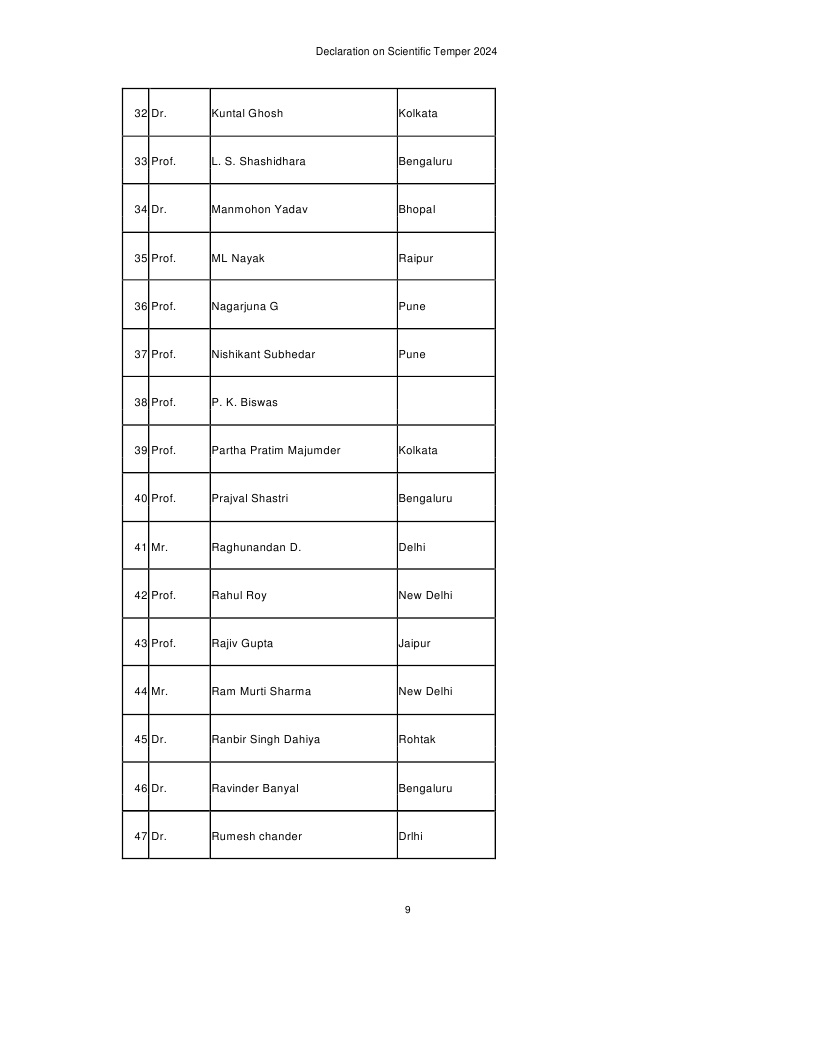
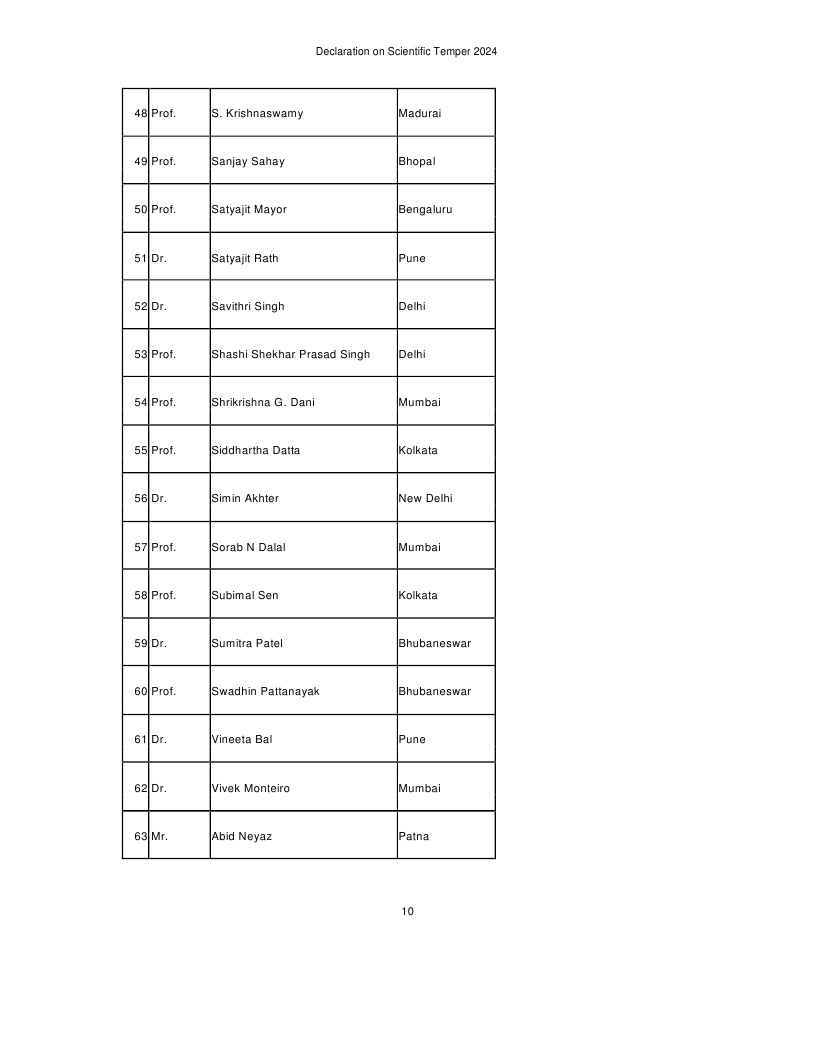
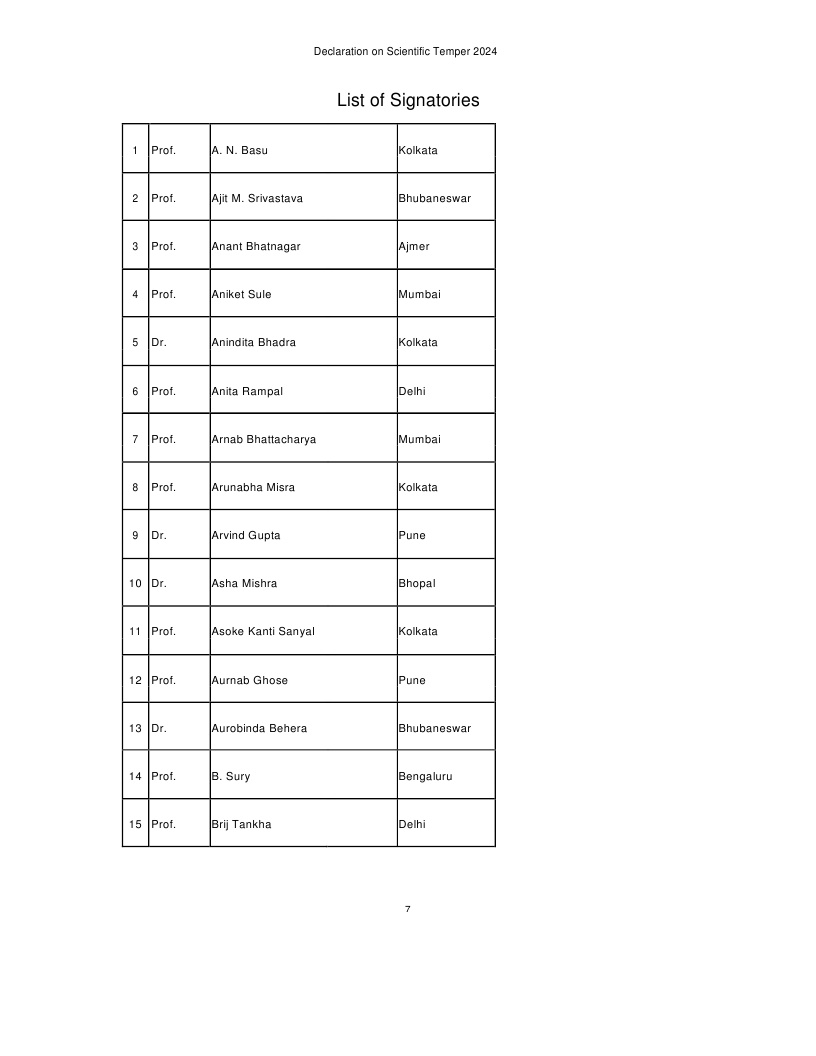
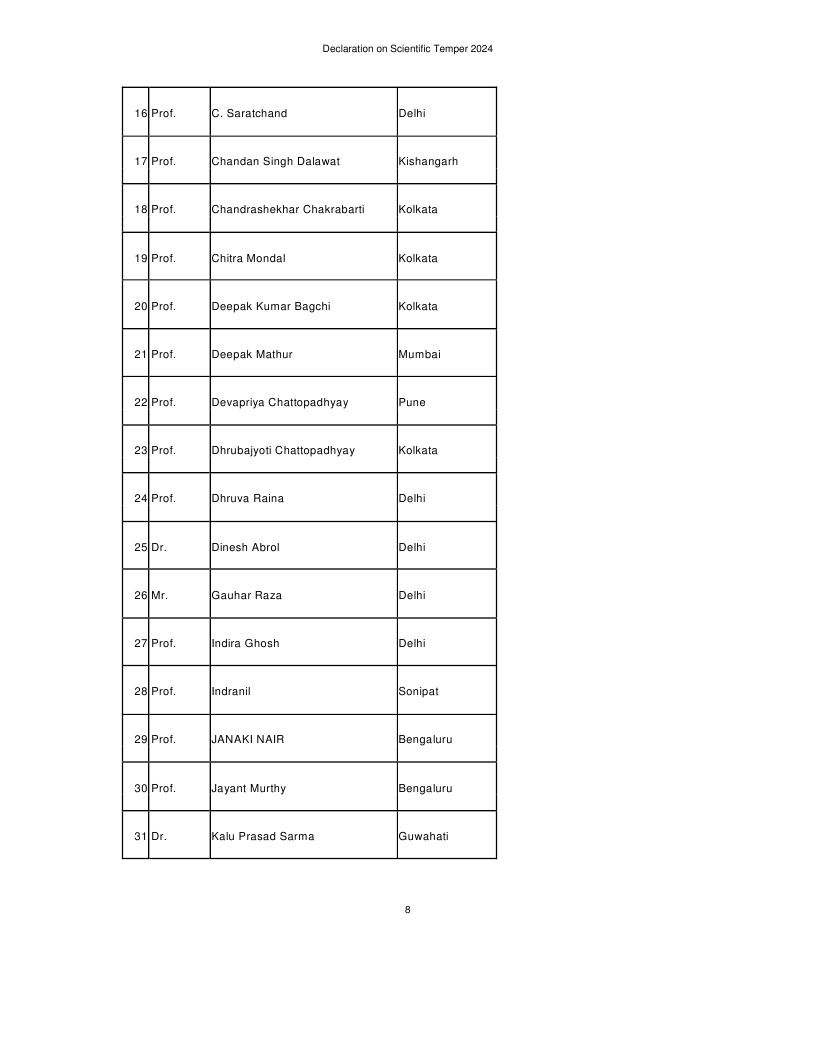
List of Signatories given below 


For further information contact

Satyajit Rath  9868877399

Asha Mishra   9425302012

Arunabh Mishra  9831105979

Krishnaswamy 8012558638

Aniket Sule  9820273239


Resolution adopted by the AIPSN along with the  “Statement on Scientific Temper Declaration”

in the  “Campaign for scientific temper culmination program and National convention for declaration on scientific temper”

held on 28th Feb 2024 at Kolkata


Convinced that India that is Bharat grew for several centuries as Hindostan, and where the people of various religions chose to live together after becoming politically independent from the British Empire and experiencing the partition, is not  a society of comparative and competitive religious fanaticism;

Certain that Hindostan is not the land of make-believe demands on Astha (the tradition of belief systems) alone, but that Hindostan is also the land of modern interpretations of religion;

Confident that Hindostan is the land of the rich tradition of syncretism (combining different traditions) and of seekers of the Universal Truths in religions, and that the people cherish civilizational heritage and celebrate the unity in diversity in food, dress and language on everyday basis;

Clear that Hindostan is the land where Nastiks and Astiks coexisted, materialistic philosophical traditions, for example, lokayata flourished, and the revolution of equality through Buddhism appealing to large sections of society took root, and where the traditions of rebellion and resistance grew through the teachings of Basava, Kabir, Nanak, Narayana Guru, Periyar and many more, promoted inclusiveness and syncretism of sufi and bhakti spiritual preachers;

Accepting that the people care for the legacy of the freedom movement, constitutional vision, national unity and integrity, and do not doubt that the majority is concerned about economic, ecological and social justice, and they continue to think about fundamental rights and directive principles of state policy enshrined in the Indian Constitution;

Recognizing that the people as bearers of historical knowledge, skills and culture, and as social carriers of agro-food diversity, culinary heritage, dietary selections, continue to enjoy variegated range of food, health and fitness practices, and they would be willing to stand up once again against the bearers of sectarian politics trying to take away their economic, social and political freedoms;

Recalling that the contributions to modern science & technology made by J C Bose,  M Visvesvaraya, P C Ray, C V Raman, M N Saha, P C Mahalanobis, S N Bose, S.S. Sokhey, SS Bhatnagar, Homi Bhabha,  Vikram Sarabhai, Satish Dhawan and by many others who challenged the colonial order in S&T, and the perspective and strategy of Scientific Policy Resolution (SPR, 1958) which cherished self-reliance and, embraced scientific approach to policymaking, the scientific and technological communities would not let the people suffer unreason and eliminate the space for pluralism and diversity from the world of higher education, science, technology and humanities;

Persuaded that as the post-independent India’s transformative impulses of self-reliance that accommodated the Gandhians, Nehruvians and Leftists to practice their own S&T heuristics for development in the parallel, gave a place to the ethos of scientific temper and humanism in the Indian Constitution, and in the National Curriculum Framework (2005) and in the Right to Education legislation (2008), the Indian S&T community and the people can be mobilized to defend these gains;

Knowing that the ecumenical (promoting unity among religions), cosmopolitan and modern traditions of scientific and technical practice have deep roots in India, the S&T community can be made to appreciate that the sources of ancient and medieval contributions to science involved multi-cultural interactions, and that the attempts to present mythology as history and fiction as science do not resonate well with the people, the vast majority of Indian people can be made to understand how the latest modern construction of the past traditions is to present an ideology that glosses over and hides the inequalities and exploitation based on caste, class, gender and community;

Recognising that as the people resisted Brahmanism and caste oppression in the ancient and medieval times, the latest attempts to cultivate and impose the irrational and unreasonable ideas on the Indian Women, Youth, Adivasis and Dalits can also be defeated among the people across North, South, East and West of India by mobilizing the people against the assault on scientific temper in the relevant spheres of school and higher education, scientific research and science popularisation;

Feeling alarmed at the Union Government’s blatant unconstitutional attempts to impose on the states the National Education Policy (NEP, 2020), that has the potential to damage irreparably the national character and destroy the secular and democratic contributions of Indian education, the Peoples’ Science Movements (PSMs) call upon the state governments to resist the efforts that sow the seeds of hatred and conformism deep into the mind of the young under the influence of the idea of Hindutava – a destructor of social progress and universal brotherhood/sisterhood, and rededicate themselves to developing quality education with public purposes of national importance

As PSMs,

We solemnly affirm our constitutional right to defend the integrity of Article 51 A(h), and to ensure that the investments in education, science, technology, humanities and arts are considerably enhanced and directed to work for the realization of the scientific temper/outlook[1], for the cultivation of linguistic and socio-cultural diversity, for the universally cherished message of love (‘Vasudhaiva Kutumbakam’ – the world is one family’ ) and for the secular and socialist idea of India and for the reduction of inequalities;

We will contribute to the movements seeking economic, social and ecological justice, and work for the dignified livelihood for the Indian people as a whole through education and research, commit to redouble our own efforts for the promotion of progressive anti-imperialist nationalism, and to strengthen the role and contribution of Indian S&T institutions in the processes of decision making and evaluation of the socio-economic policies under implementation;

We continue with the work started by Dara Shikoh, Savitribai and Jyotriba Phule, Ramabai, Rabindranath Tagore, Nehru, Mahatma Gandhi, Periyar, Bhim Rao Ambedkar, EMS Namboodripad, Ashfaqullah, Bhagat Singh, Subhas Bose, Meghnath Saha, S.S Bhatnagar, Homi Bhabha, S.S. Sokhey, Vikram Sarabhai Husain Zaheer and many others who stood their ground and established the edifice of post-independence period modern S&T institutions, and helped the people to realize the idea of India and the legacy of progressive traditions of the freedom movement;

Mobilize the scientific community to stand up for academic freedom, and actively collaborate with the democratic movement and civil society to defend civil liberties and democratic rights, freedom of expression, organization, representation and struggle through constitutional means, and expose and isolate the forces supporting the babas spreading fatalism and unreason,

Collaborate and work with the rationalists, scholars, academics, scientists, technologists, social scientists, teachers of humanities and sciences,  and professionals about the way forward for the realization of the above stated goals of social progress, propose policies, build institutions and establish a standing mechanism to pursue the challenge of cultivation of scientific temper,  humanism and world peace.

[1] The term scientific temper is broadly defined as “a modest open-minded temper—a temper ever ready to welcome new light, new knowledge, new experiments, even when their results are unfavourable to preconceived opinions and long-cherished theories.

For further information contact

Satyajit Rath  9868877399

Asha Mishra   9425302012

Arunabh Mishra  9831105979

Krishnaswamy 8012558638


No to centralization and privatization of research funding: Remit NRF bill to Parliamentary Standing Committee

Click here to see the signature campaign which closed on 30July

Press Coverage in Newsclick  TheHindu

Click here to see the press release on AIPSN letter head 

Links here  to download the press release in pdf: English , Tamil 

Read this to see a detailed AIPSN statement on the NRF

Press Release

             All India Peoples’ Science Network (AIPSN) says no to centralization and privatization of research funding and asks the Union Government to remit National Research Foundation Bill to Parliamentary Standing Committee on S&T, Environment and Forests for a comprehensive assessment.

The National Research Foundation (NRF) Bill, 2023 seeks to replace the Science and Engineering Board (SERB) Act, 2008 by establishing an entity that will not be a fully publicly funded, dependent on corporates, philanthropic bodies and international foundations for funds, centralized in decision making via the Prime Minister as ex-officio President and the Union Ministers of S&T and Education as ex-officio Vice-Presidents and controlling the directions of academic research across disciplines and domains of application.  The original rationale of NRF was to redirect the flow of funds to the state universities to strengthen them as academic institutions.

In the five year allocation of Rs 50,000 crores for R&D through the NRF, 72% of will be financed by the private sector (through as yet unidentified process), and only 28% funded by government. The funding structure will seek the establishment of a stronger intellectual property mechanism of the Bayh-Dole kind which has been resisted by the academic institutions. In the current proposal corporates and elite institutions with access to power centers will have an edge.

Only 1% of the institutions of higher education engage in active research. In terms of the percentage of GDP, India’s spending on research and development (R&D) is among the lowest in the world. In 2022, India only spent 0.65% of GDP on R&D. The public funding for R&D has come down from 0.8% at the start of the 2000s to about 0.65% now; full time equivalent (FTE) researchers in the higher education sector declined from 39.96% in 2015 to 36.48% in 2018. Researchers employed in the publicly funded research sector declined from 30.32% in 2015 to 23.13% in 2018.

The NRF would not be able to address any of these structural impediments to the promotion of academic research and research of societal application and public value.  The state universities need more qualified teachers and researchers in permanent posts. Rampant feudalism, gender and caste based oppression, lack of culture of collaboration are major obstacles to the climate for research and innovation. The NRF hands over executive control and channel of funding to the governing body with much say for corporate entities with no representation to state governments in the Union Government funds for R&D.

It is important to involve academics from all over the country, the state higher education councils and the line ministries of the Union Government to ensure decentralized decision making. The NRF can undermine the possibility of harnessing the energy of multiple sources of initiatives. Joint planning is a more effective way of realizing diversity and plurality of missions in the world threatened by climate change and inequality.

            AIPSN demands that the “National Research Foundation Bill 2023” be re-examined. This bill should be sent to the Department Related Standing Committee on S&T, Environment and Forests for a comprehensive assessment. The Committee should invite the development authorities, line departments of the union government and state governments, the representatives of organizations working with the scientific community and individuals to submit their views on the Bill. The centralisation of funding, lack of academic oversight, not addressing the existing structural problems, privatisation of funding in NRF Bill needs re-examination and a thorough open scrutiny by the scientific community.


For Contact:

Asha Mishra, General Secretary, AIPSN Mobile: 9425302012   Email: gsaipsn@gmail.com

P.Rajamanickam, AIPSN Higher Education Desk Convener, Mobile: 9442915101


AIPSN statement on Vaccines and IPR waiver: India-South Africa Proposal for TRIPS Waiver – Putting People before Profit

click here for pdf of AIPSN-statement-on-Vaccines-and-IPR

AIPSN statement on Vaccines and IPR waiver

India-South Africa Proposal for TRIPS Waiver – Putting People before Profit

As Covid-19 pandemic continues to keep its grip on the globe, countries are facing severe shortages in medical supplies and treatments, with intellectual property rights hindering the timely provisioning of affordable medical products. To address this, India and South Africa have put in a proposal at the Council for Trade-Related Aspects of Intellectual Property Rights (TRIPS), under the World Trade Organisation (WTO), demanding a temporary waiver of certain TRIPS obligations on copyrights and related rights, industrial designs, patents, and the protection of undisclosed information in relation to the prevention, containment or treatment of Covid-19.

Most of the least developed and developing countries have supported these proposal in the TRIPS council, arguing for equitable and affordable access to medicines and medical products at least in these times of widespread catastrophe. The proposal has also got support from the World Health Organisation (WHO). However, it has been opposed by developed countries such as the US, the UK, Japan and even Brazil, on the grounds that such a move would hinder innovation and that there is no indication of intellectual property rights (IPRs) being a barrier to accessing Covid-19 related medicines and technologies.

Nothing can be farther from the truth! Over the last few months, countries have faced IP barriers in drugs, masks, ventilator valves and reagents for testing kits. Multiple patents have been filed for Covid-19 vaccines in development(https://msfaccess.org/sites/default/files/2020-10/COVID_Brief_ProposalWTOWaiver_ENG_2020.pdf ). Even the stockpiles of potential vaccines have been reportedly cornered by the rich countries.

 Unequal Access to Medical Products across Countries even in times of Global Crisis

More than nine months into the pandemic, the situation across the globe remains grim not only in terms of the spread and impact of the pandemic but also the availability of medical products. On the one hand global supply chains have broken down leading to supply shortages, on the other the demand has been increasing due to rising incidence of coronavirus. The Low and Middle Income Countries (LMICs) are the worst hit because the Covid-19 pandemic has not just been a public health crisis, it has been economically devastating as well. The national budgets of these countries are severely strained and most of them also lack the production capacity of the much needed medical products. It is unfortunate that in such dire times when the world is waiting for a vaccine we are witnessing (https://twn.my/title2/briefing_papers/twn/Inovio%20countersued%20IP-COVID%20Jul%202020%20Hammond.pdf) manufacturers relying on proprietary production techniques thereby potentially making vaccines more expensive and less available, large commitments of manufacturing capacity in 2021/2022 being sealed up in contracts, and rich countries locking down COVID-19 vaccine supplies through big money contracts(https://launchandscalefaster.org/covid-19).

Appropriating Public Funds for Private Profits

Public funding must cater to people’s needs rather than corporate greed. Ironically, out of the total funding of 96 million USD for research into Coronaviral diseases (including MERS, SARS) during 2016-18, the bulk 93% has been public funding, 6% by philanthropic organisations and less than 1% by the industry. If we look at the larger set of Emerging Infectious diseases, the proportion of public funding is 77% and that of industry 18% during 2014-18 (https://gfinderdata.policycuresresearch.org/) Even for the Covid-19 pandemic, it is largely public funds that have been committed by various governments. The big pharma, thus, uses public funds for R&D to garner private profits, taking advantage of the IPR regime without any concrete commitment to share the technologies and know how developed through public funding to scale up the production through non-originator manufactures.

Multilateral Trade Policy – Creating Monopoly Profits

Just as the TRIPS agreement was bulldozed on to the least developed and developing countries during the 1990s in the name of ‘free and fair’ trade regime, so are the developed countries arguing to protect the IPRs, which are in fact means for creation of monopoly profits. The big corporations and the rich countries were as hand in glove then as they are today. The trade policy regime has led to concentration of manufacture products in a few countries. As per a WTO report (https://www.wto.org/english/news_e/news20_e/rese_03apr20_e.pdf), Germany, the United States (US), and Switzerland supply 35% of world’s medical products; China, Germany and the US export 40% of personal protective products. Such concentration of production in times of huge global demand is bound to lead to profiteering and to deal with this is to decentralise production through local manufacturing. To do this, access to the whole range of technologies and strategies for manufacturing these products is required.

TRIPS flexibilities are insufficient

TRIPS flexibilities were included in the Doha Development Agenda in order to safeguard LMICs from the adverse impact of patent regime. However, it has been effective only on a few occasions because of arm-twisting tactics of the big pharma, operating in cahoots with the rich country governments through bilateral pressures on countries as also lobbying by the big pharma against generic drugs. Also, the rules for compulsory licensing apply only on a case-by-case and product-by-product basis, which slows down the ability of countries to scale up production. Even Article 31bis, a mechanism to supply countries with insufficient manufacturing capacity, is limited in its application. TRIPS obligations, furthering the IPR regime, would only exacerbate the crisis.

Global Solidarity – A Farce!

The WHO has got little support by pharma industry for its Covid-19 Technology Access Pool (C-TAP) initiative (https://www.who.int/emergencies/diseases/novel-coronavirus-2019/global-research-on-novel-coronavirus-2019-ncov/covid-19-technology-access-pool), aiming at voluntary contribution of IP, technologies and data to support global sharing and scale up of manufacturing and supply of COVID-19 health technologies. Voluntary cooperative approaches such as the COVAX are only a short term solution and only work towards maintaining the current business models of big pharma. The GAVI-CEPI initiative has refused to address the issue of patents and other intellectual property rights even on the issue of Covid-19 preferring to work with global pharma MNC’s on vaccine development and pooling philanthropic resources for the poorer countries. Such philanthro-capitalist measures only deepen the structural inequalities in global health architecture.

The need of the hour is to dismantle, or at least limit the IPR regime, which promotes profits for a few at the cost of lives of the people. With the world facing such unprecedented public health crisis, it is important that the TRIPS obligations are waived off, at least until the situation comes under control, as mentioned in the India-South Africa proposal. A collective global struggle is required towards ensuring that the interests of people are given precedence over profits and the greed of capital!