AIPSN Statement on ISRO and Private Sector in Space in India

Click here for pdf of statement

AIPSN Statement on

ISRO and Private Sector in Space in India

14 Sept 2026

Recent pronouncements by the government and the chairman of IN-SPACe, the agency set up to oversee and promote commercialization of the space sector, have added to the fears of scientists, engineers, and concerned organizations about the direction in which ISRO is being steered.

Of particular concern is the growing role envisaged for the private sector in space-related activities in India and what appears to be shrinking responsibilities for ISRO, which is now mandated to transfer all technologies pertaining to rocket launchers and satellites to private and other non-government private entities (NGPE). Such apprehensions have also recently been expressed by serving ISRO personnel in a letter to the Chairman of ISRO. These are not knee-jerk reactions against privatization or involvement of private players in space or other strategic sectors. Rather, these concerns relate to India’s place in the global space ecosystem and for self-reliant advancement of India’s interests within it in an increasingly knowledge- or tech-based future. They also do not arise from misconstrued ‘narratives,’ as the IN-SPACe Chairman believes, but from the very framework of the Indian Space Policy of 2023 and its rollout as per official sources.

Transfer of rocket manufacturing technologies from ISRO has already begun with the Small Satellite Launch Vehicle (SSLV), thankfully to defense PSU giant Hindustan Aeronautics Limited (HAL). Transfer of mature technologies for the larger PSLV, ISRO’s workhorse, or for the even larger GSLV LVM-3 to any private entity would entail a long learning curve and higher risks, except possibly for a few companies. PSUs like Bharat Dynamics, which already produces the Agni missile, may be a safer bet. PSUs should not be excluded from the process of technology transfer from ISRO.

The idea of shifting the manufacture of rocket launchers with proven repeatability out of ISRO for commercial purposes may be understandable if the logic is to free up ISRO for the more challenging and strategic core tasks ahead, such as expeditions to the Moon or Mars, setting up and operating an Indian space station, crewed missions, scientific collaborations with other countries, and development of related technologies. ISRO was never intended or structured to be a factory and has never been one. Even now, industry partners manufacture over 80% of rocket booster parts outside of ISRO. The private sector and PSUs would probably play important roles in all the above core tasks as well. Technology transfer by ISRO should follow usual commercial practices such as licensed production with appropriate fees and charges for tech transfer, training, hand-holding, and backup, while ISRO retains ownership and IP rights over the technology for technology upgradation and improved versions. ISRO should also retain the ability to make and use these rocket boosters and related technologies for its use when required, e.g., for defense purposes.

A few private sector entities with several decades of experience and capacity-building have indeed established themselves in advanced manufacturing and engineering and could well assist in broadening the base of the space industry. ISRO has historically worked with many such entities and SMEs. Some space sector start-ups may also independently develop innovative and viable technologies and manufacturing capabilities. But all that is a far cry from the current haste to shift manufacturing and some launch functions and related infrastructure to the private sector. The current rationale for promoting the private sector does not take a fresh look at relations between the public and private sectors but seems based on the tired ideological belief that the private sector does everything better than the public sector, an idea disproved in numerous cases in strategic sectors, especially as regards technology development. Many issues need to be considered.

ISRO launches an average of 5-7 missions per year, having struck an unusual record of 17 launches in 2018. Even current demand for public security uses is much higher, and the problem does not lie with ISRO capability but with chronic understaffing and funding by the government. Assuming that somehow launch cadence or frequency goes up substantially with private sector involvement, if not up to the rather ambitious 50 launches a year by 2030, that does not make for a booming commercial business for private rocket manufacturers spread over several different booster types.

The same issue arises in respect of launches. A recently published international study has shown that launch costs in India are several times that of the US or other countries. Exact numbers may be debated, but the main factor correctly identified is that, while recurring operational expenses for each launch may be low in India, as often cited, the low annual number of launches results in a high per-launch cost when infrastructure, manpower, and other fixed costs are taken into account. When the new SSLV spaceport in Kulasekarapattinam in Tamil Nadu is handed over to a private sector player as decided, it should be ensured that the new player bears all fixed costs as well and does not just cover operational costs alone and skim profits off the top.

In the global space market today, about 78% of the value lies in commercial user services such as broadcasting, telephony, internet data, and so-called ‘reach applications’ such as aggregators, delivery services, logistics, etc., while only about one-third of that is realized through infrastructure, launch, and payload hardware. India’s space policy emphasizes a shift from supply to demand, but this shift is currently absent. Most of the vaunted start-ups are in supply-side innovations. So are the technology and infrastructure transfers from ISRO to the private sector. The significant gap in India lies in market demand. Where are the commercial applications, the business ventures that will use all the space-based data? Until now, ISRO has been doing yeoman service for the nation by generating data for resource exploration and mapping, weather, including cyclone observation and forecasting, broadcasting, and telephony, and, except for the last mentioned, government has been the main user. Commercial operations are supposed to be the private sector’s domain, and this is the main role they should be playing in the space sector, which would drive up launch frequency and hence rocket as well as payload manufacture. Will the forthcoming Space Activities Bill address this problem with adequate protection from intrusion of inimical foreign interest and venture capital for start-ups and through FDI?

ISRO has a lot on its plate, which the nation badly needs for development. India needs a new heavy rocket for crewed and interplanetary missions, reusable rocket boosters, defense satellites that are urgently required due to recent conflicts, a complete navigation system including India’s own GPS-equivalent, advanced technologies for the space station and crewed programs, lunar exploration, and more. India’s space policies should strongly support these and provide adequate funding and support to ISRO, which has been seriously lacking over the years. Technology transfer for manufacturing to PSUs or capable private sector entities through licensed production or similar appropriate arrangements between ISRO and the private sector will then make sense. Hopefully, the private sector generates the necessary commercial applications and businesses, their supposed core competences, without waiting for government funds for that too.

AIPSN is opposed to transferring public wealth to private monopolies, shrinking regular employment while expanding contract labor, and providing public-sector technology free for private profit. Moving towards a form of privatization that gradually renders ISRO—built with the tax money of crores of people, the hard labor of generations, and a lifetime of dedication by scientists—less relevant is unacceptable, as it would be a serious loss to the country’s scientific capability and public interest. ISRO’s technology is the wealth of the nation. Its infrastructure is the creation of the people’s money. Its real strength is the collective labor of scientists, employees, and workers.
 

AIPSN solidarity with ISRO employees – Save ISRO

Click here for pdf of statement

AIPSN solidarity with ISRO employees

Save ISRO

14 Sept 2026

Over the past few decades, ISRO has established India as a leader in space science and technology. Its scientists, technologists, and staff have worked tirelessly to achieve national objectives—from placing Indian and foreign satellites into orbit and executing the Mars and Chandrayaan missions to now working towards establishing an Indian space station. These achievements, which were unthinkable a few decades ago, have earned respect both internationally and among ordinary citizens.

Recent announcements by the government and the Chairman of IN-SPACe—the agency established to oversee and promote the commercialisation of the space sector—have sparked intense public debate. Nine employee organisations, representing thousands of workers at the Indian Space Research Organisation (ISRO), jointly sent a formal letter to ISRO Chairman V. Narayanan. The associations formally questioned recent statements suggesting that ISRO would eventually phase out launch vehicle manufacturing and transition into a “residual R&D boutique”. This policy shift has amplified the concerns of scientists, engineers, retired ISRO personnel, advocacy organisations, and citizens regarding the direction in which ISRO is being steered.

Unwarranted political intervention and policy changes have already caused significant strain, with 100 scientists leaving ISRO within a three-month period. These reactions are not mere knee-jerk opposition to privatisation or the involvement of private players in space and strategic sectors. Rather, these concerns centre on India’s standing in the global space ecosystem and the self-reliant advancement of national interests in an increasingly tech-driven future. Nor do these anxieties stem from misconstrued “narratives”—as the IN-SPACe Chairman suggests—but from the structural framework of the Indian Space Policy 2023 and its official implementation.

Since independence, the nation has reached a consensus that the scientific community should receive full academic freedom and financial support to serve the country. Where structural impediments have restricted research and technological development, the government’s responsibility is to address those gaps. However, since 2014, political intervention has increased alongside a shift towards handing over public sector assets to private interests. Public-Private Partnerships (PPP) have, in effect, led to the syphoning of public assets for private gain. It is deeply alarming that this approach is now being directed at ISRO.

For decades, ISRO has served the nation with distinction. It is now our duty as citizens of India to defend this vital institution, resist these damaging shifts, and stand in firm support of our scientific community.


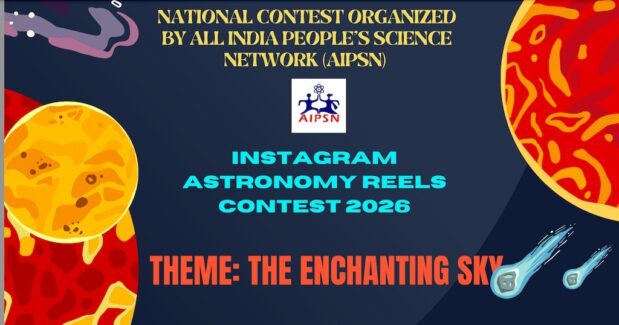
Instagram Astronomy Reels Contest 2026

Instagram Astronomy Reels Contest 2026

Click here to see the Google form for submission


Click here to see the document for rules


National contest organized by All India People’s Science Network (AIPSN)

Instagram Astronomy Reels Contest 2026


Theme: The enchanting sky

AIPSN invites submissions on this theme. The contest is open to all between 12 to 25 years of age and there is no submission fee. Winners will be announced on National Science Day, 28th February 2026. There will be five prizes in both categories given to the best 5 reels in each, and e-certificates of participation will be given to all participants.

Please read the rules and guidelines carefully before submission. You will not be able to edit your submission.


Rules:

Each participant can submit a single entry.

All entries must be published on instagram and the link of the post should be submitted through the Google form shared by AIPSN.

The contest is open to Indians living in India only.

Deadline for submissions: 17th February 2026 11:59 pm.

Incomplete submissions will not be considered for judging.

The reels should adhere to the theme of the contest.

The decision of the panel of judges will be final.

Use of AI should be duly declared in the instagram post, and is not preferred.

Plagiarism will be checked and plagiarized content will be disqualified.

Reels that hurt the sentiments of any ethnic or religious community will be disqualified.


Submission guidelines:

The reels can be of the duration from 15 sec (min) to 60 sec (max).

The reels should be in instagram friendly format and should be published / republished on instagram between 31 Jan 2026 to 17 Feb 2026.

Instagram reel description should clearly tag @aipsnmedia and include #astroreels2026 as a hashtag.

Submissions can be in English, Hindi or other Indian languages. For reels created in any language other than Hindi or English, it is mandatory to submit the transcript of the reel as a separate file through the form as directed.

The contest is open to participants from the following two categories:

A) 12 to below 18 years of age (posted on instagram by their parents / teachers / legal guardians).

B) 18 to 25 years of age.


How to Submit:

Click on the link: Google form or scan the QR code


Fill the form, upload the necessary documents and your submission.


Click on the Submit button.


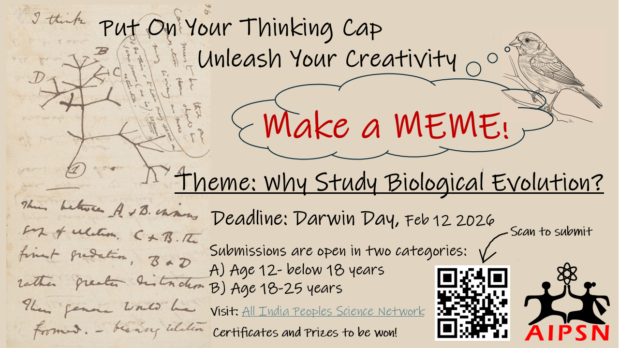
Darwin Day 2026 Meme making contest

Darwin Day 2026 Meme making contest

National meme making contest organized by

All India People’s Science Network (AIPSN)

On the occasion of Darwin Day, 12 Feb 2026


Click here to download the Rules, Regulations and how to submit the meme


 Click here to download  png    pdf  of the flyer 


 Theme: Why Study Biological Evolution?

AIPSN invites submissions on this theme. The contest is open to all, and there is no submission fee. Winners will be announced on National Science Day, 28th February 2026. There will be five prizes in both categories given to the best 5 memes in each, and e-certificates of participation will be given to all participants.

Please read the rules and guidelines carefully before submission. You will not be able to edit your submission.

Rules:

  1. Each participant can submit a single entry.
  2. All entries must be submitted through the Google form shared by AIPSN.
  3. The contest is open to Indians living in India only.
  4. Deadline for submissions: 12th February 2026 11:59 pm.
  5. Incomplete submissions will not be considered for judging.
  6. The memes should adhere to the theme of the contest.
  7. The decision of the panel of judges will be final.
  8. Use of AI should be declared at the bottom of the meme submission, and is not preferred.
  9. Plagiarism will be checked and plagiarized content will be disqualified.
  10. Memes that hurt the sentiments of any ethnic or religious community will be disqualified.


 Submission guidelines:

  1. The memes can be hand drawn or digitally created.
  2. The memes should be in the Square (1080X1080 pixels) or Rectangular (1080X1920 pixels) format only.
  3. Only jpeg/ jpg/ gif/ png/ pdf format submissions will be accepted. Please name the file with your_name_date before submitting so it is clearly identifiable.
  4. Submissions can be in English, Hindi or other Indian languages. For memes created in any language other than Hindi or English, it is mandatory to submit the text of the meme as a separate file through the form as directed.
  5. The contest is open to participants from the following two categories:
  6. A) 12 to below 18 years of age.
  7. B) 18 to 25 years of age.


How to Submit:

Click on the link: Google form or scan the QR code

Fill the form, upload the necessary documents and your submission.

Click on the Submit button.

Note: The maximum file size allowed is 10 MB for the meme and 1 MB for other documents.

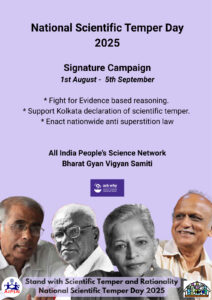
National Scientific Temper Day 2025 August 20 : Ask Why?

NSTD 2025 Appeal is here  Please visit and endorse the appeal.

Click here to read English, Malayalam, Assamese, Odiya , Tamil versions

AIPSN is releasing videos on the occasion of NSTD 2025 in which scientists and others go into the some aspects related to scientific temper. They are available on AIPSN YouTube channel @aipsnmedia

https://youtu.be/JekBsVdy6eM?si=Az5vrYNFaUl0rFnC


80 Years After Hiroshima & Nagasaki: Need Total Nuclear Disarmament

Click here to read the full version 

Click here to read a short version


6 Aug 2025

80 Years After Hiroshima & Nagasaki: Need Total Nuclear Disarmament

 The All India People’s Science Network (AIPSN) strongly condemns the development, use, and continued deployment of nuclear weapons. It calls for the rebuilding of a global people’s movement dedicated to peace, against war and militarism, and in particular for complete nuclear disarmament. In a significant move, a gathering of Nobel Laureates issued a declaration in July 2025 calling for the prevention of nuclear war—the first such unified statement from that community.

Eighty years have passed since the United States dropped atomic bombs on Hiroshima on August 6, 1945, and Nagasaki on August 9, 1945, during the closing stages of World War II. Japan was looking for ways to surrender, having already been decisively defeated. Still, hundreds of thousands of civilians, including children and the elderly, were killed when the bombs were used. About 350,000 people had perished as a result of the bombings by the end of 1945, and both cities were completely destroyed. The extent of the damage to civilians was never seen before in human history.

Following the war, the world entered a prolonged arms race. By the 1980s, the global nuclear arsenal had ballooned to nearly 70,000 weapons. Since then, arms control agreements have reduced this number to an estimated 12,000. However, the threat has not diminished. India and Pakistan became nuclear-armed states by the end of the 20th century. Iran’s alleged pursuit of nuclear weapons has led to decades of sanctions and, more recently, direct military attacks by Israel and the U.S.—despite the fact that Israel itself is the only nuclear-armed country in the Middle East.

The nuclear weapons of today are far more potent than those of 1945. Delivery systems are more accurate, faster, and lethal, including submarine-launched missiles and intercontinental ballistic missiles (ICBMs). A new level of uncertainty and possible risk is introduced by the use of cutting-edge technologies like artificial intelligence in command, control, and targeting systems, which have the potential to further enhance nuclear arsenals’ destructive potential. Some contend that “nuclear deterrence” is effective because there haven’t been any nuclear weapons deployed in the previous 80 years. However, the threat of widespread civilian casualties and complete devastation is what deterrence is based on. It is against international humanitarian law, unethical, and morally repugnant. The International Court of Justice has already ruled that the threat or use of nuclear weapons is incompatible with this body of law, which has been ratified by most United Nations member states.

Moreover, nuclear deterrence has not prevented wars between nuclear-armed states. Ukraine, backed by NATO, is fighting a long war against Russia, which has nuclear weapons. Similarly, there have been several small-scale battles and military stalemates between India and Pakistan. A nuclear war could result from any one of these disputes. Proponents of deterrence claim that it only functions between “responsible” states. However, this argument is useless in the current unstable geopolitical environment, which is marked by increasing instability, a disrespect for international norms, and provocative rhetoric from world leaders. Diplomatic solutions are jeopardized when superpowers like the US and Russia flagrantly breach international organizations and agreements.

The promises made by the Nuclear Non-Proliferation Treaty (NPT) have not been fulfilled. Under Article VI of the NPT, nuclear-armed countries pledge to pursue disarmament through sincere negotiations. This obligation has largely been ignored. Instead, nuclear powers, like the US, continue to upgrade their arsenals. They also oppose other international agreements and undermine institutions like the United Nations. The existence of non-NPT nuclear-armed states, such as Israel, emphasizes the NPT’s shortcomings even more. New risks have emerged as a result of recent events. Strikes have occurred close to nuclear or radioactive sites during conventional military conflicts, including the Dimona facility in Israel, the Kirana Hills in Pakistan, the Zaporizhzhia plant in Ukraine, and the Fordow, Natanz, and Isfahan facilities in Iran. Attacks near such sites risk catastrophic radioactive contamination and raise the threat of inadvertent nuclear disaster.

The only way to durable peace is to rebuild a people’s  campaign for complete nuclear disarmament .The campaign should seek to revive the McCloy-Zorin Accords of 20 September 1961 signed between the United States and the Soviet Union at the instance of the appeal issued by 25 Heads of State or Government, who attended the first NAM summit which was held in Belgrade from 01 to 06 September 1961.” (https://nuclearfamine.org/solutions/no-first-use-of-nuclear-weapons/)
The campaign should also incorporate the essence of Rajiv Gandhi’s “Action Plan for Ushering in a Nuclear Weapon Free and Non-Violent World Order” of 1988. In addition, it should have enough inputs from the revised “Model Nuclear Weapons Convention” submitted by Costa Rica and Malaysia to the UNGA in 2008.
Another development in this regard is the 2017 Treaty on the Prohibition of Nuclear Weapons (TPNW). The TPNW, which went into effect in January 2021, is the first legally binding international agreement to completely ban nuclear weapons with the aim of eradicating them. Notably, none of the present nuclear-armed states have signed it, despite the fact that more than 100 nations have. Nuclear weapons development, testing, possession, use, threat of use, and transfer are all prohibited by the treaty, as is aiding and abetting those engaged in such activities

In order to eliminate the nuclear threat, AIPSN urges the adoption of measures that will reduce risk and lead to disarmament:

1. Recognize the threat of nuclear weapons to humanity: Declare that the use or threat of use of nuclear weapons constitutes a crime against humanity; Prohibit all threats or uses of nuclear weapons until they are abolished.

2. Implement measures to build confidence such as: A “no first use” policy among nuclear states; Remove deployed nuclear weapons; Remove nuclear warheads from delivery systems; Revive the 1972 Anti-Ballistic Missile Treaty; Prohibit militarization of outer space; Ban the development of new nuclear weapons or delivery systems.

3. Challenge legal and moral justifications: Reassert that Article 51 of the UN Charter (Right to Self-Defence) does not permit genocide or mass destruction; Reject the idea that nuclear states have any special right to possess or use such weapons; Expose the myth of deterrence – nuclear weapons do not protect life but they only guarantee mutual destruction.


A world under the shadow of nuclear weapons is not a world at peace. The suffering endured in Hiroshima and Nagasaki must never be repeated. AIPSN renews its call to end the nuclear threat by abolishing all nuclear weapons and rebuilding a powerful people’s movement for peace, disarmament and saving lives.


Statement on High-Level Committee on Air India 171 Crash

Click here to get the pdf of the statement

16 June 2025

AIPSN Statement on High-Level Committee on Air India 171 Crash

AIPSN is deeply saddened by the horrendous crash on 12 June 2025 of Air India’s Boeing 787-8 “Dreamliner” flight AI-171 almost immediately after take-off at Ahmedabad heading for Gatwick, London.  All but one of the 242 crew and passengers perished, tragically along with (so far) an additional 30 persons where the plane crashed into a medical college student’s mess and hostel.

India’s Aircraft Accident Investigation Bureau (AAIB) has started its independent inquiry into the causes and circumstances surrounding the crash as called for by protocols of the International Civil Aviation Organization (ICAO).  AAIB has started the important step of decoding the Cockpit Voice Recorder (CVR) and Digital Flight Data Recorder (FDR) recovered from the crash site. It is understood that teams from the US and UK are also arriving in India to assist. The AAIB should also issue a public notice inviting suggestions from experts and interested persons.

However, for unexplained reasons, the Union Ministry of Civil Aviation has constituted a High Level Committee (HLC) to also inquire into the crash! Although the Order constituting the HLC states that it “will not be a substitute for other inquiries,” this is directly contradicted by its Objective to “ascertain the root cause of the crash,” assess factors such as mechanical failure, human error, weather conditions etc and examine the black boxes and aircraft maintenance records, interview Air Traffic Controllers, and collaborate with international agencies. All of these fall squarely under the ambit of the AAIB investigation as mandated by ICAO Article 13.

Clearly, the HLC is an undesirable parallel investigation which will, by virtue of its backing by highest levels of government, undermine the AAIB investigation. AIPSN calls upon the Ministry of Civil Aviation to immediately revise Terms of Reference of the HLC, and remove all objectives, scope of work and mandates which overlap those of the AAIB investigation.

It is to be noted that India constituted the AAIB precisely to address the prolonged dispute with ICAO regarding perceived government interference and conflict of interest in DGCA being the regulator, certifying authority and safety inspector also conducting accident inquiries over decades. The formation of HLC reignites this controversy by interfering with the AAIB inquiry. Air accident investigations are best left to professionals and experts.

At the same time, AIPSN welcomes the broader scope of the HLC inquiry for promotion of aviation safety, excluding investigation into the crash. In Ahmedabad, the aircraft crashed into a 5-storey medical college building just 1.5km from the airport, but there were larger hospitals and establishments in crowded areas nearby, missed only by chance. Recommendations of earlier crash inquiries regarding norms for operations at “table-top” airports, distance of settlements from airports, maintenance of airports, specifications for runway end safety areas (RESA) etc, are crying out for standards, implementation, monitoring, and enforcement in the interests of public, passengers, crew, and aircraft safety. The HLC would indeed perform a valuable service if it addressed these aspects holistically.

Many questions are being raised in the US and elsewhere about the safety record of Boeing, in the context of widely publicized whistleblower accounts of manufacturing malpractices affecting safety of Boeing aircraft. Any Government intervention at this stage will raise unnecessary suspicions around the world.


Asha Mishra                                        Satyajit Rath

General Secretary, AIPSN                    President, AIPSN


Condolence Resolution for Dr. Jayant Narlikar

Click here to download pdf in letter head

ALL INDIA PEOPLE’S SCIENCE NETWORK (AIPSN)

Condolence Resolution for Dr. Jayant Narlikar     

With the passing of Dr. Jayant Narlikar on May 20th 2025, the world has lost an outstanding Astrophysicist and Relativist, and India, one of its most eminent scientists . In addition to his important research contributions, Prof. Narlikar made outstanding contributions in the area of scientific outreach. He authored numerous popular books and articles on Astronomy, Cosmology, History of science, science fiction, in Marathi, English and Hindi. In the field of science and mathematics education, he along with his life partner Dr. Mangala Narlikar, played leadership roles in curricular and textbook development at both the national level and at the Maharashtra state level. He was the founder Director of the Inter-University Centre for Astronomy and Astrophysics, which developed under his leadership as a world renowned centre for scientific research as well as public outreach in science.

In his preface to his book ‘The Scientific Edge: The Indian Scientist from Vedic to Modern Times’, Prof. Narlikar writes “ When as a young lad of twenty-two I enrolled myself as a research student in science my aim was to restrict my attention and career to research in astronomy. More than four decades later, I see that aim as confining myself to the proverbial ivory tower.

Indeed it was fortunate that my research supervisor was Fred Hoyle, a man hailed as the most original astronomer of the twentieth century and a distinguished popularizer of science and a writer of science fiction. A close association with him gradually introduced me to the wider vista of the interaction of science and society as well as the subject of the historical evolution of science. Hoyle’s example showed me that it is possible to maintain a satisfactory level of research productivity while enlarging one’s interest in these wider issues. In fact these interests provided a more mature background to my research.

So it was that while in the UK and later after having returned to India I continued and expanded these interests through writing and lecturing. I discovered that the evolution of science in the subcontinent has followed a different track from that in the West. While interacting with the public one runs into two different viewpoints. On the one hand there is awareness that for various reasons India mounted the bus of science and technology rather late and has to make up for this. On the other hand , there is the feeling that in our ancient past we led the world in knowledge. More often than not these views are stated with undue vigour”

In his writings and speeches , Prof. Narlikar consistently articulated a critical view of undue or ahistorical glorification of the past and stood unambiguously with those promoting scientific temper. Together with Dr, Narendra Dabholkar and two others, he authored a research paper which clinchingly demolished any claim of astrology to being scientific . A few weeks after the martyrdom of Dr. Dabholkar in 2013, he presented these ideas and explained the importance of scientific temper, secularism and the values of the Indian constitution as the keynote speaker to a mass public meeting organised in Pune to protest the murder.

When the AIPSN resolved in 2018 and joined hands with MANS to initiate observance of August 20th as National Scientific Temper Day, Prof. Narlikar was the first signatory to the joint AIPSN-MANS appeal for schools , colleges and organizations to publicly observe NSTD each year. He was the main speaker the first NSTD public meeting held on the eve of NSTD 2018 in Pune in which he spoke eloquently and movingly about his association with Dr. Narendra Dabholkar.

The scientific work and writings of Prof. Narlikar will continue to inspire coming generations of young scientists. The AIPSN pays respectful homage to this great scientist, science publicist and promoter of scientific temper.


Asha Mishra                            Satyajit Rath

General Secretary, AIPSN     President, AIPSN