Position Paper on ISRO and Private Sector in Space in India

Click here to read the AIPSN Position paper on ISRO and Private Sector in Space in India


Click here to read the AIPSN solidarity with ISRO employees Save ISRO 

Click here to read the AIPSN Statement on ISRO and Private Sector in Space in India

AIPSN Position Paper on ISRO and Private Sector in Space in India

29 Sept 2026

Part A: Policy direction and sectoral analysis

A1. Context

Recent pronouncements by the government and by the Chairman of IN-SPACe, the agency set up to oversee and promote commercialisation of the space sector, have added to the fears of scientists, engineers and concerned organisations about the direction in which ISRO is being steered.

Of particular concern is the growing role envisaged for the private sector in space-related activities in India and what appears to be shrinking responsibilities for ISRO, which is now mandated to transfer all technologies related to rocket launchers and satellites to private and other non-government entities (NGEs). Such apprehensions have also recently been expressed by serving ISRO personnel in a letter to the Chairman of ISRO, while nine employee associations have separately written to the Secretary of the Department of Space, seeking clarifications on statements made on behalf of IN-SPACe vis-à-vis the future role of ISRO.

These are not knee-jerk reactions against privatisation or the involvement of private players in space or other strategic sectors. Rather, these concerns relate to India’s place in the global space ecosystem and to the self-reliant advancement of India’s interests within it in an increasingly knowledge- or tech-based future. They also do not arise from misconstrued “narratives”, as the IN-SPACe Chairman believes, but from the very framework of the Indian Space Policy of 2023 and its roll-out as per official sources.

A2. Technology transfer: public-sector and private routes

Transfer of rocket manufacturing technologies from ISRO has already begun with the Small Satellite Launch Vehicle (SSLV), in the first instance to the defence PSU Hindustan Aeronautics Limited (HAL). Under AIPSN’s core position, such transfer to a public-sector entity under public control is distinct from private takeover of launch infrastructure.

Transfer of mature technologies for the larger PSLV, ISRO’s workhorse, or for the even larger GSLV or LVM-3 to any private entity would entail a long learning curve and higher risks, except possibly for a few companies. PSUs like Bharat Dynamics, which already produces the Agni missile, may be a safer bet. AIPSN does not oppose the transfer of mature space technology under licence and on agreed terms to a PSU or highly capable and established ISRO private sector partner, with the technology remaining under ISRO ownership and with ISRO technical oversight and national-security safeguards. However, AIPSN opposes handover of launch infrastructure or outright transfer of technology and manufacturing rights to private monopolies at undervalued prices.

The growing demand for launch vehicles, which ISRO cannot meet with its current facilities, makes the idea of shifting the manufacture of rocket boosters with proven repeatability out of ISRO for commercial purposes understandable—particularly if the logic is to free up ISRO for more challenging and strategic core tasks such as expeditions to the Moon or Mars, setting up and operating an Indian space station, crewed missions, scientific collaborations with other countries, and development of related technologies. To scale up launch-vehicle production, ISRO had mooted a consortium route, and in 2022 NewSpace India Limited (NSIL) awarded a contract (initially reported around Rs 824–860 crore) to a consortium led by Hindustan Aeronautics Limited (HAL) and Larsen & Toubro (L&T) to manufacture five PSLV-XL vehicles end-to-end, with the consortium expected to deliver most of the vehicle systems while ISRO retained some strategic elements (separation systems, certain avionics, mission design, launch operations, etc.). However, senior ISRO officials and employees have said these crucial functions must remain with ISRO, and any such transfer is acceptable only with retention by ISRO of rights over technology and future upgradations, along with appropriate terms and conditions, oversight and pre-flight approval, transparent valuation, and national-security safeguards—not as a route to private monopoly and surrender of technology rights by ISRO. It’s unclear why this realistic, reliable model for scaling up launch-vehicle production is being brushed aside.

ISRO was never intended or structured to be a factory and has never been one. Even presently, over 80% of rocket booster components are made outside ISRO by PSU and private sector industry partners. PSUs and the private sector, where appropriate and under public safeguards, would probably play important roles in all the above core tasks too. Hopefully, technology transfer by ISRO would follow usual commercial practice, including fees for tech transfer, training, hand-holding and back-up, while ISRO retains rights for technology upgradation and improved versions.

A few private-sector entities with several decades of experience and capacity-building have indeed established themselves in advanced manufacturing and engineering and could well assist in broadening the base of the space industry. ISRO has historically worked with many such entities and SMEs. Some space-sector start-ups may also independently develop innovative and viable technologies and manufacturing capabilities. But all that is a far cry from the current haste to shift manufacturing and some launch functions and related infrastructure to the private sector.

However, the argument that ISRO must focus on expeditions to the Moon or Mars, setting up and operating an Indian space station, crewed missions, scientific collaborations with other countries, and development of related technologies and that commercial entities will meet the launch vehicles and satellites is not realistic nor desirable. It is not realistic because, out of the 130-odd launch manifests, nearly half are strategic, much of the remainder is civil, and only 15+ are commercial. Thus, most of the expenditure will come from public funds, and mobilising private capital is not feasible. But, it is feasible with a PSU or other public entity under public control, with transparent valuation, national-security safeguards, and ISRO retaining upgrade rights—not as a route to private monopoly. Thus, if the alleged bottleneck is the current cadence limitation, then ISRO’s idea of a consortium is the best bet.

The current rationale for promoting the private sector does not take a fresh look at relations between the public and private sector but seems based on the tired ideological belief that the private sector does everything better than the public sector—an idea disproved in numerous cases in strategic sectors, especially as regards technology development.

A3. Launch economics and the fixed-cost problem

Many issues need to be considered. ISRO launches an average of 5–7 missions per year. Current demand from the public, including security, is much higher, and the problem lies not with ISRO’s capability but with chronic understaffing and limited government funding. The realistic manifest lists nearly 130 satellites to be launched by 2030 to meet the projected demand. This includes 10+ launches for the Gaganyaan mission, about 6 deep-space missions (including Chandrayaan missions), 32 Earth observation satellites, 64 strategic satellites, and nearly 6 commercial/private satellites.

Nevertheless, claims suggest India will need to build and launch 200-300 satellites over the next six to seven years and ramp up launch frequency to around 50 a year to meet growing demand. These claims lack justification and context. The claims never explain what these 200-300 satellites will do, where the demand is, or who will fund these launches. When OneWeb used Indian launch vehicles to launch its 72 satellites, it did not use 72 separate launch vehicles and 72 launches; it accomplished this with just two launches. The wide projected gap between ISRO’s capacity and launch requirement appears magnified to create optics and a ruse for privatisation, rather than reflecting any insurmountable bottleneck.

The China Satellite Network Group Co., Ltd. (China SatNet), a state-owned enterprise established in 2021 under SASAC (State-owned Assets Supervision and Administration Commission), plans to launch 12,000–13,000 satellites for national broadband as dual-use connectivity. Hundreds of satellites are already in orbit. Shanghai SpaceSail proposes launching 15,000 satellites for commercial broadband and connectivity services. Naturally, China is augmenting its launch fleet to meet these burgeoning launch projections. China does not permit either Starlink or OneWeb.

A consortium called SpaceRISE (led by major European operators SES, Eutelsat, and Hispasat), supported by industrial partners including Airbus Defence and Space, Thales Alenia Space, OHB, and others, is leading the European Union’s IRIS² (Infrastructure for Resilience, Interconnectivity and Security by Satellite) project for a constellation of nearly 350 satellites. The EU is building this infrastructure to avoid critical dependence on a US private company (Starlink) or even a partially European commercial network (OneWeb) during crises or geopolitical tensions. As the launch requirement is comparatively small, the EU is not developing additional launch capacity or commercial launch vehicles.

The Indian telecom industry has no such plans; instead, it is tying up with OneWeb or Starlink as local partners. Neither OneWeb nor Starlink, which are expected to commence operations in India, will depend on Indian launch vehicles. Thus, there is no demonstrated commercial demand established for a large-scale launch requirement. Even assuming the rather ambitious 50 launches a year by 2030, that does not make for a booming commercial business for private rocket manufacturers spread over several different booster types.

The same issue arises in respect of launches. A recently published international study has shown that launch costs in India are several times those of the US or other countries. Exact numbers may be debated, but the main factor correctly identified is that, while recurring operational costs for each launch may be low in India, as often cited, the low annual number of launches results in a high per-launch cost when infrastructure, manpower and other fixed costs are taken into account. When the new SSLV spaceport in Kulasekarapattinam in Tamil Nadu is handed over to a private-sector player as decided, will the new player charge globally competitive rates for launches but still bear all fixed costs and run an overall loss? Or will ISRO continue to bear fixed costs while the private player skims the cream off the top of operational costs alone?

 A4. The missing demand side

In the global space market today, about 78% of the value lies in commercial user services such as broadcast, telephony, internet data and so-called “reach applications” such as aggregators, delivery services, logistics, etc., while only a much smaller share is realised through infrastructure, launch and payload hardware. India’s Space Policy calls for shifting from supply to demand, but this is still missing.

Most of the vaunted start-ups are in supply-side innovations. So are the technology and infrastructure transfers from ISRO to the private sector. The big missing link in India is in market demand. Where are the commercial applications, the business ventures which will use all the space-based data? So far, ISRO has done yeoman service for the nation by generating data for resource exploration and mapping, weather (including cyclone observation and forecasting), and Intelligence, Surveillance, and Reconnaissance (ISR) services, broadcasting, and telephony. Except for the last-mentioned, the government has been the main user.

This is not to say there is no commercial space market in India. As of the beginning of 2026, India has 53 operational civilian satellites: 21 communication, 21 Earth observation, 8 navigation, and 3 science/experimental. Of the 21 communication satellites, NSIL has taken ownership of nearly 10 in-orbit GSAT/CMS communication satellites that were previously under government/ISRO control. It also commissions new “demand-driven” satellites (for example, GSAT-24) that NSIL fully funds and owns from the start. The remaining communication satellites are used for civil and ISR; so are the EOS (they are largely dual-use). Thus, they cannot be/should not be handed over to non-government entities.

Commercial operations are supposed to be the private sector’s domain, and this is the main role they should be playing in the space sector, which would drive up launch frequency and hence rocket as well as payload manufacture. Will the forthcoming Space Activities Bill address this problem, with adequate protection from intrusion of inimical foreign interests’ venture capital for start-ups and through FDI?

A5. ISRO’s core tasks and funding

ISRO has a lot on its plate which the nation badly needs for development: a new heavy rocket for crewed and interplanetary missions, reusable rocket boosters, defence satellites found badly wanting during recent conflicts, a full navigation system including India’s own GPS-equivalent, advanced technologies for the space station and crewed programmes, lunar exploration, and so on.

India’s space policies should strongly support these and provide adequate funding and support to ISRO, which has been seriously lacking over the years. Technology transfer for manufacturing to PSUs or capable and trusted private-sector partners, with appropriate terms and conditions, will then make sense. Hopefully, the private sector generates the necessary commercial applications and businesses—their supposed core competences—without waiting for government funds for that too.

Part B: AIPSN stands in defence of ISRO

B1. Why ISRO must be defended

For several days, a flood of reports and interpretations about the Indian Space Research Organisation (ISRO)—one of the country’s most strategically important central government institutions—has circulated in newspapers and other media. Not only the employees’ associations but also former heads of ISRO have come out in the open to prevent further damage to ISRO. Especially in view of the statements emanating from IN-SPACe and its move to open up the rocket-launching segment to private-sector participation when the Space Policy has not been discussed in Parliament, nine employee associations of ISRO have addressed a letter to the Secretary, Department of Space, seeking clarifications on the statement made on behalf of IN-SPACe vis-à-vis the future role of ISRO.

AIPSN recognises that ISRO has changed everyday life. Today’s ISRO was not built in a day. Activities that began in 1962 at Thumba, Thiruvananthapuram, under the Indian National Committee for Space Research (INCOSPAR), then under the Department of Atomic Energy, formed the foundation of India’s space programme. Satellite technology has reached communications, television, telephony, the internet, weather observation, remote sensing, natural resource monitoring, disaster management, navigation, agriculture, fisheries, and the monitoring of railways and other transport systems—directly shaping the economy and people’s lives.

Designing and building the launch vehicles that place satellites needed for national security and public service into their intended orbits, without complete dependence on foreign technology, is itself a major strategic achievement and proof of scientific self-reliance. ISRO cannot therefore be treated as just another government office. ISRO is one of the main pillars of the country’s scientific capability, technological sovereignty, national security and public interest. Its capabilities were built in an era of limited facilities and resources. Indian scientists, engineers, technical staff and workers advanced the field of space technologies through extraordinary labour and dedication. This is not the achievement of any single scientist or political leader. ISRO is the collective labour of thousands across scientific, engineering, technical, worker and administrative cadres. Generations who worked as one for mission success, without measuring their contribution by pay scale or rank, are ISRO’s real capital.

B2. Importance of who decides

IN-SPACe was set up to promote the private sector in the space economy and, among others, to act as an interface between ISRO and emerging startups for sharing of space infrastructure and premises under the control of ISRO, with due consideration to ongoing activities, establishment of temporary facilities within premises under ISRO control based on safety norms and feasibility assessment and usage of spacecraft data and rolling out of space-based services and all the associated infrastructure for the same. However, surprisingly, In-SPACe has invited expressions of interest (EOI) from private industries or consortia to handle end-to-end realisation, manufacturing, operation, and commercialisation of India’s heaviest rocket, the Launch Vehicle Mark-III (LVM3), as well as Operations and Management of SLC at Kulasekarapattinam. Curiously, the EOI bars PSU and state enterprises from participation. Why so is inexplicable. IN-SPACe is not envisaged to call for an EOI; it must have been either ISRO or NSIL. Why these organisations were sidelined is also not clear.

ISRO has always engaged the private sector in the manufacturing of launch vehicles. However, IN-SPACe routes to privatisation appear to involve (1) selling cheap knowledge and technology developed and (2) hollowing out manufacturing, which means a lack of quality discipline and weakening of the knowledge required for the development of critical technologies.

This criticism is aimed at ensuring technology transfer and ensuring retention of technology and IP with ISRO. Moreover, ISRO’s traditional contracting with PSUs continues to provide public ownership and control. While the contribution of the private sector to ISRO’s requirements has not been opposed in principle by either the former heads or by the associations of employees, the demand is for a wider discussion of the Space Policy, which assigned roles to Inland IN-SPACe. The Space Policy must ensure that what shall be manufactured in-house is done after sufficient discussion internally.

B3. Stagnation in ISRO funding: NavIC and spectrum

The government is starving ISRO of funds and support. Budget allocations have consistently been less than what ISRO sought, and actuals have been less than the budget announcements. It is not unreasonable to suggest that ISRO is being deliberately starved of resources so that its functions can be transferred to private players under the guise of ‘efficiency’ and/or ‘non-performance’.

The case of NavIC (Navigation with Indian Constellation) illustrates this neglect very well. NavIC has considerable strategic importance. NavIC is meant to replace the US-based GPS, whose services the country cannot take for granted, as the Kargil crisis amply evidenced. The NavIC system’s efficacy is critically dependent on the functioning of the atomic clocks that the NavIC satellites carry. Over the last 13 years, almost all NavIC satellites have progressively become dysfunctional, largely because of faulty atomic clocks supplied by an international vendor. ISRO is now developing an indigenous clock, which has been flown on the last few NavIC satellites. The government made no effort to help ISRO replace the non-operational NavIC satellites. Investments in NavIC would have enabled ISRO to strengthen national security.

B4. IN-SPACe misjudging ISRO and the launch-infrastructure question

After IN-SPACe was formed, steps to open ISRO infrastructure to private use have come to be intensified: facilities offered at low cost, use of launch systems, and private access to new launch sites. The subsequent opening of SSLV manufacture and launch facilities to private firms—beyond the earlier transfer to HAL as a PSU—and related measures around launch infrastructure in the Thoothukudi region of Tamil Nadu illustrate the scale of the shift.

In this context, the growth of the private space start-up Skyroot is notable. It was founded in Hyderabad by Pawan Kumar Chandana and Naga Bharath Daka, both former ISRO engineers. The publicity around the successful Vikram-1 launch signalled the new importance given to the private space sector. The launch used ISRO facilities at Sriharikota. Senior ISRO officials and former chairmen attended; the Prime Minister congratulated the venture.

AIPSN is opposed to technologies, human resources and infrastructure developed over decades with public money being used cheaply to grow private companies. This opposition does not extend to transfer to public-sector entities under public ownership and ISRO oversight; such transfer may be acceptable if properly valued, audited and kept under public control. We are concerned about who in the private sector is being allowed to capture the economic benefit of knowledge created in the public sector. Foreign venture capital is driving IN-SPACe’s new routes to privatisation. We wish to ensure that public interest and national security are protected when facilities are given to private firms.

B5. Contract staff or full-time researchers

A major issue in the debate on ISRO’s future is the condition of its workforce. It is often argued that talented scientists leave ISRO for better-paid private jobs because pay and benefits are inadequate. Few attribute this attrition to better pay in the private sector. In fact, when compared with many other central government organisations, regular appointments in ISRO demand high educational qualifications and merit. Even some clerical posts require a first-class degree. Thus, the criticism that pay and promotion opportunities are not commensurate with qualifications and work across all cadres cannot be ignored. Nevertheless, the exodus of expertise appears to be driven by uncertainty about ISRO’s future direction, underfunding, and bodyshopping by the private space industry.

The resignations leave ISRO in a tight spot; meanwhile, fresh recruitment has been minimal. Together, these have created an unprecedented gap between sanctioned strength and employees on the rolls. The number of sanctioned posts across the Department of Space has stayed around 20,000 since 2019-20. Employees, however, have fallen from 17,222 in 2019-20 to 14,637 in 2025-26. Consequently, staffing has dropped from 85.9% to 72.2%, while vacancies have more than doubled from 2,817 to 5,632.

For several years, regular recruitment to many posts, including technicians, has been restricted, and contract and subcontract arrangements have been relied upon more heavily. The labour of tens of thousands of contract workers at ISRO centres has been critical to meeting rising launch demand. Many do not receive the service benefits or job security of regular employees. Many work on fixed daily wages with little social security. This human-resource problem affects the quality and continuity of the country’s space missions. When more than 10,000 technical workers on contract across centres are also counted, the scale of the invisible labour behind ISRO’s successes becomes clear. This is not only a labour issue.

B6. ISRO’s public wealth is not for sale.

When rocket technology, launch systems, research facilities and human capability developed for more than sixty years with public wealth are then opened for private profit, questions of ownership and benefit become unavoidable. Private firms may use ISRO infrastructure. But the return on public money spent to build that infrastructure is not an irrelevant question. To present privatisation as mere “development” without clear answers to these questions is dangerous.

Space technology is unlike ordinary industry. Satellites, launch vehicles, communications, navigation and disaster-management systems are directly linked to defence and security. Transfer of advanced knowledge, including rocket technology, must therefore be handled with the highest caution from a national-security standpoint. A model in which public-sector technology moves to private monopolies and infrastructure created with public money is made available to private companies at low cost must be examined for what it will give the country in the long run and how it will ensure public interest and social control.

B7. Protecting ISRO is protecting science.

When ISRO’s problems are discussed, one fact must not be forgotten: ISRO’s strength does not lie only in its buildings, rockets or machines. It lies in the people who create and operate them. To strengthen ISRO, scientists, engineers, technical staff and workers must have decent working conditions, reasonable pay, and job security and promotion prospects. The practice of using contract workers for years as substitutes for regular employment must end, and regular recruitment to required posts must take place. A work environment must be created in which a new generation of scientific talent wants to stay in ISRO. What is not needed is a policy that weakens public-sector scientific capability and channels human resources and technology into the private sector. AIPSN asks the current management not to target the voices of opposition.

Concerns about the transfer of space technology to the private sector can no longer be dismissed as merely the political argument of critics. The 410th Report of the Department-related Parliamentary Standing Committee on Science and Technology, Environment, Forests and Climate Change, presented in Parliament on 25 March 2026, itself recorded a serious concern on this subject. The Committee expressed concern that space technologies are being transferred to private entities at prices disproportionately low relative to their commercial potential. The Committee recommended that licensing fees for technology transfer should reflect real commercial value, distinctiveness and social importance. It also said clear valuation norms are needed and that all technology-transfer agreements should be subjected to periodic third-party audit.

Cooperation with the private sector is possible. New enterprises can be encouraged for technological progress. Organisations and employees in the field do not oppose this. From the beginning, ISRO has worked with both the public and private sectors. But that must not mean loss of public ownership of wealth, national scientific capability, or public control over strategically important technologies. The issue is therefore not the simple question “private sector—yes or no?”

B8. AIPSN demands

The main questions that need to be answered are:

  1. Who protects the real value of technology developed with the people’s tax money?
  2. How much of the economic gain from knowledge created with public wealth will return to the public?
  3. Who sets the price of technology transferred to private firms, and by what criteria?

The Department of Space should be transparent and publish the results of the investigation into the failure of two successive PSLV missions and take corrective measures. Privatisation of manufacturing will only add to the challenge of tackling such failures in the future. Failures occur in science; the nature of science is to learn from them and return stronger.

AIPSN is opposed to:

– transferring public wealth to private monopolies;

– shrinking regular employment while expanding contract labour;

– Moving towards a form of privatisation that gradually renders ISRO, built with the tax money of crores of people, the hard labour of generations and the life-dedication of scientists, less relevant is unacceptable because, in the long run, it will be a serious loss to the country’s scientific capability and public interest.

ISRO’s failures must be corrected scientifically; its successes must not be privatised. ISRO’s technology is the wealth of the nation. Its infrastructure is the creation of the people’s tax money. Its real strength is the collective labour of scientists, employees and workers.




AIPSN solidarity with ISRO employees – Save ISRO

Click here for pdf of statement

AIPSN solidarity with ISRO employees

Save ISRO

14 Sept 2026

Over the past few decades, ISRO has established India as a leader in space science and technology. Its scientists, technologists, and staff have worked tirelessly to achieve national objectives—from placing Indian and foreign satellites into orbit and executing the Mars and Chandrayaan missions to now working towards establishing an Indian space station. These achievements, which were unthinkable a few decades ago, have earned respect both internationally and among ordinary citizens.

Recent announcements by the government and the Chairman of IN-SPACe—the agency established to oversee and promote the commercialisation of the space sector—have sparked intense public debate. Nine employee organisations, representing thousands of workers at the Indian Space Research Organisation (ISRO), jointly sent a formal letter to ISRO Chairman V. Narayanan. The associations formally questioned recent statements suggesting that ISRO would eventually phase out launch vehicle manufacturing and transition into a “residual R&D boutique”. This policy shift has amplified the concerns of scientists, engineers, retired ISRO personnel, advocacy organisations, and citizens regarding the direction in which ISRO is being steered.

Unwarranted political intervention and policy changes have already caused significant strain, with 100 scientists leaving ISRO within a three-month period. These reactions are not mere knee-jerk opposition to privatisation or the involvement of private players in space and strategic sectors. Rather, these concerns centre on India’s standing in the global space ecosystem and the self-reliant advancement of national interests in an increasingly tech-driven future. Nor do these anxieties stem from misconstrued “narratives”—as the IN-SPACe Chairman suggests—but from the structural framework of the Indian Space Policy 2023 and its official implementation.

Since independence, the nation has reached a consensus that the scientific community should receive full academic freedom and financial support to serve the country. Where structural impediments have restricted research and technological development, the government’s responsibility is to address those gaps. However, since 2014, political intervention has increased alongside a shift towards handing over public sector assets to private interests. Public-Private Partnerships (PPP) have, in effect, led to the syphoning of public assets for private gain. It is deeply alarming that this approach is now being directed at ISRO.

For decades, ISRO has served the nation with distinction. It is now our duty as citizens of India to defend this vital institution, resist these damaging shifts, and stand in firm support of our scientific community.


AIPSN Statement on ISRO and Private Sector in Space in India

Click here for pdf of statement

AIPSN Statement on

ISRO and Private Sector in Space in India

14 Sept 2026

Recent pronouncements by the government and the chairman of IN-SPACe, the agency set up to oversee and promote commercialization of the space sector, have added to the fears of scientists, engineers, and concerned organizations about the direction in which ISRO is being steered.

Of particular concern is the growing role envisaged for the private sector in space-related activities in India and what appears to be shrinking responsibilities for ISRO, which is now mandated to transfer all technologies pertaining to rocket launchers and satellites to private and other non-government private entities (NGPE). Such apprehensions have also recently been expressed by serving ISRO personnel in a letter to the Chairman of ISRO. These are not knee-jerk reactions against privatization or involvement of private players in space or other strategic sectors. Rather, these concerns relate to India’s place in the global space ecosystem and for self-reliant advancement of India’s interests within it in an increasingly knowledge- or tech-based future. They also do not arise from misconstrued ‘narratives,’ as the IN-SPACe Chairman believes, but from the very framework of the Indian Space Policy of 2023 and its rollout as per official sources.

Transfer of rocket manufacturing technologies from ISRO has already begun with the Small Satellite Launch Vehicle (SSLV), thankfully to defense PSU giant Hindustan Aeronautics Limited (HAL). Transfer of mature technologies for the larger PSLV, ISRO’s workhorse, or for the even larger GSLV LVM-3 to any private entity would entail a long learning curve and higher risks, except possibly for a few companies. PSUs like Bharat Dynamics, which already produces the Agni missile, may be a safer bet. PSUs should not be excluded from the process of technology transfer from ISRO.

The idea of shifting the manufacture of rocket launchers with proven repeatability out of ISRO for commercial purposes may be understandable if the logic is to free up ISRO for the more challenging and strategic core tasks ahead, such as expeditions to the Moon or Mars, setting up and operating an Indian space station, crewed missions, scientific collaborations with other countries, and development of related technologies. ISRO was never intended or structured to be a factory and has never been one. Even now, industry partners manufacture over 80% of rocket booster parts outside of ISRO. The private sector and PSUs would probably play important roles in all the above core tasks as well. Technology transfer by ISRO should follow usual commercial practices such as licensed production with appropriate fees and charges for tech transfer, training, hand-holding, and backup, while ISRO retains ownership and IP rights over the technology for technology upgradation and improved versions. ISRO should also retain the ability to make and use these rocket boosters and related technologies for its use when required, e.g., for defense purposes.

A few private sector entities with several decades of experience and capacity-building have indeed established themselves in advanced manufacturing and engineering and could well assist in broadening the base of the space industry. ISRO has historically worked with many such entities and SMEs. Some space sector start-ups may also independently develop innovative and viable technologies and manufacturing capabilities. But all that is a far cry from the current haste to shift manufacturing and some launch functions and related infrastructure to the private sector. The current rationale for promoting the private sector does not take a fresh look at relations between the public and private sectors but seems based on the tired ideological belief that the private sector does everything better than the public sector, an idea disproved in numerous cases in strategic sectors, especially as regards technology development. Many issues need to be considered.

ISRO launches an average of 5-7 missions per year, having struck an unusual record of 17 launches in 2018. Even current demand for public security uses is much higher, and the problem does not lie with ISRO capability but with chronic understaffing and funding by the government. Assuming that somehow launch cadence or frequency goes up substantially with private sector involvement, if not up to the rather ambitious 50 launches a year by 2030, that does not make for a booming commercial business for private rocket manufacturers spread over several different booster types.

The same issue arises in respect of launches. A recently published international study has shown that launch costs in India are several times that of the US or other countries. Exact numbers may be debated, but the main factor correctly identified is that, while recurring operational expenses for each launch may be low in India, as often cited, the low annual number of launches results in a high per-launch cost when infrastructure, manpower, and other fixed costs are taken into account. When the new SSLV spaceport in Kulasekarapattinam in Tamil Nadu is handed over to a private sector player as decided, it should be ensured that the new player bears all fixed costs as well and does not just cover operational costs alone and skim profits off the top.

In the global space market today, about 78% of the value lies in commercial user services such as broadcasting, telephony, internet data, and so-called ‘reach applications’ such as aggregators, delivery services, logistics, etc., while only about one-third of that is realized through infrastructure, launch, and payload hardware. India’s space policy emphasizes a shift from supply to demand, but this shift is currently absent. Most of the vaunted start-ups are in supply-side innovations. So are the technology and infrastructure transfers from ISRO to the private sector. The significant gap in India lies in market demand. Where are the commercial applications, the business ventures that will use all the space-based data? Until now, ISRO has been doing yeoman service for the nation by generating data for resource exploration and mapping, weather, including cyclone observation and forecasting, broadcasting, and telephony, and, except for the last mentioned, government has been the main user. Commercial operations are supposed to be the private sector’s domain, and this is the main role they should be playing in the space sector, which would drive up launch frequency and hence rocket as well as payload manufacture. Will the forthcoming Space Activities Bill address this problem with adequate protection from intrusion of inimical foreign interest and venture capital for start-ups and through FDI?

ISRO has a lot on its plate, which the nation badly needs for development. India needs a new heavy rocket for crewed and interplanetary missions, reusable rocket boosters, defense satellites that are urgently required due to recent conflicts, a complete navigation system including India’s own GPS-equivalent, advanced technologies for the space station and crewed programs, lunar exploration, and more. India’s space policies should strongly support these and provide adequate funding and support to ISRO, which has been seriously lacking over the years. Technology transfer for manufacturing to PSUs or capable private sector entities through licensed production or similar appropriate arrangements between ISRO and the private sector will then make sense. Hopefully, the private sector generates the necessary commercial applications and businesses, their supposed core competences, without waiting for government funds for that too.

AIPSN is opposed to transferring public wealth to private monopolies, shrinking regular employment while expanding contract labor, and providing public-sector technology free for private profit. Moving towards a form of privatization that gradually renders ISRO—built with the tax money of crores of people, the hard labor of generations, and a lifetime of dedication by scientists—less relevant is unacceptable, as it would be a serious loss to the country’s scientific capability and public interest. ISRO’s technology is the wealth of the nation. Its infrastructure is the creation of the people’s money. Its real strength is the collective labor of scientists, employees, and workers.


Statement on High-Level Committee on Air India 171 Crash

Click here to get the pdf of the statement

16 June 2025

AIPSN Statement on High-Level Committee on Air India 171 Crash

AIPSN is deeply saddened by the horrendous crash on 12 June 2025 of Air India’s Boeing 787-8 “Dreamliner” flight AI-171 almost immediately after take-off at Ahmedabad heading for Gatwick, London.  All but one of the 242 crew and passengers perished, tragically along with (so far) an additional 30 persons where the plane crashed into a medical college student’s mess and hostel.

India’s Aircraft Accident Investigation Bureau (AAIB) has started its independent inquiry into the causes and circumstances surrounding the crash as called for by protocols of the International Civil Aviation Organization (ICAO).  AAIB has started the important step of decoding the Cockpit Voice Recorder (CVR) and Digital Flight Data Recorder (FDR) recovered from the crash site. It is understood that teams from the US and UK are also arriving in India to assist. The AAIB should also issue a public notice inviting suggestions from experts and interested persons.

However, for unexplained reasons, the Union Ministry of Civil Aviation has constituted a High Level Committee (HLC) to also inquire into the crash! Although the Order constituting the HLC states that it “will not be a substitute for other inquiries,” this is directly contradicted by its Objective to “ascertain the root cause of the crash,” assess factors such as mechanical failure, human error, weather conditions etc and examine the black boxes and aircraft maintenance records, interview Air Traffic Controllers, and collaborate with international agencies. All of these fall squarely under the ambit of the AAIB investigation as mandated by ICAO Article 13.

Clearly, the HLC is an undesirable parallel investigation which will, by virtue of its backing by highest levels of government, undermine the AAIB investigation. AIPSN calls upon the Ministry of Civil Aviation to immediately revise Terms of Reference of the HLC, and remove all objectives, scope of work and mandates which overlap those of the AAIB investigation.

It is to be noted that India constituted the AAIB precisely to address the prolonged dispute with ICAO regarding perceived government interference and conflict of interest in DGCA being the regulator, certifying authority and safety inspector also conducting accident inquiries over decades. The formation of HLC reignites this controversy by interfering with the AAIB inquiry. Air accident investigations are best left to professionals and experts.

At the same time, AIPSN welcomes the broader scope of the HLC inquiry for promotion of aviation safety, excluding investigation into the crash. In Ahmedabad, the aircraft crashed into a 5-storey medical college building just 1.5km from the airport, but there were larger hospitals and establishments in crowded areas nearby, missed only by chance. Recommendations of earlier crash inquiries regarding norms for operations at “table-top” airports, distance of settlements from airports, maintenance of airports, specifications for runway end safety areas (RESA) etc, are crying out for standards, implementation, monitoring, and enforcement in the interests of public, passengers, crew, and aircraft safety. The HLC would indeed perform a valuable service if it addressed these aspects holistically.

Many questions are being raised in the US and elsewhere about the safety record of Boeing, in the context of widely publicized whistleblower accounts of manufacturing malpractices affecting safety of Boeing aircraft. Any Government intervention at this stage will raise unnecessary suspicions around the world.


Asha Mishra                                        Satyajit Rath

General Secretary, AIPSN                    President, AIPSN


Statement of solidarity with Dr. Ali Khan Mahmudabad of Ashoka University, against state led harassment! Uphold the Right to Freedom of Expression!

Click here for the pdf of the statement

27 May 2025

Statement of solidarity with Dr. Ali Khan Mahmudabad of Ashoka University, against state led harassment! Uphold the Right to Freedom of Expression!

The All India People’s Science Network (AIPSN) strongly condemns the action of the Haryana police lodging FIRs at the direction of the chair of the Haryana State Women’s Commission and others against Dr. Ali Khan Mahmudabad, Associate Professor at Ashoka University, and his subsequent arrest for his social media posts which were in the public domain. AIPSN also views with concern the subsequent pronouncements of the Honourable Supreme Court two judge bench while giving interim bail. Stringent restrictions of freedom have been imposed and formation of SIT has been ordered even while no criminal intent was found.

The whole process is not just an attack on Dr. Mahmudabad’s right to freedom of speech and expression but an unlawful denial of his right to personal liberty. The lodging of the FIRs by itself required no custodial interrogation, given that his movements and place of residence and work were known.

We condemn the action of the state police which chose to go ahead with two FIRs, arrested him and sought extension of his police custody to more than a week to harass him. It is apparent that in an effort to drum up so called public opinion and influence judicial decision making, several vice chancellors were mobilized to send a message to academics to remain quiet. It is apparent that legitimate opinions on the developments in the country which differ from the official government narrative are not being tolerated but being treated as a crime.

Clearly, the social media posts neither contained any divisive overtone nor a threat to the sovereignty and integrity of India, as alleged. Dr. Mahmudabad spoke on a matter of public interest and expressed a view that many people may share. The AIPSN believes that we cannot remain silent because the arrest of Dr. Ali Khan Mahmudabad is an issue of wider concern for the scientific community and for society. As the citizens of a constitutional democracy, we are concerned that the freedom of people to express themselves and to be informed by scholars is under threat now. The attack on him is not just an attack on academic freedom but it is an attack on the democratic rights of the people.

With due respect for the Honourable Court, we believe that the court went beyond the call of duty in commenting on the case in a manner that led to the impression that any departure from the official narrative of the state would lead to an arrest. We are disturbed that an academic who should enjoy academic freedom is facing an SIT for merely expressing his opinion.

The court order issued is seemingly a gag order, restraining him from expressing his opinion and depriving his students of the benefit of his views on matters of public interest.

Although Dr Mahmudabad has been released on interim bail, we are deeply concerned about the entire premise of the complaints filed against him.

The legal system is operating in a selective form against a chosen few who are perceived to be political and ideological opponents of the regime. Persecution is replacing prosecution and the process itself is becoming a punishment. And it is not the rule of law but the rule of the police that is in operation.

The proceedings on this matter do not augur well for a constitutional democracy founded in the wake of a glorious struggle of the Indian people against the British rulers who often used the provision of sedition to put the freedom fighters behind bars for expressing themselves in public. The complaints filed against him under several sections including Section 152 of the Bharatiya Nyay Sanhita for alleged “acts endangering India’s sovereignty, unity, and integrity” make a mockery of the right to freedom of expression.

Since the official motive behind the arrest is unsupportable, the severity in approach towards Dr. Mahmudabad gives reason to believe that a Muslim is being targeted for his identity.

Dr. Mahmudabad’s social media posts, which critique jingoism and underscore the human cost of war, fall squarely within the realm of legally protected right to speech under Article 19(1)(a) of the Constitution of India. His remarks, including concerns about communal polarisation and the imperative to safeguard marginalised communities, reflect a commitment to constitutional values. To equate such critiques with “sedition” or threats to sovereignty is morally and legally untenable. It is an attempt to undermine the very foundations and ethos of constitutional democracy.

We disagree that Dr. Mahmudabad’s nuanced commentary, which seeks to locate the role of women officers within the larger context of the current political scenario, is any form of “disparagement” of women or an “attempt to create disunity”. His posts explicitly lauded the armed forces’ professionalism while urging vigilance in protecting the socially oppressed from state-sanctioned, communally motivated persecution.

While appreciating the fact that Dr. Mahmudabad has been provided interim bail, we wonder why the SIT has been constituted, even though the court noted that it has found nothing incriminating in the posts. The restrictions imposed on him deprive him of his constitutional rights and the order signals that any form of reasoned disagreement with government policies—no matter how well-founded – may be met with criminal proceedings and loss of liberty.

AIPSN notes that critical pedagogy and dissent are essential pillars of democracy and the rule of law. The AIPSN stands in solidarity with Dr Mahmudabad and calls for immediate withdrawal of all charges against him which are legally baseless in their entirety. We hail the solidarity shown by Ashoka University students and faculty and salute the larger academic community that has come out to stand in solidarity with Dr. Mahmudabad.

The AIPSN calls upon the Honourable Court to recall the order and recognise the action of the state as a misuse of law and take remedial action to protect his right to free speech and liberty. AIPSN resolves to continue the struggle to protect and uphold the Constitutional Right to Freedom of Expression.


Asha Mishra Satyajit Rath

General Secretary, AIPSN President, AIPSN


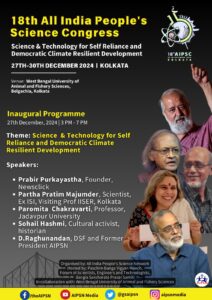
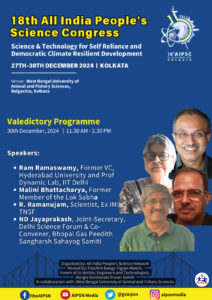
18th All India Peoples Science Congress 27 Dec to 30 Dec @ Kolkata

Click here to see a You Tube video showing glimpses of the 18 AIPSC 

QR code for 18AIPSC photos

QR code for 18AIPSC photos Click here for the URL

QRcode for 18AIPSC presentations

QRcode for 18AIPSC presentations                            Click here for the URL


Click here for the Abstract book of the 18 AIPSC 

Click here to see the Kolkata Declaration booklet released at 18 AIPSC

Click here for the theme paper of 18AIPSC

Click here to see the program brochure 

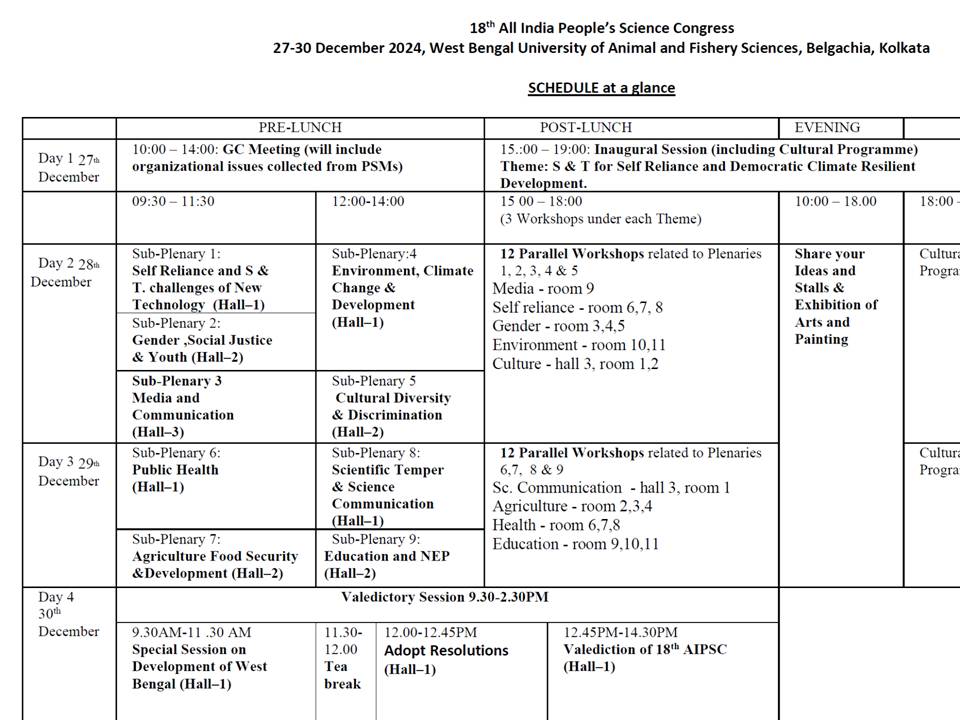
Click here for quick schedule view


National Scientific Temper Day 2024: Advocating Scientific Integrity and Unhindered Rational Inquiry

Click here for the press release of this statement 

Click here for the statement 


19  Aug 2024

National Scientific Temper Day 2024

Advocating Scientific Integrity and Unhindered Rational Inquiry


The 7th National Scientific Temper Day (NSTD 24) will be observed across the nation on August 20, 2024, to honour Dr. Narendra Dabholkar, a notable proponent of science and rational thought, who was tragically killed on this day in 2013 by anti-science extremists. His assassination was followed by the murders of others equally vocal and of similar thinking – Govind Pansare, M.M. Kalburgi, and Gauri Lankesh – who were also murdered. In 2018, the All India People’s Science Network (AIPSN), in collaboration with the Maharashtra Andhshraddha Nirmulan Samiti (MANS), established National Scientific Temper Day (NSTD) as an annual event to commemorate these individuals and to promote a scientific mindset.

Upholding Constitutional Values:

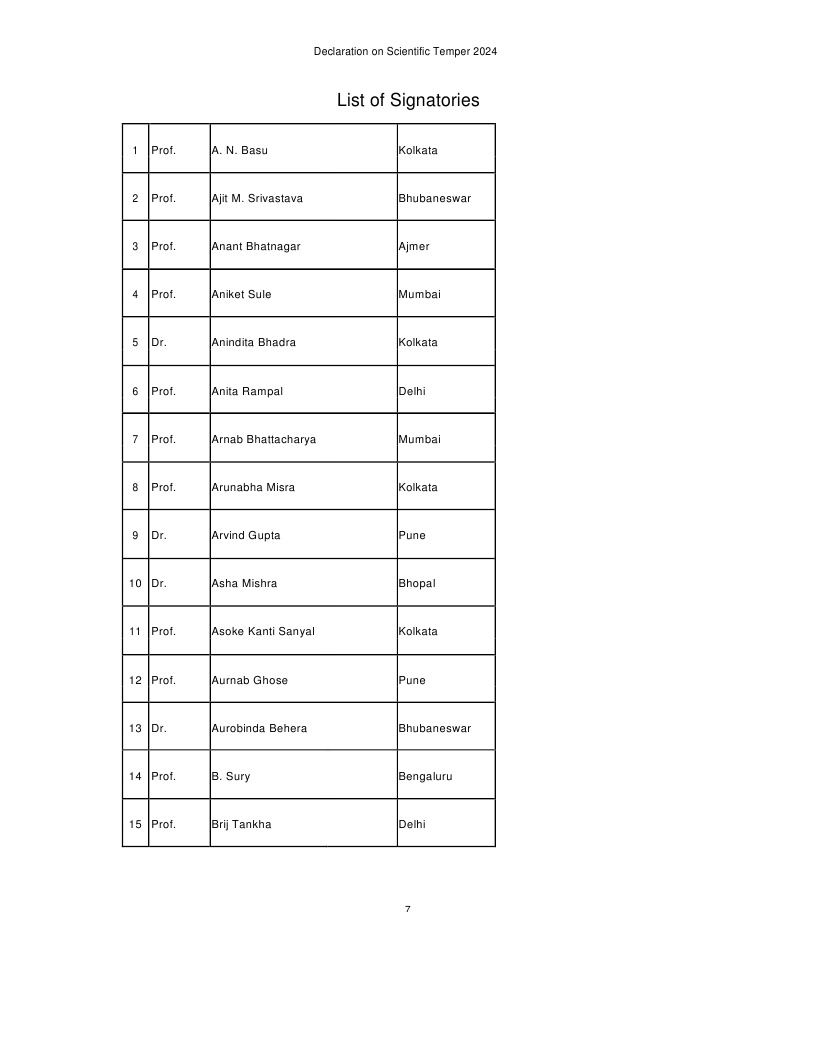
Since its establishment, NSTD has received considerable support from a variety of groups and individuals throughout India, with events occurring in numerous regions. This year’s emphasis is on the Kolkata 2024 Declaration on Scientific Temper, which underscores the urgent need for a renewed commitment to evidence-based reasoning and critical analysis in India. This is especially crucial in light of emerging socio-political movements that challenge scientific inquiry and the generation of universal knowledge. The Kolkata Declaration highlights three primary areas for focus: the role of government, the responsibilities of scientific and educational institutions, and the necessity to combat the erosion of academic freedom and the proliferation of pseudo-science. It calls upon scientists, intellectuals, and advocates promoting evidence-based thinking and upholding constitutional values, thereby fostering a scientific perspective.

NSTD also includes the “Ask Why?” campaign, which aims to advance scientific temper and promote Article 51A (h) of the Indian Constitution. This initiative seeks to reinforce the constitutional right to scientific inquiry and to enhance investment in employment; people centred development, education for all, science, technology, humanities, and the arts.

Interplay of Politics and Education:

Concerns are mounting regarding the influence of Hindutva-related initiatives within research institutions and universities, reflecting a significant political agenda that deserves condemnation. A contentious aspect of the New Education Policy (NEP) 2021 was the introduction of Indian Knowledge Systems (IKS) into educational curricula at all levels. The policy proposed integrating IKS content into existing subjects and introducing specialized IKS courses at both undergraduate and postgraduate levels.

It is essential to recognize that the foundations of modern knowledge are rooted in various ancient and modern cultures, including India, which also encompass oral traditions from marginalized groups such as tribal communities and unwritten knowledge related to agriculture, livestock, and local practices.

The implementation of IKS into educational curricula has been fraught with contention at the school and UG/PG levels. The NCERT’s recent introduction of new textbooks for Class VI, particularly in social science, gives an inaccurate and biased sanskritised representation of Indian knowledge traditions. Scholars and Ayurveda experts have noted that the NCERT Class XI textbook’s portrayal of Ayurveda includes exaggerations and inflated claims of Ayurveda as being codified 4000 years ago. In reality evidence points to around 6th century BCE.

At the higher education level, guidelines issued by UGC for incorporating IKS are unrealistic. Moreover, due to lack of faculty who understand that IKS even in earlier times has been evidence based, many HEIs are implementing courses that misrepresent, simplify and distort its rich history. Thus, the introduction of IKS has opened the door for individuals with naive or pseudoscientific views on Indian science and mathematics to gain influence. For instance, the director of IIT Mandi has faced widespread criticism for making outrageous claims that have circulated on social media, yet he represents only a small part of a much larger issue.

Haunting the System:

This year, IIT Mandi has introduced controversial topics such as “reincarnation” and “out-of-body experiences” into its IKS curriculum for B.Tech students, eliciting mixed reactions. Similarly, Banaras Hindu University (BHU) has established an entire unit within the faculty of Ayurveda dedicated to Bhoot Vidya. This six-month certificate course aims to educate doctors holding BAMS and MBBS degrees in psychotherapy, treatment of psychosomatic conditions, and paranormal activities as part of their Ayurvedic practice.

It is essential not to entirely dismiss Ayurveda and other ancient or folk medicines as irrational, as they were based on empirical practices of their times. India has a long legacy of Ayurvedic medicine grounded in experience and trial and error formulations. However, these need to undergo rigorous randomised clinical trials, which are considered the gold standard in contemporary evidence-based medicine. It has been shown that it is possible to evaluate ancient practices using modern scientific methods while maintaining their cultural significance. There is a need for rigorous research and evidence-based approaches to ensure their credibility and relevance in contemporary health practices. Consequently, AIPSN continues to emphasize the necessity of adhering to evidence-based medicine, where healing and wellness are founded on published and verified evidence.

These regressive IKS-related incursions into research institutions and universities have become commonplace, creating a persistent challenge for rational thinkers to issue statements in response. Nevertheless, in this ongoing struggle, AIPSN cannot remain silent simply because the government is a repeat offender.

Academic Freedom:  

In a separate development, South Asian University recently raised concerns regarding a PhD student’s research proposal on Kashmir, which was labelled as ‘anti-national’ by university authorities. The university’s actions led to the resignation of the student’s supervisor, Professor Sasanka Perera, raising alarms about the diminishing space for unbiased research in society.

The situation at South Asian University pertains to academic freedom and the international character of the institution, rather than being an Indian institution where the directives of the government, however misguided, may be viewed as “legitimate.” If this is how South Asian University is to be operated, it may be more prudent to relocate it outside of India, shut it down, or place it under the oversight of a completely independent body comprising South Asian representatives.

Importance of NSTD 2024:

The issues related to IKS outlined here exemplify a broader agenda that necessitates critique. Similarly, the coercive influence exerted at institutions like South Asian University poses a significant threat to academic freedom and demands vigilant oversight.

These developments highlight the critical importance of NSTD 2024, which is anchored in the Kolkata Declaration on Scientific Temper, serving as a vital advocate for scientific integrity and unhindered rational inquiry in India.


Contact:

General Secretary AIPSN – Asha Mishra 9425302012  gsaipsn@gmail.com @gsaipsn

Arunabha Misra, Convenor, Scientific Temper Desk,  AIPSN 9831105979


AIPSN brief to the political parties for consideration in their election manifesto

AIPSN brief to the political parties for consideration in their election manifesto

Read the manifesto from JVV Andhra Pradesh in Telugu


Click here to read the pdf of the AIPSN brief for Political Parties 

28 Mar 2024

AIPSN brief to the political parties for consideration in their election manifesto

The All India People’s Science Network (AIPSN) – a platform of people’s science movements across the country has the following positions on various critical issues e.g., propagation of scientific temper, S&T policy and process, Environment and Water resources, Health and Agriculture. As the country gears up for the 18th General Election, we would like to present these positions to be considered for inclusion in the electoral manifesto of the secular, democratic political parties of the country.

  1. On Scientific Temper

Article 51A (h) of the Constitution of India speaks of the duty of citizens to promote scientific temper. Recently, new challenges have emerged in the country in the form of strong socio-political narratives, backed by the State power, that seek to oppose any scientific approach, evidence-based reasoning or, indeed, any perspective that acknowledges universal scientific knowledge. We demand:

  • Promote the separation of State apparatus from religion.
  • Promotion and support of campaigns for popularization of science and its methods, and for promotion of scientific temper, evidence-based reasoning and critical thinking.
  • Reversal of the present government’s various methods and measures to undermine scientific temper, critical thinking and evidence-based reasoning in governance, education and among the wider public
  • Reconstitution of text-book committees to reverse the present. government’s anti-science revision of NCERT textbooks so as to promote critical thinking among students; re-write these textbooks to address deletion of Darwin’s theory of evolution and various chapters/ sections on India’s natural resources, forests, environment, mineral resources etc, and rectify the distorted picture of ancient Indian civilization projected in these texts.
  • A thorough revision of the now compulsory UG/PG Courses and reading material on so-called “traditional Indian knowledge systems;” revise teaching material for new optional Courses on Science, Technology and other Knowledge Systems in Ancient and Medieval India based on the vast body of historical evidence-based material already available on the subject.
  • Correction of the unscientific view being projected in educational institutions and among the wider public of imaginary achievements in S&T in ancient India, and the primacy and superiority of only one stream of cultural-religious-linguistic knowledge, as against the diverse sources and streams of knowledge in the Indian civilization including bi-directional exchanges with other civilizations for a true picture of the growth of science.
  • Restoration of autonomy of academic and research Institutions in both natural and social sciences; pay due regard to research/survey-based data as basis for evidence-based policy-making; correct retrospective manipulation of data to suit ideological narratives; defend and restore academic freedom and pluralism of opinion in universities and research institutes; restore the confidence of the people in scientific institutions
  • Strict monitoring and regulation of the dissemination of “magical remedies,” pseudo-science and superstitious beliefs through commercial activities and in the media, including through Anti-Superstition legislation in the Centre and States.
  • Resumption of population census driven public policy framing.
  1. On Science and Technology (S&T)
  • Enhancement of public funding of indigenous research in S&T to at least 2 per cent of GDP, with due importance to basic research.
  • Strengthening of the university system in research and development (R&D).
  • Decentralization of systems and processes for research funding; scrap the highly centralized National Research Foundation (NRF) set up under the NEP, which also burdens State governments without according to them equitable participation in decision-making; enhance research in state-level universities and collaborations with Central universities and national S&T institutions.
  • Allocation of funds for state-level initiatives for S&T interventions to tackle people’s problems e.g. drought, water resource management, rural livelihoods, issues faced by marginalized communities.
  • Provision of requisite mission-mode R&D funding for identified sectors of the “4th Industrial Revolution” such as Artificial Intelligence (AI), Internet of Things (IoT), bio- and nano-technology etc towards self-reliance in advanced technologies expected to dominate the “knowledge era,” but in which India is in danger of being left behind in pursuit of externally-dependent and false “atma-nirbharta”; also focus on agricultural research to break monopolies of MNCs and enable climate-resilient agriculture/horticulture.
  • Increase in number of research fellowships especially for first generation students; increase number of faculty research positions in institutes; increase quality and quantity of PhDs in which India lags behind.
  • Systematic measures to increase participation of women in STEM (science, technology, engineering and mathematics) research and jobs
  • Initiation of measures to reduce bureaucratism in S&T Institutions, and encourage academic freedom and culture of research towards reversing brain drain; reverse current trend of sycophancy, fear and discouragement of pluralism in universities and research institutes.
  • Regulation of AI, genetic engineering, data-mining and IT-based surveillance so as to ensure the public good.
  • Review of decision to close down many government-funded S&T Institutions; resuming government support for a restructured Indian Science Congress.
  • Promote free and open source software (FOSS) and other new technologies, free from monopoly ownership through copyrights or patents; “knowledge commons” to be promoted across disciplines e.g. like biotechnology, AI and drug discovery.
  • Recognition of digital infrastructure as public infrastructure to be used for public good.
  • Investment in public communication networks and free knowledge access to scientific and other academic publications without copyright barriers.
  • Ensuring all public funded research is made accessible to all.
  • Rigorous double-blind clinical trials with publication of data for open review for approval of new medicines, vaccines etc.


  1. Environment

Various dilutions of regulatory provisions for environmental protection have taken place in the recent past that would have serious impact on our natural resources and climate and will affect people’s livelihoods and wellbeing. There will have to be reversals of these changes. The specific demands are the following:


  • The system and processes of Environmental Impact Assessment (EIA) and Environmental Clearances at State and Central level be made effective, time-bound, transparent, accountable, and free of conflict of interests. EIA is to be conducted preferably through an independent Environmental Protection Agency; repeal EIA Notification 2020 and issue revised guidelines.
  • Economy-wide measures be planned and initiated to reduce greenhouse gas (GHG) emissions under the UNFCCC framework as applicable to developing countries, through effective policies, regulation, de-carbonization, energy efficiency in all sectors of production and consumption, while providing for a just transition from fossil fuels; promotion of renewable energy such as solar and wind; reducing energy inequality and promoting energy access for economically weaker sections such as in public transport; India’s updated Nationally Determined Contribution (NDC) required to be submitted to UNFCCC in 2025 to be re-cast through a participatory process involving all stakeholders.
  • A National Adaptation Plan (NAP) should be evolved through a participatory process involving all stakeholders especially States to tackle climate impacts such as on agriculture, extreme rainfall and related landslides and urban flooding, heat waves and urban heat islands, coastal erosion and sea-level rise; streamline systems to tackle natural and climate-related disasters; evolve and implement climate resilient development strategies especially addressing the needs of vulnerable populations; provide adequate funds from the Centre and build capabilities of States and local governance structures for the above.
  • Sustainable and environment/climate-friendly development strategies should be evolved for the fragile Himalayan region and eco-sensitive regions of Western Ghats and the North-East; undertake comprehensive review of infrastructure development and urbanization in hill areas, especially in the Western Himalayan region.
  • Thoroughly revise National Clean Air Programme (NCAP) towards rapid and goal-oriented reduction of air pollution in urban areas especially through promotion of public mass transportation in preference to personal vehicle use, and effective regulation of polluting industries and construction activities; strengthen Central and State regulatory authorities.
  • Urgently initiate measures to prevent degradation and destructive development of riverbeds and flood plains, including in urban areas.
  • Undo different provisions of the Forest (Conservation) Amendment Act, apart from the modified definition of Forests struck down by the SC, especially 100 km from international boarder and LAC/LOC being exempt from any regulatory measure; ensure protection of rights of tribals and other forest dwellers under Forest Rights Act, 2006.
  • Repeal provisions of biodiversity Amendment Act 2023 which permits transfer of knowledge regarding bio-diversity resources to corporate without permission of National biodiversity Authority, and also denies local communities of due compensation or share of these benefits.
  • Scrap the environmentally disastrous and pro-corporate islands Development Plan for Andaman & Nicobar and Lakshadweep Island chains, without due consultation with local population in Lakshadweep, and endangering the tiny remaining populations of mostly isolated tribes in the Andamans; re-examine feasibility and location of proposed naval base in A&N.
  • Scrap environmentally dangerous National Oil Palm Mission with highly inflated claims of yields and focusing on eco-sensitive North-East and Andaman Islands.
  1. Water Resources
  • Re-formulate National Water Policy treating water as a scarce public good; tackle the growing water crisis; enhance equitable water availability for optimized domestic use, irrigation and industry through effective protection of rivers, expansion of water bodies and increased groundwater recharge; appropriate legislation, effective regulation and demand management of water; water audits and measures to conserve, treat and recycle water especially in urban areas.
  • Ensure equitable provision of WHO-standard piped potable drinking water to all households
  • Halt privatization of water resources and water distribution utilities in urban areas and recognise the right to water as part of the right to life.
  • Check pollution of rivers and other water bodies through effective legislation, regulation and enforcement of sewage and other waste-water treatment and recycling policies; withdraw provisions of Water (Prevention and Control of Pollution) Amendment, 2024 allowing Centre to override State Pollution Control Boards (SPCBs).
  • Undertake comprehensive review of the programme and projects for inter-linking of rivers.
  • Plan and urgently implement measures to protect and improve catchment areas of major rivers especially in the Himalayan region; also take all steps possible to check glacier melting rates such as through regulation of fossil-fuel powered vehicular movement and air pollution in mountain regions.
  1. Health
  • Make right to free health care justiciable through enactment of appropriate legislations at both Central and State levels.
  • Retain health services as a state subject with strong emphasis on federalism.
  • Public expenditure on health to be raised to at least 3.5 per cent in the short term and 5 per cent of the GDP in the long term, with at least 1% and 2% respectively coming from the Centre.
  • Out-of-pocket expenditure on health to be brought to below 25% of health spending expand and strengthen the public healthcare system to ensure free availability of quality health care at all levels, including entire range of medicines, diagnostics and vaccines, and accountability to local communities.
  • Scrap the government-funded PMJAY/Ayushman Bharat health insurance scheme and replace it with a Public-centred Universal Health Care system.
  • Reverse the privatisation of health care services and outsourcing of services through PPPs.
  • Reverse the re-branding of Health and Wellness Centres as ‘Arogya mandirs’.
  • Extend and reform the ESI scheme to effectively protect workers’ health in both organized and unorganized sector, and also covering occupational health.
  • Effectively regulate the private health care sector, especially corporate hospitals which should be brought under the Clinical Establishment Act. Modify the National Clinical Establishment Act, 2010 ensuring implementation of the Patients’ Rights Charter and standardization of reasonable rates and quality of various services.
  • Ensure right-based access to comprehensive treatment and care of persons with mental illness through integration of the revised District Mental Health Programme with the National Health Mission.
  • Adopt a people-centred, rational pharmaceutical policy with effective cost-based price controls, elimination of irrational and hazardous formulations, and a comprehensive generic medicines policy covering labelling, prescription and availability at all retail outlets; ensure availability of essential drugs free of cost at all public health care facilities.
  • Initiate programs to break monopolies of pharmaceutical multinational companies in critical areas.
  • Revive public sector pharmaceutical units to harness them for production of essential drugs and vaccines, and reverse privatization trends; reinstate Open-Source Drug Discovery (OSDD) programmes and collaborative R&D for affordable medicines; remove GST for life-saving and crucial medicines.
  • Strictly control and regulate clinical trials and prohibit unethical clinical trials; develop a justiciable charter of rights for clinical trial participants
  • Remove US government’s drug law enforcing agency USFDA’s offices and officials from India.
  • Resist dilution of India’s Patent of Laws and reject provisions in Free Trade Agreements that obstruct domestic production low-cost generic drugs.
  • Ensure effective, appropriate regulatory oversight of AYUSH system of medicine, while supporting evidence-based use of such systems.
  • Give priority to the setting up of new public colleges to train doctors and nurses, especially in underserved areas such as in the North East and in poorer States. Training institutes to be set up for health workers.
  1. Agriculture

            Right to land, water and commons for all

  • Provide equitable access to land and water: legislate for homesteads for the rural poor; grant land rights to landless for cultivation; promote kitchen gardens, backyard poultry, cattle sheds and group farming.
  • Place all above-ceiling land presently held by public or private entities under control of the state and union government for the redistribution to the landless.
  • Create a register of tenants and provide smallholders with secure tenancy. Give tenant farmers statutory support, recognise tenants as beneficiaries of schemes announced for individual benefits, and access to benefits from sector wide schemes financed through public investment.
  • Recognize women as farmers and grant them land rights, secure their tenancy rights over leased lands.
  • Recognize land rights of Adivasi farmers, implement Forest Rights Act (FRA), review all rejections under FRA, and roll back pro-corporate amendments to Indian Forest Act, 1927.

            Right to Food, Employment, Education, Health and Social Protection

  • Ensure job security and minimum wage by extending the number of workdays from 100 to 200 workdays in rural areas @ Rs. 800 wages per day, implement existing provision of 100 days of MGNREGA without creating digital hurdles.
  • Introduce a provision of 100 days of labour support for the SC, ST, and other small and marginal farmers for land development and for the adoption of integrated farming systems (IFS) including natural farming, thus 200 days of rural employment @ Rs. 800 wages per day.
  • Enact old age pensions.
  • Provide childcare and crèche facilities in agricultural workspaces.
  • Provide for separate courts for protection against caste, ethnic, religious, gender-based oppression.
  • Introduce Urban Employment Guarantee Act, guarantee employment for graduates from rural households in nearby towns.

            Right to public and bank finance, production inputs, knowledge and market

  • Guarantee extra budgetary resources to states from the 15th finance commission for raising the level of gross capital formation in agriculture as a percentage ford from the current level of 15.7% to 30%.
  • Guarantee primary producers’ freedom from debt by implementing complete(formal and informal) loan waiver, restore the right of primary producers to priority lending, stop co-lending to delink farmers from the high-cost economy in agriculture; reduce the risks faced from climate change in respect of pursuing agriculture & allied sector occupations.
  • Create a single-window loan facility for small holders to promote integrated farming, strengthen SHGs and Kudambashree-type of institutions to enable women farmers to access agriculture credit from public banking.
  • Guarantee remunerative prices for agricultural commodities establish an effective system of public procurement of all farm produce declared as essential produce/value added products by rural households through cooperatives for the promotion of sustainable rural livelihoods and for the creation of a universal public distribution system.
  • Guarantee access to publicly regulated markets purchasing the primary produce at the minimum support price (MSP) not lower than C2 costs plus 50 % for the products declared as essential commodities for production by state legislatures.
  • Take agriculture out of WTO, no more free trade agreements (FTAs), and no more patent like intellectual property rights (IPRs) on seeds.
  • Withdraw from the agreements signed by ICAR with Bayer, Amazon and otherness, guarantee research, advice, testing and extension through public sector undertakings, and pave the way for national ownership and control of infrastructure required for agri-digitalization and agri-tech delivery.
  • Reintroduce sectoral reservation through legislation for the products attracting AGMARK label to encourage value addition through cooperatives, micro and small businesses & PSUs in order to keep big business out of local markets.
  • Ensure agro-ecologically coupled integration of primary, secondary and tertiary industries, and restore state/district level planning by establishing statutory boards for scientific and equitable land use, area planning, market development, and promotion of value addition to co-products and by-products through group enterprises.
  • Separate Fisheries Ministry in Central and State Governments with the mandate to protect and promote sustainable fisheries and the livelihood of small-scale fish workers including fishers, fish farmers, fish vendors and other ancillary fish workers.
  • Establish a National Commission for Fisheries to look after policy implementation, inter-state disputes, protection and promotion of the rights and entitlements of small-scale fishing communities.
  • Create in every state “State Commissions for Agriculture and Farmers’ Welfare”.
  • Stop entry of private Dairy Corporate Companies and import of foreign dairy products that threaten existence of India’s Dairy Cooperatives.
  • Abandon plan to open the Indian market by permitting Free Trade on milk and milk-based products.
  • Ensure remunerative prices for milk and milk products.


For clarifications contact:

Asha Mishra, General Secretary, AIPSN  gsaipsn@gmail.com, 9425302012, Twitter: @gsaipsn

Declaration and Resolution on Scientific Temper

Click here for English pdf  of the Declaration of Statement on Scientific Temper with signatories 


Other languages: Tamil Bengali Telugu


Click here for English pdf of the Resolution adopted along with the Declaration on Scientific Temper 


Other languages: Tamil    Bengali  


Leaflet/Powerpoint distributed about the Declaration/Resolution in  Tamil  Bengali 


Adopted at “Campaign for scientific temper culmination program and National convention for declaration on scientific temper”

held on 28th Feb 2024 at Kolkata


Statement on Scientific Temper in the Current Context

Executive Summary There is an urgent need for a renewed commitment to evidence-based reasoning, critical thinking and a scientific approach in India, especially amidst growing socio-political movements that challenge a scientific temper and universal knowledge production based on commonly agreed methods and understanding. Given the changes in society and technology since the earlier declarations on scientific temper in 1981 and 2011, we emphasise the importance of embracing natural and social sciences, humanities, and the rational experiences of ordinary people in the common endeavour to combat the post-truth culture, the intentional promotion of ignorance, and diminishing trust in science exacerbated by misuse of technology. We call for action across three fronts: the State’s role, the involvement of scientific and academic institutions, and combating the undermining of science by the State, the erosion of academic freedom, and the spread of pseudo-science and unscientific beliefs. We urge scientists, intellectuals, and other like-minded individuals to support evidence-based thinking and policy-making and to uphold constitutional values to foster a scientific temper.

Introduction Since the Coonoor Statement on Scientific Temper in 1981 and the Palampur Declaration in 2011, there have been significant socio-political changes in India and around the world. Briefly, these earlier statements had emphasised the importance of fostering a scientific attitude among the people for development and social advancement. Over time, movements promoting scientific temper in India have also evolved in accordance with changing public perceptions of science and technology (S&T).

Recently, new challenges have emerged in India and elsewhere in the world in the form of strong socio-political movements, backed by the State power, that seek to oppose any scientific approach, evidence-based reasoning or, indeed, any perspective that acknowledges universal scientific knowledge. Globally, a post-truth culture is spreading, marked by a deliberate spreading of ignorance and an anti-intellectual atmosphere, along with a diminishing trust in science. It is ironic that technology, part of the broad umbrella of science, is being harnessed to support these trends through social media, such that manufactured sentiment, prejudice, false narratives, baseless opinions and conspiracy theories gain acceptance as valid ways of thinking.

Against this background, the current situation requires a renewed commitment to robust evidence-based reasoning, drawing from accumulated knowledge in the natural and social sciences, and humanities, as well as from the know-how and rational experiences of working people. Such reasoning aligns with well-recognized methodologies of different disciplines, including emerging interdisciplinary research, applicable not only in academic environments, but also in public discourse and understanding. Both scientists and lay practitioners need to actively embrace and popularise these methods considering the new socio-political realities in India.

This contemporary statement on Scientific Temper has become essential, to address present challenges. This statement shall not undertake a critical review of the previous statements / declarations or debate their points. Instead, it acknowledges past debates and critiques, incorporating their essence into the current statement, recognizing the commonality of scientific disciplines and their methodologies. Rather than revisiting old debates, the focus here is on delineating the significant challenges faced in contemporary India for the constitutionally mandated task of promoting scientific temper, the spirit of inquiry, and humanism. Knowledge production and advancement through purposeful discovery and evidence-based reasoning, including thorough consideration of diverse opinions, is currently under severe threat both in academia and in society at large.

Dangerous new theatre As noted earlier, the arena for fostering scientific temper has evolved significantly in recent decades, becoming increasingly contested, including aggressive socio-cultural forces as well as governmental policies and administrative measures antagonistic to scientific temper. The current situation in India demands critical understanding and action on three interrelated fronts: the role of the State and polity, the character and function of scientific research and academic institutions, and malign influences in society and among the general public.

Article 51A(h) of the Constitution of India speaks of the duty of citizens to promote scientific temper. There is concern in some quarters that responsibilities of the State in this regard have not been adequately highlighted. While it might have been assumed that the State’s primary responsibility is implicit when citizens are called upon for certain duties, there is a need for a clearer delineation of the State’s role.

Note: In the declaration, the terms ‘scientists’ and ‘scientific institutions’ are used as terms denoting all natural sciences, social sciences and humanities disciplines, and those others following an evidence-based path of knowledge production and understanding.

Role of the State In the initial post-Independence decades, the Indian State placed significant trust in scientists1 and scientific institutions. Development policies were evidence-driven, with research institutions and centres of excellence enjoying high priority and prestige, and enjoying substantial autonomy. Documents like the Industrial Policy Resolution and a unique Scientific Policy Resolution were foundational to planned development, guided by a multidisciplinary group of experts in the Planning Commission. Independent scientists and social scientists, both from India and abroad, were involved in policy-making, underlining the importance given to science and evidence-based policy-making. Notably, religion played a minimal role in state affairs, and secularism, defined as non-discrimination and equal respect for all religions, was practised. However, the evils of casteism and communalism have never been properly eliminated.

However, in subsequent years, bureaucratism, elitism, and a techno-fix mentality crept into the system, creating something of a divide between scientists and the general public. Trust in scientific institutions also eroded as a perception grew that “establishment science” primarily served officialdom and corporate interests, rather than the public good as supported by verifiable data. During this period, academic, professional, and informed activist voices in civil society critiqued official narratives, influencing public opinion and contributing to critical thinking and evidence-based policymaking. While the State may not have proactively cultivated scientific temper, it engaged with and supported activities to popularise science among the wider public and children. The State also provided considerable space in governance and public discourse for non-official scientific, expert, and informed lay opinion.

Undermining science and a scientific approach   Presently, the State displays a stark departure from this earlier stance. Government and its various organs now actively oppose a scientific approach, independent or critical thinking, and evidence-based thinking and policy-making. This antagonistic stance is widely and persistently communicated to the public through various means, perpetuating such attitudes. State support for research and development (R&D), already below comparable countries as a percentage of GDP, has hit historic lows, raising serious concerns about India’s future in the knowledge era. Domestic assembly by cheap labour is misrepresented as self-reliance, thus also underplaying the need for research and knowledge production.

Funding, fellowships, and independent research face severe cuts in academic and research institutions, burdened by overpowering bureaucratic structures. Career advancement now favours adherence to dominant ideologies, sycophancy, and obedience to government directives over adherence to imperatives arising from domain expertise and research-based insights. Development data and India’s position in reputed international rankings are contested on spurious grounds. Similar data generated in India, even by government institutions, are rejected or manipulated to fit political narratives. On numerous issues, the government claims to lack data, but still proceeds with policy decisions. Open discussions in higher learning institutions are discouraged, hindering critical thinking, pluralism, and academic freedom.

Beyond image management, these tendencies undermine a scientific approach and evidence-based policymaking, demoralising the knowledge production community and fostering anti-intellectual attitudes.

The State and allied social forces directly undermine science and its methods among the public. Unscientific claims by prominent figures in political circles, boasting of imaginary technological achievements and exaggerated ideas about ancient Indian knowledge, are used to build and support a hyper-nationalist narrative. These assertions lack evidence, relying on ambiguous mythological references and dubious interpretations of ancient texts, often draped in quasi-religious cover so as to suppress dissenting voices. Such fanciful and boastful claims undermine many actual substantial contributions of ancient India emanating from various cultural streams and covering intellectual as well as artisanal and technical accomplishments. Critics of such claims are readily branded as anti-national or westernised, questioning both history and science, and undermining the scientific method. Dissent and plurality of opinion, known to be enabling conditions for intellectual progress, are presently under threat.

Assault on the education sector It is disheartening to witness these trends now being introduced into the formal education system, potentially influencing an entire generation unless effectively countered. School textbooks and readings in higher education are undergoing revisions that promote the idea of the unquestioned superiority of knowledge in ancient India, while downplaying the role of other civilizations and their groundbreaking contributions. Whereas addressing Euro-centrism and acknowledging the contributions from ancient India, China, and other “eastern” civilizations is essential, denying the emergence of modern science and technology and the industrial revolution, and the factors leading to it, is not only untruthful but also misleading. The giant strides of modern science and technology cannot be undermined or replaced by fictional narratives, as seen in revised school textbooks of agencies at the Centre and in various states.

These revised textbooks also omit chapters on crucial historical, societal, economic, and ecological issues in India. In an examination-oriented system not fostering critical thinking, this leaves students ill-prepared for higher studies or research and for their roles as informed citizens contributing to national development.

In higher education, mandatory courses on “traditional knowledge systems” are being introduced, presenting a-historical and distorted accounts of knowledge in ancient India. These courses exclusively glorify the Vedic-Sanskritic tradition, neglecting other cultural streams in ancient India and completely disregarding the significant generation of new knowledge in mediaeval India, out of prejudice against particular religious and cultural

streams. This deliberate slant aims to erase or rewrite historical evidence and obstruct critical thinking, leaving students and citizens vulnerable to bias and instilling a distorted view of syncretic Indian traditions and multicultural reality. In the long run, this will result in incalculable damage to the progress of Indian science and to social harmony.

Societal attack In recent decades, India has witnessed the growth of socio-religious orthodoxy, traditionalism, and revivalism, fueled by majoritarian socio-political forces. Traditional religious practices, festivals, and communal forms of organisation have proliferated. Numerous “Godmen” have emerged with substantial resources, sizable followings, and at times, significant political backing. These cults, despite projecting high-thinking spiritualism, have propagated superstitions, pseudo-scientific beliefs, and socio-religious orthodoxy.

Today, social forces aligned with the ruling establishment and supported by the State, disseminate pseudo-science and a belief in mythology as history. False narratives are being used to construct a unitary majoritarian religion and culture, contrary to the diverse religious beliefs even among the majority community. False and unscientific narratives, such as vegetarianism as a dominant “traditional” practice, are being promoted, contradicting scientific surveys conducted by official agencies.

During the COVID pandemic, superstitions and pseudo-scientific notions related to health were actively promoted under the guise of endorsing “traditional” or ancient Indian health systems while implicitly or explicitly criticising modern medicine. Highly placed authorities encouraged practices like lighting lamps and clanging utensils to ward off the virus, with social media amplifying purported “proof” of efficacy, such as recordings of “cosmic vibrations” by NASA. Other pseudo-scientific claims are similarly backed by false evidence supposedly coming from reputed scientific agencies. Artificial creation of long-lost legendary ancient rivers is being undertaken to perpetuate mythology. All these exploit the enduring respect common people hold for science and its truth value. The forces of unreason seek to sow confusion regarding evidence and scientific methods.

Social media and digital technologies play a pivotal role in the State-backed dissemination of unscientific and anti-scientific views, pseudo-science, false narratives, and conspiracy theories aimed at undermining a scientific approach.

In closing, it is important to address the idea that “other worldly” religious beliefs pose the only or major obstacle to fostering a scientific temper in India. Faith poses many challenges which science or rationalism may not always be able to tackle, insofar as faith itself may be defined or perceived as belonging to a non-physical domain. Freedom of religion or Individual faith may indeed be accorded due recognition. At the same time, discriminatory practices or those that impinge on others’ rights or affect public order, must be opposed, and their irrational basis explained. Obscurantism persists due to ongoing weaknesses in society itself, highlighting larger battles that need to be fought, of which the present one may be just a part. Given the organised challenges to a scientific approach discussed earlier, a more focused and targeted strategy is required for the campaign to promote or strengthen a scientific temper.

Declaration We scientists and intellectuals across disciplines, activists and all individuals passionate about spreading a scientific temper, acknowledge that the struggle to promote a scientific temper is wide-ranging and embraces many dimensions. Yet we also understand that, given the grave threats posed in the current context, the major challenge in this period is to combat and roll back these threats. We realise the imminent danger posed by organised multi-pronged attacks to undermine a scientific attitude among the populace. Such attacks not only disseminate pseudo-science, blind faith, and unreason but also promote obscurantism, communitarian prejudices, and discrimination, striking at the core of a humanist approach. False narratives, unfounded opinions, and a cloak of religiosity are wielded to instil adherence to a manufactured, homogenised, majoritarian idea of India.

We, the signatories of this declaration, re-attest the importance of working towards promotion of scientific temper in society. We recognise the grassroots work put in by people’s science movements, other like-minded organisations and dedicated individuals, and commit to support these and other similar efforts. We appeal to like-minded individuals in academia and research institutions, the bureaucracy, and the political class to take a stand upholding constitutional values.


List of Signatories given below 


For further information contact

Satyajit Rath  9868877399

Asha Mishra   9425302012

Arunabh Mishra  9831105979

Krishnaswamy 8012558638

Aniket Sule  9820273239


Resolution adopted by the AIPSN along with the  “Statement on Scientific Temper Declaration”

in the  “Campaign for scientific temper culmination program and National convention for declaration on scientific temper”

held on 28th Feb 2024 at Kolkata


Convinced that India that is Bharat grew for several centuries as Hindostan, and where the people of various religions chose to live together after becoming politically independent from the British Empire and experiencing the partition, is not  a society of comparative and competitive religious fanaticism;

Certain that Hindostan is not the land of make-believe demands on Astha (the tradition of belief systems) alone, but that Hindostan is also the land of modern interpretations of religion;

Confident that Hindostan is the land of the rich tradition of syncretism (combining different traditions) and of seekers of the Universal Truths in religions, and that the people cherish civilizational heritage and celebrate the unity in diversity in food, dress and language on everyday basis;

Clear that Hindostan is the land where Nastiks and Astiks coexisted, materialistic philosophical traditions, for example, lokayata flourished, and the revolution of equality through Buddhism appealing to large sections of society took root, and where the traditions of rebellion and resistance grew through the teachings of Basava, Kabir, Nanak, Narayana Guru, Periyar and many more, promoted inclusiveness and syncretism of sufi and bhakti spiritual preachers;

Accepting that the people care for the legacy of the freedom movement, constitutional vision, national unity and integrity, and do not doubt that the majority is concerned about economic, ecological and social justice, and they continue to think about fundamental rights and directive principles of state policy enshrined in the Indian Constitution;

Recognizing that the people as bearers of historical knowledge, skills and culture, and as social carriers of agro-food diversity, culinary heritage, dietary selections, continue to enjoy variegated range of food, health and fitness practices, and they would be willing to stand up once again against the bearers of sectarian politics trying to take away their economic, social and political freedoms;

Recalling that the contributions to modern science & technology made by J C Bose,  M Visvesvaraya, P C Ray, C V Raman, M N Saha, P C Mahalanobis, S N Bose, S.S. Sokhey, SS Bhatnagar, Homi Bhabha,  Vikram Sarabhai, Satish Dhawan and by many others who challenged the colonial order in S&T, and the perspective and strategy of Scientific Policy Resolution (SPR, 1958) which cherished self-reliance and, embraced scientific approach to policymaking, the scientific and technological communities would not let the people suffer unreason and eliminate the space for pluralism and diversity from the world of higher education, science, technology and humanities;

Persuaded that as the post-independent India’s transformative impulses of self-reliance that accommodated the Gandhians, Nehruvians and Leftists to practice their own S&T heuristics for development in the parallel, gave a place to the ethos of scientific temper and humanism in the Indian Constitution, and in the National Curriculum Framework (2005) and in the Right to Education legislation (2008), the Indian S&T community and the people can be mobilized to defend these gains;

Knowing that the ecumenical (promoting unity among religions), cosmopolitan and modern traditions of scientific and technical practice have deep roots in India, the S&T community can be made to appreciate that the sources of ancient and medieval contributions to science involved multi-cultural interactions, and that the attempts to present mythology as history and fiction as science do not resonate well with the people, the vast majority of Indian people can be made to understand how the latest modern construction of the past traditions is to present an ideology that glosses over and hides the inequalities and exploitation based on caste, class, gender and community;

Recognising that as the people resisted Brahmanism and caste oppression in the ancient and medieval times, the latest attempts to cultivate and impose the irrational and unreasonable ideas on the Indian Women, Youth, Adivasis and Dalits can also be defeated among the people across North, South, East and West of India by mobilizing the people against the assault on scientific temper in the relevant spheres of school and higher education, scientific research and science popularisation;

Feeling alarmed at the Union Government’s blatant unconstitutional attempts to impose on the states the National Education Policy (NEP, 2020), that has the potential to damage irreparably the national character and destroy the secular and democratic contributions of Indian education, the Peoples’ Science Movements (PSMs) call upon the state governments to resist the efforts that sow the seeds of hatred and conformism deep into the mind of the young under the influence of the idea of Hindutava – a destructor of social progress and universal brotherhood/sisterhood, and rededicate themselves to developing quality education with public purposes of national importance

As PSMs,

We solemnly affirm our constitutional right to defend the integrity of Article 51 A(h), and to ensure that the investments in education, science, technology, humanities and arts are considerably enhanced and directed to work for the realization of the scientific temper/outlook[1], for the cultivation of linguistic and socio-cultural diversity, for the universally cherished message of love (‘Vasudhaiva Kutumbakam’ – the world is one family’ ) and for the secular and socialist idea of India and for the reduction of inequalities;

We will contribute to the movements seeking economic, social and ecological justice, and work for the dignified livelihood for the Indian people as a whole through education and research, commit to redouble our own efforts for the promotion of progressive anti-imperialist nationalism, and to strengthen the role and contribution of Indian S&T institutions in the processes of decision making and evaluation of the socio-economic policies under implementation;

We continue with the work started by Dara Shikoh, Savitribai and Jyotriba Phule, Ramabai, Rabindranath Tagore, Nehru, Mahatma Gandhi, Periyar, Bhim Rao Ambedkar, EMS Namboodripad, Ashfaqullah, Bhagat Singh, Subhas Bose, Meghnath Saha, S.S Bhatnagar, Homi Bhabha, S.S. Sokhey, Vikram Sarabhai Husain Zaheer and many others who stood their ground and established the edifice of post-independence period modern S&T institutions, and helped the people to realize the idea of India and the legacy of progressive traditions of the freedom movement;

Mobilize the scientific community to stand up for academic freedom, and actively collaborate with the democratic movement and civil society to defend civil liberties and democratic rights, freedom of expression, organization, representation and struggle through constitutional means, and expose and isolate the forces supporting the babas spreading fatalism and unreason,

Collaborate and work with the rationalists, scholars, academics, scientists, technologists, social scientists, teachers of humanities and sciences,  and professionals about the way forward for the realization of the above stated goals of social progress, propose policies, build institutions and establish a standing mechanism to pursue the challenge of cultivation of scientific temper,  humanism and world peace.

[1] The term scientific temper is broadly defined as “a modest open-minded temper—a temper ever ready to welcome new light, new knowledge, new experiments, even when their results are unfavourable to preconceived opinions and long-cherished theories.

For further information contact

Satyajit Rath  9868877399

Asha Mishra   9425302012

Arunabh Mishra  9831105979

Krishnaswamy 8012558638


National Campaign on Scientific Temper 7Nov2023-28Feb2024

National Campaign on Scientific Temper 7Nov2023-28Feb2024

Click here to get Press Release pdf English

Press Release

National Campaign on Scientific Temper

7 Nov2023 to 28 Feb2024

 All India People’s Science Network (AIPSN) and Bharat Gyan Vigyan Samiti (BGVS) are starting a national campaign on Scientific Temper on 7th Nov2023. This day marks the birth anniversary of both, Sir CV Raman,and Marie Curie, Raman the only Indian who throughout his life worked in India and won the Nobel Prize. Curie,the woman scientist who first won the Nobel prize.Both the scientists were critical thinkers who valuedthe importance of basic scientific research and the role science plays in transforming society.Both questioned false prevailing beliefs and made significant contributions to science.

AIPSN-BGVS will carry on the National Campaign on Scientific Temper from 7 Nov 2023 till 28 Feb 2024 with the slogans “Science for Secularism” and “Science for Democracy”. We firmly believe that rationality, secularism and scientific temper are a great democratizing forces and are determined to make knowledge available to all including those who were systematically prevented from accessing it. As Ambedkar and Nehru have pointed out rationality is crucial to democracy and bedrock of our Constitution. They viewed the future India not just as a political but also a social democracy. Their dream was to build the country based on ideals of liberty, equality, justice and fraternity. They wanted to end centuries of oppression and ill-treatment meted out to the marginalized and excluded classes. A dream shared by millions of Indians who participated in the freedom struggle. This could happen only in a secular state where all citizens, irrespective of religions, caste, gender and region are treated equally.

We are now witnessing an ever-increasing clash of ideas, on the one hand there are those who want to keep the society under the yoke irrational, anti-science, myths and superstitions and on the other side are those who want to build a future based on rationality and scientific temper. In the recent past we had never experienced anti-science and irrational ideasbeing propagated with impunity by the people placed at higher administrative position of the country. We have witnessed with concern that:

  • Method of science and evidence-based reasoning are no longer going to be considered as the way to finding truth,
  • Pre-conceived believes and reliance on scriptures are getting more importance in decision making,
  • People in power are expressing mythology as history and theology as science or philosophy,
  • School books are rewritten with distorted and pseudoscientific facts,
  • Scientific theories like Darwinian evolution contrary to religious beliefs are deliberately expunged from syllabus,
  • Spreading of communal hatred and lodging atrocious attacks on Dalits, minorities and weaker section of the community are becoming a regular feature,
  • Rationality and reason are gradually getting dumped, encouraging cultivation of irrationality and unreason,
  • Democratic rights of dialogue, debate and dissent are viewed as antinationalist acts,
  • Constitutional binding of developing scientific temper, spirit of enquiry and reform according to article 51 A(h) are trampled upon by the current ruling regime on regular basis.

An atmosphere of irrationality and anti-science feeling was created in the country with the result that science popularizes and propagators of scientific temper – like Narendra Dabholkar, Govind Pansare, M MKalburgi and GauriLankesh – were murdered by forces which are against scientific temper and rationality. We strongly believe that at this point in the history of independent India, our Constitution and democracy is threatened by these forces. We feel that, today a National Campaign on Scientific Temper is necessary to protect the constitutional democracy of India that is needed if we are to remain a secular and pluralistic country which was envisaged by the makers of the Constitution.

The National Campaign on Scientific Temper (NCST),is not just a struggle against superstition. It is a systemic battle against a wholesale assault on scientific temper, critical thinking, evidence-based reasoning and, indeed, on science itself. Superstition exists primarily due to the persistent backwardness of our society, and the conspiracy of vested interests to exploit it. In order to subvert the rational thinking the present ruling class, which is the prime moverof current political regime have repeatedly invokedreligious, traditional, cultural and nationalistic sentiments of wide sections of the people. The defense and promotion of scientific temper at the current juncture is a battle that requires to be fought on many fronts against a systemic assault on evidence-based reasoning, pluralism, freedom of thought and reduced role for S&T as a key driver of inclusive self-reliant development.

Ambedkar said “The sovereignty of scriptures of all religions must come to an end if we want to have a united, integrated modern India”. The Statement of Scientific Temper published in 1981 states that “Scientific temper is incompatible with all types of dogmas / traditions whether religious or social”. For the past nine years,numerous efforts by top government ministers,officials and by even some judges have been made to pushand promote mythology as science. They have tried to build a fake, manufactured narrative of a mythical past when ancient Vedic-Hindu knowledge preceded, and indeed surpassed, all knowledge from all other civilizations and cultures. This does great disservice to the many real, major achievements in ancient India, which may come under suspicion due to this cloud of untruths and exaggeration.

Scientific temper is also being undermined when the government refuses to collect data or denies or falsifies official data. Which it has done repeatedly in the past nine years. Without collection of data, its critical examination not effectual policies could be formulated. It not only devalues evidence-based reasoning but also subverts evaluation of policies and conclusions.  Leading scientists and technologists have expressed concern that, for the first time since Independence, they are nowadays not consulted for policy-making which is often done without evidence-based expert opinion as witnessed during demonetization and the Covid-19 pandemic.

During the campaign, the unscientific social-cultural and false a-historical narratives of the groups who seek to manufacture a single “Indian” culture will be countered. These fake narratives are now sought to be spread through the school and higher education system. They try to force manufactured “national” culture and identity upon the huge cultural, linguistic, ethnic and religious diversity that is the real India. We will undertake activities to counter all the falls narratives. We are aware that the critics of these trends are viciously attacked as anti-national, westernized, and products of “colonized minds,”.We are also aware that we will be confronted by an organized army of violent trolls, but we also strongly believe that our society, our democracy is threatened and it is our duty to protect it. This can only be done by reaching out to the masses and building a scientifically tempered society.

AIPSN-BGVS calls upon all rational, critical thinking people to join in the National Campaign on Scientific Temper.We in the process will also build a broad alliance of all those organizations who cherish the constitutional values and dream of propagating scientific temper in the country.