Position Paper on ISRO and Private Sector in Space in India

Click here to read the AIPSN Position paper on ISRO and Private Sector in Space in India


Click here to read the AIPSN solidarity with ISRO employees Save ISRO 

Click here to read the AIPSN Statement on ISRO and Private Sector in Space in India

AIPSN Position Paper on ISRO and Private Sector in Space in India

29 Sept 2026

Part A: Policy direction and sectoral analysis

A1. Context

Recent pronouncements by the government and by the Chairman of IN-SPACe, the agency set up to oversee and promote commercialisation of the space sector, have added to the fears of scientists, engineers and concerned organisations about the direction in which ISRO is being steered.

Of particular concern is the growing role envisaged for the private sector in space-related activities in India and what appears to be shrinking responsibilities for ISRO, which is now mandated to transfer all technologies related to rocket launchers and satellites to private and other non-government entities (NGEs). Such apprehensions have also recently been expressed by serving ISRO personnel in a letter to the Chairman of ISRO, while nine employee associations have separately written to the Secretary of the Department of Space, seeking clarifications on statements made on behalf of IN-SPACe vis-à-vis the future role of ISRO.

These are not knee-jerk reactions against privatisation or the involvement of private players in space or other strategic sectors. Rather, these concerns relate to India’s place in the global space ecosystem and to the self-reliant advancement of India’s interests within it in an increasingly knowledge- or tech-based future. They also do not arise from misconstrued “narratives”, as the IN-SPACe Chairman believes, but from the very framework of the Indian Space Policy of 2023 and its roll-out as per official sources.

A2. Technology transfer: public-sector and private routes

Transfer of rocket manufacturing technologies from ISRO has already begun with the Small Satellite Launch Vehicle (SSLV), in the first instance to the defence PSU Hindustan Aeronautics Limited (HAL). Under AIPSN’s core position, such transfer to a public-sector entity under public control is distinct from private takeover of launch infrastructure.

Transfer of mature technologies for the larger PSLV, ISRO’s workhorse, or for the even larger GSLV or LVM-3 to any private entity would entail a long learning curve and higher risks, except possibly for a few companies. PSUs like Bharat Dynamics, which already produces the Agni missile, may be a safer bet. AIPSN does not oppose the transfer of mature space technology under licence and on agreed terms to a PSU or highly capable and established ISRO private sector partner, with the technology remaining under ISRO ownership and with ISRO technical oversight and national-security safeguards. However, AIPSN opposes handover of launch infrastructure or outright transfer of technology and manufacturing rights to private monopolies at undervalued prices.

The growing demand for launch vehicles, which ISRO cannot meet with its current facilities, makes the idea of shifting the manufacture of rocket boosters with proven repeatability out of ISRO for commercial purposes understandable—particularly if the logic is to free up ISRO for more challenging and strategic core tasks such as expeditions to the Moon or Mars, setting up and operating an Indian space station, crewed missions, scientific collaborations with other countries, and development of related technologies. To scale up launch-vehicle production, ISRO had mooted a consortium route, and in 2022 NewSpace India Limited (NSIL) awarded a contract (initially reported around Rs 824–860 crore) to a consortium led by Hindustan Aeronautics Limited (HAL) and Larsen & Toubro (L&T) to manufacture five PSLV-XL vehicles end-to-end, with the consortium expected to deliver most of the vehicle systems while ISRO retained some strategic elements (separation systems, certain avionics, mission design, launch operations, etc.). However, senior ISRO officials and employees have said these crucial functions must remain with ISRO, and any such transfer is acceptable only with retention by ISRO of rights over technology and future upgradations, along with appropriate terms and conditions, oversight and pre-flight approval, transparent valuation, and national-security safeguards—not as a route to private monopoly and surrender of technology rights by ISRO. It’s unclear why this realistic, reliable model for scaling up launch-vehicle production is being brushed aside.

ISRO was never intended or structured to be a factory and has never been one. Even presently, over 80% of rocket booster components are made outside ISRO by PSU and private sector industry partners. PSUs and the private sector, where appropriate and under public safeguards, would probably play important roles in all the above core tasks too. Hopefully, technology transfer by ISRO would follow usual commercial practice, including fees for tech transfer, training, hand-holding and back-up, while ISRO retains rights for technology upgradation and improved versions.

A few private-sector entities with several decades of experience and capacity-building have indeed established themselves in advanced manufacturing and engineering and could well assist in broadening the base of the space industry. ISRO has historically worked with many such entities and SMEs. Some space-sector start-ups may also independently develop innovative and viable technologies and manufacturing capabilities. But all that is a far cry from the current haste to shift manufacturing and some launch functions and related infrastructure to the private sector.

However, the argument that ISRO must focus on expeditions to the Moon or Mars, setting up and operating an Indian space station, crewed missions, scientific collaborations with other countries, and development of related technologies and that commercial entities will meet the launch vehicles and satellites is not realistic nor desirable. It is not realistic because, out of the 130-odd launch manifests, nearly half are strategic, much of the remainder is civil, and only 15+ are commercial. Thus, most of the expenditure will come from public funds, and mobilising private capital is not feasible. But, it is feasible with a PSU or other public entity under public control, with transparent valuation, national-security safeguards, and ISRO retaining upgrade rights—not as a route to private monopoly. Thus, if the alleged bottleneck is the current cadence limitation, then ISRO’s idea of a consortium is the best bet.

The current rationale for promoting the private sector does not take a fresh look at relations between the public and private sector but seems based on the tired ideological belief that the private sector does everything better than the public sector—an idea disproved in numerous cases in strategic sectors, especially as regards technology development.

A3. Launch economics and the fixed-cost problem

Many issues need to be considered. ISRO launches an average of 5–7 missions per year. Current demand from the public, including security, is much higher, and the problem lies not with ISRO’s capability but with chronic understaffing and limited government funding. The realistic manifest lists nearly 130 satellites to be launched by 2030 to meet the projected demand. This includes 10+ launches for the Gaganyaan mission, about 6 deep-space missions (including Chandrayaan missions), 32 Earth observation satellites, 64 strategic satellites, and nearly 6 commercial/private satellites.

Nevertheless, claims suggest India will need to build and launch 200-300 satellites over the next six to seven years and ramp up launch frequency to around 50 a year to meet growing demand. These claims lack justification and context. The claims never explain what these 200-300 satellites will do, where the demand is, or who will fund these launches. When OneWeb used Indian launch vehicles to launch its 72 satellites, it did not use 72 separate launch vehicles and 72 launches; it accomplished this with just two launches. The wide projected gap between ISRO’s capacity and launch requirement appears magnified to create optics and a ruse for privatisation, rather than reflecting any insurmountable bottleneck.

The China Satellite Network Group Co., Ltd. (China SatNet), a state-owned enterprise established in 2021 under SASAC (State-owned Assets Supervision and Administration Commission), plans to launch 12,000–13,000 satellites for national broadband as dual-use connectivity. Hundreds of satellites are already in orbit. Shanghai SpaceSail proposes launching 15,000 satellites for commercial broadband and connectivity services. Naturally, China is augmenting its launch fleet to meet these burgeoning launch projections. China does not permit either Starlink or OneWeb.

A consortium called SpaceRISE (led by major European operators SES, Eutelsat, and Hispasat), supported by industrial partners including Airbus Defence and Space, Thales Alenia Space, OHB, and others, is leading the European Union’s IRIS² (Infrastructure for Resilience, Interconnectivity and Security by Satellite) project for a constellation of nearly 350 satellites. The EU is building this infrastructure to avoid critical dependence on a US private company (Starlink) or even a partially European commercial network (OneWeb) during crises or geopolitical tensions. As the launch requirement is comparatively small, the EU is not developing additional launch capacity or commercial launch vehicles.

The Indian telecom industry has no such plans; instead, it is tying up with OneWeb or Starlink as local partners. Neither OneWeb nor Starlink, which are expected to commence operations in India, will depend on Indian launch vehicles. Thus, there is no demonstrated commercial demand established for a large-scale launch requirement. Even assuming the rather ambitious 50 launches a year by 2030, that does not make for a booming commercial business for private rocket manufacturers spread over several different booster types.

The same issue arises in respect of launches. A recently published international study has shown that launch costs in India are several times those of the US or other countries. Exact numbers may be debated, but the main factor correctly identified is that, while recurring operational costs for each launch may be low in India, as often cited, the low annual number of launches results in a high per-launch cost when infrastructure, manpower and other fixed costs are taken into account. When the new SSLV spaceport in Kulasekarapattinam in Tamil Nadu is handed over to a private-sector player as decided, will the new player charge globally competitive rates for launches but still bear all fixed costs and run an overall loss? Or will ISRO continue to bear fixed costs while the private player skims the cream off the top of operational costs alone?

 A4. The missing demand side

In the global space market today, about 78% of the value lies in commercial user services such as broadcast, telephony, internet data and so-called “reach applications” such as aggregators, delivery services, logistics, etc., while only a much smaller share is realised through infrastructure, launch and payload hardware. India’s Space Policy calls for shifting from supply to demand, but this is still missing.

Most of the vaunted start-ups are in supply-side innovations. So are the technology and infrastructure transfers from ISRO to the private sector. The big missing link in India is in market demand. Where are the commercial applications, the business ventures which will use all the space-based data? So far, ISRO has done yeoman service for the nation by generating data for resource exploration and mapping, weather (including cyclone observation and forecasting), and Intelligence, Surveillance, and Reconnaissance (ISR) services, broadcasting, and telephony. Except for the last-mentioned, the government has been the main user.

This is not to say there is no commercial space market in India. As of the beginning of 2026, India has 53 operational civilian satellites: 21 communication, 21 Earth observation, 8 navigation, and 3 science/experimental. Of the 21 communication satellites, NSIL has taken ownership of nearly 10 in-orbit GSAT/CMS communication satellites that were previously under government/ISRO control. It also commissions new “demand-driven” satellites (for example, GSAT-24) that NSIL fully funds and owns from the start. The remaining communication satellites are used for civil and ISR; so are the EOS (they are largely dual-use). Thus, they cannot be/should not be handed over to non-government entities.

Commercial operations are supposed to be the private sector’s domain, and this is the main role they should be playing in the space sector, which would drive up launch frequency and hence rocket as well as payload manufacture. Will the forthcoming Space Activities Bill address this problem, with adequate protection from intrusion of inimical foreign interests’ venture capital for start-ups and through FDI?

A5. ISRO’s core tasks and funding

ISRO has a lot on its plate which the nation badly needs for development: a new heavy rocket for crewed and interplanetary missions, reusable rocket boosters, defence satellites found badly wanting during recent conflicts, a full navigation system including India’s own GPS-equivalent, advanced technologies for the space station and crewed programmes, lunar exploration, and so on.

India’s space policies should strongly support these and provide adequate funding and support to ISRO, which has been seriously lacking over the years. Technology transfer for manufacturing to PSUs or capable and trusted private-sector partners, with appropriate terms and conditions, will then make sense. Hopefully, the private sector generates the necessary commercial applications and businesses—their supposed core competences—without waiting for government funds for that too.

Part B: AIPSN stands in defence of ISRO

B1. Why ISRO must be defended

For several days, a flood of reports and interpretations about the Indian Space Research Organisation (ISRO)—one of the country’s most strategically important central government institutions—has circulated in newspapers and other media. Not only the employees’ associations but also former heads of ISRO have come out in the open to prevent further damage to ISRO. Especially in view of the statements emanating from IN-SPACe and its move to open up the rocket-launching segment to private-sector participation when the Space Policy has not been discussed in Parliament, nine employee associations of ISRO have addressed a letter to the Secretary, Department of Space, seeking clarifications on the statement made on behalf of IN-SPACe vis-à-vis the future role of ISRO.

AIPSN recognises that ISRO has changed everyday life. Today’s ISRO was not built in a day. Activities that began in 1962 at Thumba, Thiruvananthapuram, under the Indian National Committee for Space Research (INCOSPAR), then under the Department of Atomic Energy, formed the foundation of India’s space programme. Satellite technology has reached communications, television, telephony, the internet, weather observation, remote sensing, natural resource monitoring, disaster management, navigation, agriculture, fisheries, and the monitoring of railways and other transport systems—directly shaping the economy and people’s lives.

Designing and building the launch vehicles that place satellites needed for national security and public service into their intended orbits, without complete dependence on foreign technology, is itself a major strategic achievement and proof of scientific self-reliance. ISRO cannot therefore be treated as just another government office. ISRO is one of the main pillars of the country’s scientific capability, technological sovereignty, national security and public interest. Its capabilities were built in an era of limited facilities and resources. Indian scientists, engineers, technical staff and workers advanced the field of space technologies through extraordinary labour and dedication. This is not the achievement of any single scientist or political leader. ISRO is the collective labour of thousands across scientific, engineering, technical, worker and administrative cadres. Generations who worked as one for mission success, without measuring their contribution by pay scale or rank, are ISRO’s real capital.

B2. Importance of who decides

IN-SPACe was set up to promote the private sector in the space economy and, among others, to act as an interface between ISRO and emerging startups for sharing of space infrastructure and premises under the control of ISRO, with due consideration to ongoing activities, establishment of temporary facilities within premises under ISRO control based on safety norms and feasibility assessment and usage of spacecraft data and rolling out of space-based services and all the associated infrastructure for the same. However, surprisingly, In-SPACe has invited expressions of interest (EOI) from private industries or consortia to handle end-to-end realisation, manufacturing, operation, and commercialisation of India’s heaviest rocket, the Launch Vehicle Mark-III (LVM3), as well as Operations and Management of SLC at Kulasekarapattinam. Curiously, the EOI bars PSU and state enterprises from participation. Why so is inexplicable. IN-SPACe is not envisaged to call for an EOI; it must have been either ISRO or NSIL. Why these organisations were sidelined is also not clear.

ISRO has always engaged the private sector in the manufacturing of launch vehicles. However, IN-SPACe routes to privatisation appear to involve (1) selling cheap knowledge and technology developed and (2) hollowing out manufacturing, which means a lack of quality discipline and weakening of the knowledge required for the development of critical technologies.

This criticism is aimed at ensuring technology transfer and ensuring retention of technology and IP with ISRO. Moreover, ISRO’s traditional contracting with PSUs continues to provide public ownership and control. While the contribution of the private sector to ISRO’s requirements has not been opposed in principle by either the former heads or by the associations of employees, the demand is for a wider discussion of the Space Policy, which assigned roles to Inland IN-SPACe. The Space Policy must ensure that what shall be manufactured in-house is done after sufficient discussion internally.

B3. Stagnation in ISRO funding: NavIC and spectrum

The government is starving ISRO of funds and support. Budget allocations have consistently been less than what ISRO sought, and actuals have been less than the budget announcements. It is not unreasonable to suggest that ISRO is being deliberately starved of resources so that its functions can be transferred to private players under the guise of ‘efficiency’ and/or ‘non-performance’.

The case of NavIC (Navigation with Indian Constellation) illustrates this neglect very well. NavIC has considerable strategic importance. NavIC is meant to replace the US-based GPS, whose services the country cannot take for granted, as the Kargil crisis amply evidenced. The NavIC system’s efficacy is critically dependent on the functioning of the atomic clocks that the NavIC satellites carry. Over the last 13 years, almost all NavIC satellites have progressively become dysfunctional, largely because of faulty atomic clocks supplied by an international vendor. ISRO is now developing an indigenous clock, which has been flown on the last few NavIC satellites. The government made no effort to help ISRO replace the non-operational NavIC satellites. Investments in NavIC would have enabled ISRO to strengthen national security.

B4. IN-SPACe misjudging ISRO and the launch-infrastructure question

After IN-SPACe was formed, steps to open ISRO infrastructure to private use have come to be intensified: facilities offered at low cost, use of launch systems, and private access to new launch sites. The subsequent opening of SSLV manufacture and launch facilities to private firms—beyond the earlier transfer to HAL as a PSU—and related measures around launch infrastructure in the Thoothukudi region of Tamil Nadu illustrate the scale of the shift.

In this context, the growth of the private space start-up Skyroot is notable. It was founded in Hyderabad by Pawan Kumar Chandana and Naga Bharath Daka, both former ISRO engineers. The publicity around the successful Vikram-1 launch signalled the new importance given to the private space sector. The launch used ISRO facilities at Sriharikota. Senior ISRO officials and former chairmen attended; the Prime Minister congratulated the venture.

AIPSN is opposed to technologies, human resources and infrastructure developed over decades with public money being used cheaply to grow private companies. This opposition does not extend to transfer to public-sector entities under public ownership and ISRO oversight; such transfer may be acceptable if properly valued, audited and kept under public control. We are concerned about who in the private sector is being allowed to capture the economic benefit of knowledge created in the public sector. Foreign venture capital is driving IN-SPACe’s new routes to privatisation. We wish to ensure that public interest and national security are protected when facilities are given to private firms.

B5. Contract staff or full-time researchers

A major issue in the debate on ISRO’s future is the condition of its workforce. It is often argued that talented scientists leave ISRO for better-paid private jobs because pay and benefits are inadequate. Few attribute this attrition to better pay in the private sector. In fact, when compared with many other central government organisations, regular appointments in ISRO demand high educational qualifications and merit. Even some clerical posts require a first-class degree. Thus, the criticism that pay and promotion opportunities are not commensurate with qualifications and work across all cadres cannot be ignored. Nevertheless, the exodus of expertise appears to be driven by uncertainty about ISRO’s future direction, underfunding, and bodyshopping by the private space industry.

The resignations leave ISRO in a tight spot; meanwhile, fresh recruitment has been minimal. Together, these have created an unprecedented gap between sanctioned strength and employees on the rolls. The number of sanctioned posts across the Department of Space has stayed around 20,000 since 2019-20. Employees, however, have fallen from 17,222 in 2019-20 to 14,637 in 2025-26. Consequently, staffing has dropped from 85.9% to 72.2%, while vacancies have more than doubled from 2,817 to 5,632.

For several years, regular recruitment to many posts, including technicians, has been restricted, and contract and subcontract arrangements have been relied upon more heavily. The labour of tens of thousands of contract workers at ISRO centres has been critical to meeting rising launch demand. Many do not receive the service benefits or job security of regular employees. Many work on fixed daily wages with little social security. This human-resource problem affects the quality and continuity of the country’s space missions. When more than 10,000 technical workers on contract across centres are also counted, the scale of the invisible labour behind ISRO’s successes becomes clear. This is not only a labour issue.

B6. ISRO’s public wealth is not for sale.

When rocket technology, launch systems, research facilities and human capability developed for more than sixty years with public wealth are then opened for private profit, questions of ownership and benefit become unavoidable. Private firms may use ISRO infrastructure. But the return on public money spent to build that infrastructure is not an irrelevant question. To present privatisation as mere “development” without clear answers to these questions is dangerous.

Space technology is unlike ordinary industry. Satellites, launch vehicles, communications, navigation and disaster-management systems are directly linked to defence and security. Transfer of advanced knowledge, including rocket technology, must therefore be handled with the highest caution from a national-security standpoint. A model in which public-sector technology moves to private monopolies and infrastructure created with public money is made available to private companies at low cost must be examined for what it will give the country in the long run and how it will ensure public interest and social control.

B7. Protecting ISRO is protecting science.

When ISRO’s problems are discussed, one fact must not be forgotten: ISRO’s strength does not lie only in its buildings, rockets or machines. It lies in the people who create and operate them. To strengthen ISRO, scientists, engineers, technical staff and workers must have decent working conditions, reasonable pay, and job security and promotion prospects. The practice of using contract workers for years as substitutes for regular employment must end, and regular recruitment to required posts must take place. A work environment must be created in which a new generation of scientific talent wants to stay in ISRO. What is not needed is a policy that weakens public-sector scientific capability and channels human resources and technology into the private sector. AIPSN asks the current management not to target the voices of opposition.

Concerns about the transfer of space technology to the private sector can no longer be dismissed as merely the political argument of critics. The 410th Report of the Department-related Parliamentary Standing Committee on Science and Technology, Environment, Forests and Climate Change, presented in Parliament on 25 March 2026, itself recorded a serious concern on this subject. The Committee expressed concern that space technologies are being transferred to private entities at prices disproportionately low relative to their commercial potential. The Committee recommended that licensing fees for technology transfer should reflect real commercial value, distinctiveness and social importance. It also said clear valuation norms are needed and that all technology-transfer agreements should be subjected to periodic third-party audit.

Cooperation with the private sector is possible. New enterprises can be encouraged for technological progress. Organisations and employees in the field do not oppose this. From the beginning, ISRO has worked with both the public and private sectors. But that must not mean loss of public ownership of wealth, national scientific capability, or public control over strategically important technologies. The issue is therefore not the simple question “private sector—yes or no?”

B8. AIPSN demands

The main questions that need to be answered are:

  1. Who protects the real value of technology developed with the people’s tax money?
  2. How much of the economic gain from knowledge created with public wealth will return to the public?
  3. Who sets the price of technology transferred to private firms, and by what criteria?

The Department of Space should be transparent and publish the results of the investigation into the failure of two successive PSLV missions and take corrective measures. Privatisation of manufacturing will only add to the challenge of tackling such failures in the future. Failures occur in science; the nature of science is to learn from them and return stronger.

AIPSN is opposed to:

– transferring public wealth to private monopolies;

– shrinking regular employment while expanding contract labour;

– Moving towards a form of privatisation that gradually renders ISRO, built with the tax money of crores of people, the hard labour of generations and the life-dedication of scientists, less relevant is unacceptable because, in the long run, it will be a serious loss to the country’s scientific capability and public interest.

ISRO’s failures must be corrected scientifically; its successes must not be privatised. ISRO’s technology is the wealth of the nation. Its infrastructure is the creation of the people’s tax money. Its real strength is the collective labour of scientists, employees and workers.



AIPSN solidarity with ISRO employees – Save ISRO

Click here for pdf of statement

AIPSN solidarity with ISRO employees

Save ISRO

14 Sept 2026

Over the past few decades, ISRO has established India as a leader in space science and technology. Its scientists, technologists, and staff have worked tirelessly to achieve national objectives—from placing Indian and foreign satellites into orbit and executing the Mars and Chandrayaan missions to now working towards establishing an Indian space station. These achievements, which were unthinkable a few decades ago, have earned respect both internationally and among ordinary citizens.

Recent announcements by the government and the Chairman of IN-SPACe—the agency established to oversee and promote the commercialisation of the space sector—have sparked intense public debate. Nine employee organisations, representing thousands of workers at the Indian Space Research Organisation (ISRO), jointly sent a formal letter to ISRO Chairman V. Narayanan. The associations formally questioned recent statements suggesting that ISRO would eventually phase out launch vehicle manufacturing and transition into a “residual R&D boutique”. This policy shift has amplified the concerns of scientists, engineers, retired ISRO personnel, advocacy organisations, and citizens regarding the direction in which ISRO is being steered.

Unwarranted political intervention and policy changes have already caused significant strain, with 100 scientists leaving ISRO within a three-month period. These reactions are not mere knee-jerk opposition to privatisation or the involvement of private players in space and strategic sectors. Rather, these concerns centre on India’s standing in the global space ecosystem and the self-reliant advancement of national interests in an increasingly tech-driven future. Nor do these anxieties stem from misconstrued “narratives”—as the IN-SPACe Chairman suggests—but from the structural framework of the Indian Space Policy 2023 and its official implementation.

Since independence, the nation has reached a consensus that the scientific community should receive full academic freedom and financial support to serve the country. Where structural impediments have restricted research and technological development, the government’s responsibility is to address those gaps. However, since 2014, political intervention has increased alongside a shift towards handing over public sector assets to private interests. Public-Private Partnerships (PPP) have, in effect, led to the syphoning of public assets for private gain. It is deeply alarming that this approach is now being directed at ISRO.

For decades, ISRO has served the nation with distinction. It is now our duty as citizens of India to defend this vital institution, resist these damaging shifts, and stand in firm support of our scientific community.


AIPSN Statement on ISRO and Private Sector in Space in India

Click here for pdf of statement

AIPSN Statement on

ISRO and Private Sector in Space in India

14 Sept 2026

Recent pronouncements by the government and the chairman of IN-SPACe, the agency set up to oversee and promote commercialization of the space sector, have added to the fears of scientists, engineers, and concerned organizations about the direction in which ISRO is being steered.

Of particular concern is the growing role envisaged for the private sector in space-related activities in India and what appears to be shrinking responsibilities for ISRO, which is now mandated to transfer all technologies pertaining to rocket launchers and satellites to private and other non-government private entities (NGPE). Such apprehensions have also recently been expressed by serving ISRO personnel in a letter to the Chairman of ISRO. These are not knee-jerk reactions against privatization or involvement of private players in space or other strategic sectors. Rather, these concerns relate to India’s place in the global space ecosystem and for self-reliant advancement of India’s interests within it in an increasingly knowledge- or tech-based future. They also do not arise from misconstrued ‘narratives,’ as the IN-SPACe Chairman believes, but from the very framework of the Indian Space Policy of 2023 and its rollout as per official sources.

Transfer of rocket manufacturing technologies from ISRO has already begun with the Small Satellite Launch Vehicle (SSLV), thankfully to defense PSU giant Hindustan Aeronautics Limited (HAL). Transfer of mature technologies for the larger PSLV, ISRO’s workhorse, or for the even larger GSLV LVM-3 to any private entity would entail a long learning curve and higher risks, except possibly for a few companies. PSUs like Bharat Dynamics, which already produces the Agni missile, may be a safer bet. PSUs should not be excluded from the process of technology transfer from ISRO.

The idea of shifting the manufacture of rocket launchers with proven repeatability out of ISRO for commercial purposes may be understandable if the logic is to free up ISRO for the more challenging and strategic core tasks ahead, such as expeditions to the Moon or Mars, setting up and operating an Indian space station, crewed missions, scientific collaborations with other countries, and development of related technologies. ISRO was never intended or structured to be a factory and has never been one. Even now, industry partners manufacture over 80% of rocket booster parts outside of ISRO. The private sector and PSUs would probably play important roles in all the above core tasks as well. Technology transfer by ISRO should follow usual commercial practices such as licensed production with appropriate fees and charges for tech transfer, training, hand-holding, and backup, while ISRO retains ownership and IP rights over the technology for technology upgradation and improved versions. ISRO should also retain the ability to make and use these rocket boosters and related technologies for its use when required, e.g., for defense purposes.

A few private sector entities with several decades of experience and capacity-building have indeed established themselves in advanced manufacturing and engineering and could well assist in broadening the base of the space industry. ISRO has historically worked with many such entities and SMEs. Some space sector start-ups may also independently develop innovative and viable technologies and manufacturing capabilities. But all that is a far cry from the current haste to shift manufacturing and some launch functions and related infrastructure to the private sector. The current rationale for promoting the private sector does not take a fresh look at relations between the public and private sectors but seems based on the tired ideological belief that the private sector does everything better than the public sector, an idea disproved in numerous cases in strategic sectors, especially as regards technology development. Many issues need to be considered.

ISRO launches an average of 5-7 missions per year, having struck an unusual record of 17 launches in 2018. Even current demand for public security uses is much higher, and the problem does not lie with ISRO capability but with chronic understaffing and funding by the government. Assuming that somehow launch cadence or frequency goes up substantially with private sector involvement, if not up to the rather ambitious 50 launches a year by 2030, that does not make for a booming commercial business for private rocket manufacturers spread over several different booster types.

The same issue arises in respect of launches. A recently published international study has shown that launch costs in India are several times that of the US or other countries. Exact numbers may be debated, but the main factor correctly identified is that, while recurring operational expenses for each launch may be low in India, as often cited, the low annual number of launches results in a high per-launch cost when infrastructure, manpower, and other fixed costs are taken into account. When the new SSLV spaceport in Kulasekarapattinam in Tamil Nadu is handed over to a private sector player as decided, it should be ensured that the new player bears all fixed costs as well and does not just cover operational costs alone and skim profits off the top.

In the global space market today, about 78% of the value lies in commercial user services such as broadcasting, telephony, internet data, and so-called ‘reach applications’ such as aggregators, delivery services, logistics, etc., while only about one-third of that is realized through infrastructure, launch, and payload hardware. India’s space policy emphasizes a shift from supply to demand, but this shift is currently absent. Most of the vaunted start-ups are in supply-side innovations. So are the technology and infrastructure transfers from ISRO to the private sector. The significant gap in India lies in market demand. Where are the commercial applications, the business ventures that will use all the space-based data? Until now, ISRO has been doing yeoman service for the nation by generating data for resource exploration and mapping, weather, including cyclone observation and forecasting, broadcasting, and telephony, and, except for the last mentioned, government has been the main user. Commercial operations are supposed to be the private sector’s domain, and this is the main role they should be playing in the space sector, which would drive up launch frequency and hence rocket as well as payload manufacture. Will the forthcoming Space Activities Bill address this problem with adequate protection from intrusion of inimical foreign interest and venture capital for start-ups and through FDI?

ISRO has a lot on its plate, which the nation badly needs for development. India needs a new heavy rocket for crewed and interplanetary missions, reusable rocket boosters, defense satellites that are urgently required due to recent conflicts, a complete navigation system including India’s own GPS-equivalent, advanced technologies for the space station and crewed programs, lunar exploration, and more. India’s space policies should strongly support these and provide adequate funding and support to ISRO, which has been seriously lacking over the years. Technology transfer for manufacturing to PSUs or capable private sector entities through licensed production or similar appropriate arrangements between ISRO and the private sector will then make sense. Hopefully, the private sector generates the necessary commercial applications and businesses, their supposed core competences, without waiting for government funds for that too.

AIPSN is opposed to transferring public wealth to private monopolies, shrinking regular employment while expanding contract labor, and providing public-sector technology free for private profit. Moving towards a form of privatization that gradually renders ISRO—built with the tax money of crores of people, the hard labor of generations, and a lifetime of dedication by scientists—less relevant is unacceptable, as it would be a serious loss to the country’s scientific capability and public interest. ISRO’s technology is the wealth of the nation. Its infrastructure is the creation of the people’s money. Its real strength is the collective labor of scientists, employees, and workers.


SOLIDARITY STATEMENT on STUDENT-YOUTH PROTESTS   

Click here for pdf of statement in English

Click here for pdf of statement in letter head 

27 July 2026

SOLIDARITY STATEMENT on STUDENT-YOUTH PROTESTS   


   The All-India People’s Science Network (AIPSN) of 40 organisations/movements across 25 states, stands shoulder‑to‑shoulder with the students’ and youth protests for justice and accountability in higher education, especially regarding centralised examinations NEET, NET and the NTA. We congratulate all the protesters for securing the resignation of Education Minister Dharmendra Pradhan, who presided over the testing fiasco. We welcome the demands raised for examination reforms.

   We salute the courage of all the protesters at Jantar Mantar and the ‘Sansad March’ despite brutal police repression by lathi charges, tear gas, unprecedented use of pellet guns and stun batons, internet shutdowns, and arrests.

  We fully support the demands for withdrawal of all cases filed during the protests and compensation to families who lost children to suicides driven by the examination scam. We also demand a judicial inquiry into police excesses.

  AIPSN notes with concern that the High-Powered Task Force on Examination Reform announced today includes no educationist. This seems to reduce the critical demand for reforming the content, format and accessibility of entrance and eligibility examinations, to a narrow window of technical issues related to security, surveillance and cyber-intelligence.  AIPSN calls upon the students’, youth, teachers’ and other organisations it has participated with in the struggle, to ensure that these are brought on board for deliberations on this vital agenda. 

 Ever since NEP was announced, AIPSN has fought against centralisation and commercialisation of education, by opposing the NEP, NTA, and now the VBSA Bill replacing the UGC. The NEET/NTA fiasco is no accident. Centralised, single‑stage examinations based on multiple-choice-questions (MCQ) feed a coaching mafia, push students into high‑fee private colleges, and put students from under-privileged backgrounds at a severe disadvantage. The NTA is a private society answerable only to the minister not the Parliament, and we have seen its utter incompetence and lack of academic autonomy and professional probity. The conduct of examinations is outsourced to profit‑driven agencies often complicit in organised corruption and the leakage of papers. AIPSN demands that NTA be scrapped outright.

  AIPSN has long called for states to reclaim their constitutional role in education through developing State‑centred curricula and admission procedures. We urge that states collaborate with academic institutions and design admissions based on regional contexts and needs, school board marks, social justice and inter‑regional equity. We express our empathy and deep solidarity with the students and families that have suffered the consequences of this distorted examination system as we stand by them in the continuing struggle for a fair and equitable system.


Asha Mishra.            Dr. Satyajit Rath  Prof. P. Rajamanickam 

General Secretary    President.           Convener, Hr Edn Desk

AIPSN Statement on NEET 2026 “Paper Loot” Inflicting Injustice and Suffering on Students

The pdf of statement is available in link below

English

22 May 2026

AIPSN Statement on

NEET 2026 “Paper Loot” Inflicting Injustice and Suffering on Students 

We are witnessing a devastating farce being played out on our youth, as they persevere to work towards entrance into higher education programmes. Recently the NEET entrance examinations have been cancelled under a dark cloud of complaints of extensive ‘paper leaks’. The ongoing CBI investigations have revealed a sinister scenario of an organised network which sells question papers under the garb of coaching, “guess papers” and “mock tests”. With surprising audacity, the Director of the National Testing Agency (NTA) continues to deny any ‘paper leak’; we might tend to agree, it’s certainly not an accidental leak, it’s a carefully organised paper loot propped by huge money. In view of the federal nature of education and the diverse nature of our country, State Governments must have a say in the admission process and allotment to students. AIPSN calls for the dismantling of the National Testing Agency and NEET

In 2024 and again in 2026, reports emerged of paper leaks in the NEET UG Examination (medical undergraduate admissions), pushing the future of 22.79 lakh students into greater uncertainty and anxiety. Investigations have revealed organised multi-state networks operating across Maharashtra, Haryana, Bihar, Uttar Pradesh, Rajasthan, Kashmir, involving paper setters, coaching centres, courier services, ‘solver gangs’ and others. The NEET cancellation case is one among a long series of examinations that have witnessed malpractices and paper leaks, such as sSSC CGL examination (2017-18), which exposed the vulnerability of computer-based examinations; CBSE (2018), where Class 10 Mathematics and Economics papers were leaked before examinations; Railway Recruitment Examinations (2009, 2013, 2014, 2024, 2025); UGC-NET examination cancellation (2024).

Since its establishment in 2017, the National Testing Agency (NTA) has proved incapable of maintaining the integrity and sanctity of important examinations such as NEET UG and UGC-NET. These recurring scams indicate the emergence of an organised network involving paper setters, corrupt officials, coaching centres, printing presses, cyber networks that often operate with impunity and political patronage. The consequences of such corrupt practices are severe, including loss of trust in public institutions, false promises leading to severe indebtedness of families, mental stress and growing frustration among students, weakening of recruitment credibility, the entry of corrupt persons with false credentials into sensitive professions like medicine and teaching, which indeed poses a potential danger to people’s lives.

In 2024 many malpractices had become apparent; apparent more than 1500 examinees were allotted grace marks, while 67 candidates secured the first rank with full marks. In 2026, NTA has failed miserably and the ongoing CBI investigations unravel large scale malpractices in the NEET UG entrance examination, which may be the tip of the iceberg. Reports suggest that leaked papers were sold with impunity for amounts ranging from rupees 15 to 30 lakh or even more, and even ‘bookings’ for the “guess paper” were made several months in advance.. .There are questions about no implementation and no fear of the Public Examinations (Prevention of Unfair Means) Act enacted in 2024.

The NTA conducts major examinations such as NEET UG, JEE Main, UGC-NET, CUET-UG & CUET-PG, CMAT, GPAT, NCET and SWAYAM. and has become a matter of serious concern for the country. Collectively, the NTA is entrusted with the future of over 80 lakh candidates every year (approximately 24 lakh for NEET-UG, 12-14 lakh for JEE Main, over 30 lakh for CUET, several more lakhs for UGC-NET and others). Such a huge responsibility has been assigned to an agency that is not a public statutory body established by an Act of Parliament, but a society registered under the Societies Registration Act, 1860). Even while it generates huge funds through admission fees, it is not accountable to the Parliament or the CAG audits. Moreover, NTA is not academically equipped for the major tasks it undertakes and its repeated failures are seriously impacting our youth and large segments of society. In fact, a major portion of NTA’s operational work depends on outsourced agencies, contractual personnel, deputed officers, temporary examination staff and technology partners.

AIPSN Concerns and Views 

AIPSN would like to recall that the Medical Council of India announced the introduction of NEET UG in 2010, replacing the then AIPMT (All India Pre Medical Test) and various state-level examinations, for implementation from 2012 onwards. Following this announcement, several states, including Andhra Pradesh, Karnataka, Gujarat, West Bengal and Tamil Nadu, strongly opposed the proposed transformation, citing huge variations between the syllabus proposed by the MCI and their respective state syllabi, the impracticality of conducting a centralised entrance examination in a multicultural society like India. Consequently, the CBSE and MCI deferred NEET by a year.

Further, on 18 July 2013, the Supreme Court of India quashed the National Eligibility-cum-Entrance Test (NEET) for admissions into all medical and dental colleges (in the case of Medical Council of India vs. Christian Medical College). The apex court ruled that the Medical Council of India could not conduct a unified examination. However, the judgment was later recalled by a five-judge Constitution Bench on 11 April 2016, and NEET was restored. Tthe Supreme Court of India should come forward to order a judicial enquiry over the repeated incidences of paper leaks and the corrupt nexus involved. Meanwhile, medical admissions this year should be on school marks instead of imposing the burden of a repeat NEET examination.

Earlier, NEET was conducted by the CBSE and is now conducted by NTA in accordance with the National Education Policy, 2020. However, the NTA is neither a fully governmental institution nor an academic body competent to conduct such crucial entrance examinations, which serve as gateways to higher education in medical sciences. Furthermore, the NTA lacks the necessary infrastructure and capability to conduct examinations on such a massive scale. Owing to the very nature of NTA, many had predicted that it would fail and lead to severe scams. This prediction came true in 2024 with the large-scale NEET UG and UGC-NET controversies and the same has been repeated on an even larger scale in 2026.

Several newspaper investigations and probe reports have alleged the involvement of coaching centres, “guess paper” rackets, organised examination networks including examination insiders and persons associated with NTA in repeated NEET paper leak controversies. Rajasthan investigators reportedly recovered a handwritten “guess paper” containing around 150 questions matching the actual NEET examination paper (equivalent to 600 marks out of 720), raising suspicious of a leak network linked to coaching hubs (The Times of India, 12 May, 2026 & India Today, 11 May, 2026). Reports further alleged that leaked NEET material circulated through coaching centres, counsellors, hostel operators, WhatsApp groups in Rajasthan’s coaching hub, Sikar, before the examination (Hindustan Times, 14 May, 2026). Media reports and social media discussions have also questioned the political links of some accused persons

Playing with the future of deserving students must stop right now. Conducting such highly competitive entrance examinations, subsequently cancelling them due to reported paper leaks and corruption, and then conducting re-examinations for nearly 23-24 lakh students is extremely burdensome not only for students but also for the nation’s resources.

Therefore, All India People’s Science Network (AIPSN) strongly demands :

  • Scraping of the NEET and also the NTA and the handing over of NTA responsibilities to competent public institutions and academics;
  • End the outsourcing of examinations; 
  • Admission through State Level Tests and due weightage to students’ school examination marks; Admission to be decided by the States.
  • No single stage test based on multiple choice questions (MCQ) to decide the abilities and aptitude of students. The multiple stage testing process must identify and select students who will serve communities, not become self-serving mercenaries
  • State governments to organise special courses to help deserving students to take entrance tests, not place them into private coaching classes
  • Ban on private coaching centres for examinations
  • Prosecute and punish through fast-track judicial proceedings all those involved in the selling of “guess papers” based on the question paper ; 
  • Resignation of the Union Education Minister


Asha Mishra Satyajit Rath

General Secretary, AIPSN President, AIPSN


Contact

Prof. P. Rajamanickam +919442915101

Convenor Higher Education Desk AIPSN

Dr. Salim Shah +91 94365 82375

Member, Higher Education D

esk AIPSN

Prof. Anita Rampal, anita.rampal@gmail.com

AIPSN


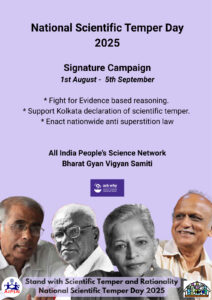
National Scientific Temper Day 2025 August 20 : Ask Why?

NSTD 2025 Appeal is here  Please visit and endorse the appeal.

Click here to read English, Malayalam, Assamese, Odiya , Tamil versions

AIPSN is releasing videos on the occasion of NSTD 2025 in which scientists and others go into the some aspects related to scientific temper. They are available on AIPSN YouTube channel @aipsnmedia

https://youtu.be/JekBsVdy6eM?si=Az5vrYNFaUl0rFnC


Comments on Draft Solid Waste Management Rules 2024

Click here to see the email that was sent  

Click here to see the pdf of the comments  

09 Feb 2025

To

Secretary,

Ministry of Environment, Forest and Climate Change,

New Delhi- 110 003

e-mail: sohsmd-mef@gov.in

Sub: AIPSN Comments on Draft Solid Waste Management Rules 2024

            Ref: Yr. Gazette Notification dt 9.12.2024

Please find below the comments from All India People’s Science Network (AIPSN) on the Draft Solid Waste Management Rules 2024.

The comments are regarding  Segregation at household level, Segregation after Collection at Waste Collector/Processing Facilities, Waste pickers, Waste to Energy (WtE) Plants, Sanitary/Operational Landfills & Existing Dumpsites, Over-centralization, Monitoring in public domain and Penalties.

Kindly acknowledge receipt of this document.

The comments received and the action taken should be put  in the public domain in the interests of transparency.

Yours sincerely

Asha Mishra

General Secretary, AIPSN

AIPSN Comments on Draft Solid Waste Management Rules 2024 (hereafter SWM 2024)

1) Segregation at household level     At the very outset, SWM 2024 sets itself for failure by imposing an onerous responsibility on the household waste generator, namely to segregate and hand over 4 (four) segregated waste streams to the waste collector viz. wet waste, dry (recyclable waste), sanitary waste and “special” or bio-medical or other hazardous waste, and also requires the householder to separately store and dispose of horticultural/garden waste and construction and demolition waste (CDW)! Even now, India is struggling to ensure that households (HH) even segregate into 2 streams (wet and dry waste). One understands that technically, garden waste is different from kitchen/ food waste but again to expect HH to segregate these is too much. 2 Streams from HH are adequate, and the rest should be left to the Segregation/Pre-processing/ Waste Processing facilities as further defined in the Draft Rules.

2)  Segregation after Collection at Waste Collector/Processing Facilities is the achilles’ heel of SWM systems. Improper segregation causes multiple problems at Dumpyards, Waste to Energy (WtE) plants etc. This is not emphasized enough in the Rules. Payments to Waste pre-processing Contractors (the system most Urban Local Bodies (ULBs) are following these days) should be linked to the extent of Segregation achieved, not total quantity of Solid Waste handled as provided for.

3) Waste pickers can play a significant role in proper segregation, and have not been adequately emphasized in the Draft SWM2024. Peculiarly, their role has been stressed in Rural Areas, where even the role of CSOs in organizing them has been mentioned, but not in Urban Areas! New clauses should be inserted calling upon ULBs to actively involve Waste Pickers organised in SHGs or other collectives, hopefully with CSO assistance, and incentivize them through payments for segregation achieved and share from sale of recyclables to recycling units as provided for in the Rules.

4) Waste to Energy (WtE) Plants               There is huge confusion in the Rules regarding WtE or other methods of processing dry/recyclable waste. Chapter II.9.1 says that non-recyclable waste with high Calorific Value shall only be used to produce Refuse-Derived Fuel (RDF) or given to a facility producing RDF, but various other parts of the Draft SWM Rules 2024 appear to suggest that WtE Plants would be directly using such wastes. Simultaneously, Ministry of Housing and Urban Affairs (MoHUA) is encouraged (Chapter VII(2)(xii) to “drive” setting up of “adequate numbers” of WtE plants by 2028, contradicting other parts of the Rules underplaying WtE and speaking only of RDF. This appears to be a thinly disguised attempt at making WtE plants using the Incineration method a mainstay of the SWM system. Although the Draft Rules specify standards for emissions from WtE Plants, which are close to EU standards, experience from Delhi so far clearly testifies to highly inefficient, non-conforming and polluting WtEs, often if not mostly using unsegregated solid waste. Without going into details, Incineration-based WtE Systems have been a total disaster in India and should be avoided altogether, or strictly defined and monitored as regards process, technology, temperature, emissions etc.

5) Sanitary/Operational Landfills & Existing Dumpsites                   A similar situation obtains regarding Sanitary/ Operational Landfills (Chapter III.1) and Existing Dumpsites (Chapter III.2). Both these very different systems are spoken of in different places of the Draft SWM2024 with various different specifications, technologies and standards. Chapter III.1.(4) states that “only non-recyclable and non-energy recoverable dry wastes and inerts shall be disposed of” in Sanitary/Operational Landfills,” while Schedule I governing Specifications for Sanitary Landfills say Landfill gas including collection and utilization “should be considered,” (Schedule I(F)(i) to (iii), incidentally without specifying methane emission limits, clearly implying that Landfills can also be used for wet/bio-degradable wastes! Further, the Draft Rules in III.1(5) and.1(6) provide for charging fees for dumping unsegregated solid wastes “till the time” proper Sanitary Landfills are built and made operational, without specifying any outer time limit!  This is not acceptable. Especially so, since provisions for Existing Dumpsites speak only of Mapping by 2026 (III.2(a)) and talk of bio-mining and bio-remediation only “as practicable.” If the current provisions in the Draft SWM2024 remain, it suggests that unsanitary Dumpyards will likely continue well into the future. Some time may be given to Local Bodies to shift completely away from Dumpyards, but Sanitary Landfills should be unambiguously defined in the Rules.

6) Over-centralization                     The Draft SWM2024 calls for vast amounts of information including monitoring details to be uploaded into a Centralized portal. This is an unnecessary over-burdening of a single Portal and an unnecessary degree of over-centralization. It is suggested that all Information be uploaded in State portals and then also compiled into a single National-level portal. This will make State Governments more partners of SWM processes than they appear to be at present.

7) Monitoring in public domain and Penalties             Most of the penalties and fines seem aimed at the first rung of the waste-management chain namely the household, who can be penalized even by the Waste Collector (!), or contracted (private) facility operators for simple or obvious infractions. For example, the Draft speaks of heavy penalties for anyone burning horticultural or garden wastes (IV(7)). However, there is no mention of monitoring of performance of Local Bodies (LB) or their licensed operators and penalties for failures to adequately or properly collect, segregate, handle, treat etc. For example, if a LB continues to run Dumpsites with unsegregated waste, or a WtE Operator does not ensure conformity to air pollution standards, what will be the penalties? There is also no provision for making public the data from Monitoring of pollution levels of air, ground, water bodies or sub-soil water. Without provisions for these, and without strict timelines for the Rules, the Draft SWM Rules 2024 will remain a paper tiger with a set of pious expectations.

 For Contact:

Asha Mishra                                                    D. Raghunandan

General Secretary, AIPSN                              Convenor, Environment Desk, AIPSN

Mobile: 9425302012                                       Mobile 9810098621

Email: gsaipsn@gmail.com                                      Email: raghunandan.d@gmail.com

Feedback on the draft UGC Regulations 2025 

Click to see the email sent to UGC

Click to see the pdf of the points in the feedback

The feedback  was accompanied by  a cover letter  signed by the General Secretary on AIPSN letter head .

The text of the letter and feedback is given below

02 Feb 2025

To

Prof. Mamidala Jagadesh Kumar

Chairman, UGC

cm.ugc@nic.in

draft-regulations@ugc.gov.in

Sub: Feedback on the draft UGC Regulations 2025

                        Ref: UGC Secretary  Lr No. F. 6-1/2025 (Regulations Feedback) dt 6 Jan 2025

Based on the request in your above referred letter from the UGC site, please find attached the feedback from AIPSN on the draft UGC (Minimum Qualifications for Appointment and Promotion of Teachers and Academic Staff in Universities and Colleges and measures for the Maintenance of Standards in Higher Education) Regulations 2025

 Do acknowledge the receipt of this document.

 Look forward to having all the inputs received made available publicly.

 There are 11 points of concern that AIPSN has raised in the 2 pages below. Importantly AIPSN demands the withdrawal of the draft revised UGC Regulations-2025 which goes against the federal structure of the constitution, destroys the academic autonomy and is against the interests of marginalized students and goes beyond the UGC mandate.

Yours sincerely

Asha Mishra

General Secretary, AIPSN

Mobile: 9425302012

cc:  Secretary, UGC Email: secy.ugc@nic.in

02 Feb 2025

All India People’s Science Network

Feedback from AIPSN on the draft UGC (Minimum Qualifications for Appointment and Promotion of Teachers and Academic Staff in Universities and Colleges and measures for the Maintenance of Standards in Higher Education) Regulations 2025

                      UGC Secretary Lr.  No. F. 6-1/2025 (Regulations Feedback) dt 6 Jan 2025

Points of serious concern:

  1. Non-Academicians as Vice-Chancellors: The regulations (10.1.i) permit the appointment of non-academicians as Vice-Chancellors, which has sparked fears about the privatization of universities and the marginalization of disadvantaged students especially if business persons or others with vested interests are made Vice-Chancellors. The draft regulations have far-reaching implications for the higher education sector in India. The appointment of non-academicians as Vice-Chancellors may lead to the privatization of universities, undermining their social responsibility to provide access to education for marginalized students.


  1. Chancellor’s Nominee as Chairperson: The draft regulations (10.1.iv.a) propose that the Chancellor’s nominee will be the chairperson of the search-cum-selection committee for appointing vice chancellors. The Chancellor being the Governor for State Universities, this move raises concerns about potential political interference in academic appointments and is against the autonomy of the public funded State run Universities. It is a back door move that deprived the State of control over the University it has created for the welfare of students in that region.
  2. A nominee of UGC: This (10.1.iv. b.) also helps the union government’s indirect control over selection of candidate. UGC which was an independent body established under an act has now almost become the wing of the Union Govt. to implement New Education Policy which was not accepted by many state governments.
  3. Against the Statutes of each state university: 10.1.v refers that the conditions of service of the Vice-Chancellor shall be prescribed in the Statutes of the respective University in conformity with these Regulations. If so, how UGC can lay down conditions to constitute a selection committee when the statutes are made by the State Government. Hence the selection of Vice-Chancellor should be based on existing rules and regulations of each and every university as the conditions of service of the Vice-Chancellor shall be prescribed in the Statutes of the respective University in conformity with these Regulations. The Search Committee should be constituted as per the rules and regulations of each and every university.


  1. Appointment of Asst.Professors: Provision for recruitment of Academic Staff in University and College have been separately mentioned implying that cadre selection and service conditions for University and College will be different but with the same academic qualifications. It will dismantle the parity among the staff with the same qualifications. It’s against the spirit of equality. 3.3 states that if the discipline/subject chosen in the 4-year undergraduate programme (NCrF level 6) or postgraduate programme (NCrF level 6.5/7) is different from the chosen discipline/subject in NET/SET, the discipline/subject in which a candidate qualified NET/SET shall be considered eligible for appointment as Assistant Professor in that discipline/subject. This guideline will not help to get qualified people for the subject concerned and instead help institutions to fill the vacancy with candidates of their choice.
  2. Recruitment and Promotion (3.8): The candidate for appointment and promotion need to have any four of the nine notable contributions may deprive the candidates from appointment and promotions as these opportunities are inaccessible to all unlike educational opportunities. These opportunities may be given to all after recruitment.
  3. The withdrawal of the cap on contract appointments (8.0) in teaching positions will lead to HEIs becoming teaching shops with contractual labor especially in the context of governments reducing and withdrawing from financial support of State Universities. The sanctioned post must be filled by permanent faculty.
  4. Violation of UGC regulations(11.0)These regulations are based on NEP-2020 which is not accepted by some States and in the  context of these regulations and the imposition of NEP  it will provide a handle for the Union Government controlled UGC to threaten and coerce HEIs to start following NEP.
  5. Privatization and Commercialization: The regulations’ emphasis on industry partnerships and entrepreneurship has raised concerns about the increasing privatization and commercialization of higher education, which may lead to a decrease in funding for social sciences, humanities, and other non-lucrative fields. This will also reduce access to education for marginalized students.
  6. Though the draft regulations are open for public feedback, it seems more like a ritual given the time frame and the history of earlier invitation of comments which are never made available in a transparent manner. The comments received and the response to the comments should be made available in the website.

We demand the withdrawal of the draft revised UGC regulations-January 2025 which go against the federal structure of the constitution, destroys the academic autonomy and is against the interests of marginalized students and goes beyond the UGC mandate

 For Contact:

Asha Mishra                                                    P.Rajamanickam

General Secretary, AIPSN                              Convenor, Higher Education Desk AIPSN

Mobile: 9425302012                                       Mobile 9698025569

Email: gsaipsn@gmail.com                                      Email: rajamanickamponniah@gmail.com

National Scientific Temper Day 2024: Advocating Scientific Integrity and Unhindered Rational Inquiry

Click here for the press release of this statement 

Click here for the statement 


19  Aug 2024

National Scientific Temper Day 2024

Advocating Scientific Integrity and Unhindered Rational Inquiry


The 7th National Scientific Temper Day (NSTD 24) will be observed across the nation on August 20, 2024, to honour Dr. Narendra Dabholkar, a notable proponent of science and rational thought, who was tragically killed on this day in 2013 by anti-science extremists. His assassination was followed by the murders of others equally vocal and of similar thinking – Govind Pansare, M.M. Kalburgi, and Gauri Lankesh – who were also murdered. In 2018, the All India People’s Science Network (AIPSN), in collaboration with the Maharashtra Andhshraddha Nirmulan Samiti (MANS), established National Scientific Temper Day (NSTD) as an annual event to commemorate these individuals and to promote a scientific mindset.

Upholding Constitutional Values:

Since its establishment, NSTD has received considerable support from a variety of groups and individuals throughout India, with events occurring in numerous regions. This year’s emphasis is on the Kolkata 2024 Declaration on Scientific Temper, which underscores the urgent need for a renewed commitment to evidence-based reasoning and critical analysis in India. This is especially crucial in light of emerging socio-political movements that challenge scientific inquiry and the generation of universal knowledge. The Kolkata Declaration highlights three primary areas for focus: the role of government, the responsibilities of scientific and educational institutions, and the necessity to combat the erosion of academic freedom and the proliferation of pseudo-science. It calls upon scientists, intellectuals, and advocates promoting evidence-based thinking and upholding constitutional values, thereby fostering a scientific perspective.

NSTD also includes the “Ask Why?” campaign, which aims to advance scientific temper and promote Article 51A (h) of the Indian Constitution. This initiative seeks to reinforce the constitutional right to scientific inquiry and to enhance investment in employment; people centred development, education for all, science, technology, humanities, and the arts.

Interplay of Politics and Education:

Concerns are mounting regarding the influence of Hindutva-related initiatives within research institutions and universities, reflecting a significant political agenda that deserves condemnation. A contentious aspect of the New Education Policy (NEP) 2021 was the introduction of Indian Knowledge Systems (IKS) into educational curricula at all levels. The policy proposed integrating IKS content into existing subjects and introducing specialized IKS courses at both undergraduate and postgraduate levels.

It is essential to recognize that the foundations of modern knowledge are rooted in various ancient and modern cultures, including India, which also encompass oral traditions from marginalized groups such as tribal communities and unwritten knowledge related to agriculture, livestock, and local practices.

The implementation of IKS into educational curricula has been fraught with contention at the school and UG/PG levels. The NCERT’s recent introduction of new textbooks for Class VI, particularly in social science, gives an inaccurate and biased sanskritised representation of Indian knowledge traditions. Scholars and Ayurveda experts have noted that the NCERT Class XI textbook’s portrayal of Ayurveda includes exaggerations and inflated claims of Ayurveda as being codified 4000 years ago. In reality evidence points to around 6th century BCE.

At the higher education level, guidelines issued by UGC for incorporating IKS are unrealistic. Moreover, due to lack of faculty who understand that IKS even in earlier times has been evidence based, many HEIs are implementing courses that misrepresent, simplify and distort its rich history. Thus, the introduction of IKS has opened the door for individuals with naive or pseudoscientific views on Indian science and mathematics to gain influence. For instance, the director of IIT Mandi has faced widespread criticism for making outrageous claims that have circulated on social media, yet he represents only a small part of a much larger issue.

Haunting the System:

This year, IIT Mandi has introduced controversial topics such as “reincarnation” and “out-of-body experiences” into its IKS curriculum for B.Tech students, eliciting mixed reactions. Similarly, Banaras Hindu University (BHU) has established an entire unit within the faculty of Ayurveda dedicated to Bhoot Vidya. This six-month certificate course aims to educate doctors holding BAMS and MBBS degrees in psychotherapy, treatment of psychosomatic conditions, and paranormal activities as part of their Ayurvedic practice.

It is essential not to entirely dismiss Ayurveda and other ancient or folk medicines as irrational, as they were based on empirical practices of their times. India has a long legacy of Ayurvedic medicine grounded in experience and trial and error formulations. However, these need to undergo rigorous randomised clinical trials, which are considered the gold standard in contemporary evidence-based medicine. It has been shown that it is possible to evaluate ancient practices using modern scientific methods while maintaining their cultural significance. There is a need for rigorous research and evidence-based approaches to ensure their credibility and relevance in contemporary health practices. Consequently, AIPSN continues to emphasize the necessity of adhering to evidence-based medicine, where healing and wellness are founded on published and verified evidence.

These regressive IKS-related incursions into research institutions and universities have become commonplace, creating a persistent challenge for rational thinkers to issue statements in response. Nevertheless, in this ongoing struggle, AIPSN cannot remain silent simply because the government is a repeat offender.

Academic Freedom:  

In a separate development, South Asian University recently raised concerns regarding a PhD student’s research proposal on Kashmir, which was labelled as ‘anti-national’ by university authorities. The university’s actions led to the resignation of the student’s supervisor, Professor Sasanka Perera, raising alarms about the diminishing space for unbiased research in society.

The situation at South Asian University pertains to academic freedom and the international character of the institution, rather than being an Indian institution where the directives of the government, however misguided, may be viewed as “legitimate.” If this is how South Asian University is to be operated, it may be more prudent to relocate it outside of India, shut it down, or place it under the oversight of a completely independent body comprising South Asian representatives.

Importance of NSTD 2024:

The issues related to IKS outlined here exemplify a broader agenda that necessitates critique. Similarly, the coercive influence exerted at institutions like South Asian University poses a significant threat to academic freedom and demands vigilant oversight.

These developments highlight the critical importance of NSTD 2024, which is anchored in the Kolkata Declaration on Scientific Temper, serving as a vital advocate for scientific integrity and unhindered rational inquiry in India.


Contact:

General Secretary AIPSN – Asha Mishra 9425302012  gsaipsn@gmail.com @gsaipsn

Arunabha Misra, Convenor, Scientific Temper Desk,  AIPSN 9831105979


AIPSN deplores harassment of organisations that criticise the government

click here to get pdf of statement

25 July 2024

AIPSN deplores harassment of  organisations that criticise the government


On July 10, 2024 the Ministry of Home Affairs (MHA) revoked the Foreign Contribution Regulation Act (FCRA) registration of the parent entity (CACIM) of the non-profit Centre for Financial Accountability (CFA), an organization that critically examines the role of financial institutions in development, human rights, and environmental issues. Earlier in January, the MHA had also cancelled the FCRA registration of the Centre for Policy Research (CPR), a leading public policy research institution in New Delhi. These are only a very few cases from the hundreds of NGOs whose FCRA registrations have been cancelled in an arbitrary and non-transparent manner. An unmistakable common thread is that many of these organizations are known for their stout defence of civil rights, government accountability, democratic norms and people’s interests, and have often been critical of government policies and actions. In several cases of FCRA cancellation, reasons given by the government include positions taken against certain development projects or support for people’s struggles against specific industrial projects perceived by locals as being against tribal rights or destructive of the environment. If there are indeed any actual procedural or other “violations” of the regulations by any of these Organizations, they should be afforded the opportunity to take corrective action, institute measures to avoid repetition, and resume operations. But the government’s misuse of FCRA provisions and cancellation of permissions smacks of vindictiveness, intolerance towards criticism and manipulation of regulatory institutions and mechanisms. The government has clearly weaponized FCRA to silence dissenting civil society voices and intimidate others. AIPSN calls upon the government to stop harassing organisations that criticise  actions and policies of the government.

AIPSN has earlier noted similar trends of selectively targeting journalists, online news outlets, cultural personalities, academics and public intellectuals, and even stand-up comics and Youtubers, who have been active in raising public awareness on a variety of civic, governance and policy issues. These trends have serious implications for democracy in India, freedom of expression, and for pluralism. As a network of people-centred science movements, AIPSN is acutely aware that science and a scientific temper cannot thrive if critical thinking and pluralism are suppressed in all spheres.

AIPSN is aware that there are differing opinions in India as to the role of foreign financial assistance to civil society organizations. AIPSN itself does not receive foreign funds nor is it registered under FCRA. Yet AIPSN works with many progressive civil society organizations who do receive such funding, and recognizes their positive contributions to perspectives on development, environment, civic rights and governance. AIPSN will steadfastly defend the right of these Organizations to conduct their activities in accordance with regulatory frameworks in the country. AIPSN recognizes the need for some regulation of fund flows to civil society organizations as exist for commercial activities too. However, the FCRA as it currently operates is totally non-transparent, allows for arbitrary decisions, and gives a dominant role to the bureaucracy and its political masters, with poor oversight and even less accountability. FCRA as it stands requires thorough re-examination, institutional mechanisms for independent oversight and provisions for quasi-judicial appeals and arbitration, beside full recourse to the justice system.

It is indeed ironic that even while this vindictive and partisan crackdown on civil society recipients of foreign developmental funds is underway, several NGOs, so-called “socio-cultural” organizations and even political parties with close ties to the ruling establishment have been quietly receiving foreign funds without scrutiny, exposing the hypocrisy of the on-going onslaught on NGOs receiving foreign assistance. Why is there no level playing field? This is yet another reason for an independent regulatory mechanism, oversight and quasi-judicial review processes.


Contact: Asha Mishra, General Secretary 9425302012 gsaipsn@gmail.com