No to centralization and privatization of research funding: Remit NRF bill to Parliamentary Standing Committee

Click here to see the signature campaign which closed on 30July

Press Coverage in Newsclick  TheHindu

Click here to see the press release on AIPSN letter head 

Links here  to download the press release in pdf: English , Tamil 

Read this to see a detailed AIPSN statement on the NRF

Press Release

             All India Peoples’ Science Network (AIPSN) says no to centralization and privatization of research funding and asks the Union Government to remit National Research Foundation Bill to Parliamentary Standing Committee on S&T, Environment and Forests for a comprehensive assessment.

The National Research Foundation (NRF) Bill, 2023 seeks to replace the Science and Engineering Board (SERB) Act, 2008 by establishing an entity that will not be a fully publicly funded, dependent on corporates, philanthropic bodies and international foundations for funds, centralized in decision making via the Prime Minister as ex-officio President and the Union Ministers of S&T and Education as ex-officio Vice-Presidents and controlling the directions of academic research across disciplines and domains of application.  The original rationale of NRF was to redirect the flow of funds to the state universities to strengthen them as academic institutions.

In the five year allocation of Rs 50,000 crores for R&D through the NRF, 72% of will be financed by the private sector (through as yet unidentified process), and only 28% funded by government. The funding structure will seek the establishment of a stronger intellectual property mechanism of the Bayh-Dole kind which has been resisted by the academic institutions. In the current proposal corporates and elite institutions with access to power centers will have an edge.

Only 1% of the institutions of higher education engage in active research. In terms of the percentage of GDP, India’s spending on research and development (R&D) is among the lowest in the world. In 2022, India only spent 0.65% of GDP on R&D. The public funding for R&D has come down from 0.8% at the start of the 2000s to about 0.65% now; full time equivalent (FTE) researchers in the higher education sector declined from 39.96% in 2015 to 36.48% in 2018. Researchers employed in the publicly funded research sector declined from 30.32% in 2015 to 23.13% in 2018.

The NRF would not be able to address any of these structural impediments to the promotion of academic research and research of societal application and public value.  The state universities need more qualified teachers and researchers in permanent posts. Rampant feudalism, gender and caste based oppression, lack of culture of collaboration are major obstacles to the climate for research and innovation. The NRF hands over executive control and channel of funding to the governing body with much say for corporate entities with no representation to state governments in the Union Government funds for R&D.

It is important to involve academics from all over the country, the state higher education councils and the line ministries of the Union Government to ensure decentralized decision making. The NRF can undermine the possibility of harnessing the energy of multiple sources of initiatives. Joint planning is a more effective way of realizing diversity and plurality of missions in the world threatened by climate change and inequality.

            AIPSN demands that the “National Research Foundation Bill 2023” be re-examined. This bill should be sent to the Department Related Standing Committee on S&T, Environment and Forests for a comprehensive assessment. The Committee should invite the development authorities, line departments of the union government and state governments, the representatives of organizations working with the scientific community and individuals to submit their views on the Bill. The centralisation of funding, lack of academic oversight, not addressing the existing structural problems, privatisation of funding in NRF Bill needs re-examination and a thorough open scrutiny by the scientific community.


For Contact:

Asha Mishra, General Secretary, AIPSN Mobile: 9425302012   Email: gsaipsn@gmail.com

P.Rajamanickam, AIPSN Higher Education Desk Convener, Mobile: 9442915101


AIPSN Response to the JPC on the amendments to Forest (Conservation) Act (1980)

Click here to see the pdf of AIPSN Response 

click here to see the email that was sent  

Click here to see the earlier response to the MoEFCC on 1 Nov 2021

 12.06.2023

All-India Peoples Science Network

            Submission of AIPSN on Forest (Conservation) Amendment Bill, 2023


Due to large-scale degradation of forests in India due to mining and other development activities, the Forest (Conservation) Act, 1980 was enacted by Parliament. This Act regulated many unlawful activities within forests and legislated several compensatory measures to redress any loss of forest due to activities by public or private entities. The Union government introduced the Forest (Conservation) Amendment Bill, 2023 in the Lok Sabha on March 29th this year in order to bring about certain changes in the original FCA 1980, specifically in order to taken into account certain domestic and international developments since then, to clarify certain ambiguities in the original enactment, and to exempt certain types of forest land from restrictions imposed by the original Act.


The All-India Peoples Science Network submits the following suggestions to the various provisions of the proposed Forest (Conservation) Amendment Bill, 2023.


  1. The introductory sections of the Bill draw attention to the Government’s announced goal of net-zero emissions by 2070, the overall aim of bringing one-third of the country’s land area under forest or tree cover, and the Nationally Determined Contribution (NDC) target of creating an additional carbon sink of 2.5 to 3 billion tonnes of CO2 equivalent through additional forest and tree cover by 2030.”
  2. There is a serious problem of viewing forests and green cover exclusively through the prism of carbon sequestration, ignoring all other ecological services of forests.
  3. It is also problematic to conflate forests with tree cover. The former is a complex mix of species providing, besides carbon sequestration, a variety of ecological services including rainwater harvesting and storage in aquifers, preventing top soil run-off and loss, and also providing fuel, fodder, medicinal plants, fruits, oilseeds and a variety of other means to sustain human lives and livelihoods in surrounding areas, besides sustaining considerable bio-diversity including wildlife. However, plantations for commercial or “social” forestry may only provide limited tree cover, carbon sequestration services and commercial value, and the two cannot be equated in any manner. Efforts to conflate these two, in this Bill and in other government policy, will mean only that commercial plantations are being prioritized over natural forests with multiple benefits, and that grounds are being created for converting forests to plantations, couched in the language of “sustainable development” and carbon sequestration.


  1. The Amendment proposes to exempt certain tracts of forest land from restrictions on non-forest activities.


a))land within 100 kilometres along international borders, LoC or LAC to be used for land within 100 kilometres along international borders, LoC or LAC to be used for “strategic linear projects of national importance and concerning national security”

b)up to 10ha in any forest land to be used for security related infrastructure

c))up to 5ha for developing infrastructure of defence-related or paramilitary forces in areas affected by Left-Wing Extremism


i)100 km of forest land in border areas in the North, North-East or along the LOC or LAC encompasses almost the entire length of the Western and Eastern Himalayas, North-east India, while the international border along the North-East States and West Bengal covers huge swathes of eco-sensitive areas. These areas also include two important Biodiversity Hotspots of the world out of the total 4 hotspots in India. These Biodiversity hotspots are not only biologically rich but also deeply threatened. The two Biodiversity hotspots along the Eastern Himalayas and the North East border or LAC areas are also ecologically sensitive and home to several rare wildlife species. Similarly, almost the entire Sunderbans, a globally unparalleled unique delta and forest region which is currently severely threatened by sea-level rise caused by climate change, lies within 100 km of the Indo-Bangladesh border. Any diversion of forest land for non-forest developmental activities will be disastrous for this highly eco-sensitive, vulnerable and threatened ecosystem which also sustains a large, mostly poor population. It is also difficult to comprehend the exemption sought for “linear projects,” since most projects along the LAC or border areas are likely to be non-linear roads, settlements etc. Perhaps shelter is being wrongly taken behind the concept of “linear projects” such as electricity transmission lines, pipelines etc. which are already exempt.

ii)Similarly, acquiring up to 10ha or even 5ha of forest land in any part of the country in the name of security and Left-Wing extremism will entail destruction of important and dense central Indian forests. It is well known that creation of even infrastructure of 5-10 ha in dense forest areas will also entail access roads, perhaps electricity lines, water supply and other infrastructure involving additional destruction of the forest system. Again, forests in these regions also support substantial mostly poor tribal populations, including Particularly Vulnerable Tribal Groups (PVTG) who are as vulnerable as the eco-system they derive their sustenance from.

iii)It is strongly urged that exemption for all such projects be sought on a strictly case-by-case basis.


  1. The definition of Forest in the Bill is unacceptable. One of the major provisions of the Bill is to cover only land that has been declared or notified as a Forest under the Indian Forest Act, 1927 or under any other law. It also seeks to recognize lands that were recorded as forests on or after October 25, 1980. Many lands in government records are in fact recorded as forests many years or even decades before 1980. As per the latest Forest Survey of India’s State of Forest Report (2021), out of the total forest area of 7,75,288 sq.km, 1,20,753sq.km is categorized as “unclassed.” These account for approximately 15% of India’s total forest cover, and in some states and Union Territories, unclassed forests are a massive portion of the total forest cover.                                                 i)The Bill attempts to retrospectively “de-recognize” certain classes of forests under the guise of these lands being private lands, plantations etc.                                                                                                                                                                                                           ii)The Bill is therefore a ploy to overturn the 1996 Supreme Court judgment in the famous Godavarman Thirumulpad vs. Union of India and others which ruled that the term “Forest” will not only include forest as understood in the dictionary sense, but also any area recorded as forest in Government records irrespective of the ownership.


  1. The Bill under Section 5(2) empowers the Union Government to unilaterally “specify the terms and conditions subject to which any survey, such as, reconnaissance, prospecting, investigation or exploration including seismic survey, shall not be treated as non-forest purpose.” This is highly objectionable, and allows for invasive activities such as prospecting with potential for serious ecological damage. This clause should be withdrawn.


  1. Forests come under the Concurrent List in the division of power between the Union Government and the State Governments. However, the Bill under Section 6 empowers the Central Government to issue any directions as it deems necessary to State Governments in pursuit of implementation of provisions of the Bill. This too is highly objectionable, violative of the Constitutionally-granted powers of the State Governments and should therefore be withdrawn.


  1. In view of the above, AIPSN is of the view that the proposed Forest (Conservation) Amendment Bill, 2023, placed by the Union Government in the Lok Sabha be withdrawn in its present form. The need of the hour is restoration, protection and improvement of devastated forest ecosystems, rather than diversion or alteration in the use of forest lands in large parts of the country in one guise or another.


For Contact:

Asha Mishra                                        D. Raghunandan

General Secretary, AIPSN                  Convenor, Environment Desk, AIPSN

Mobile: 9425302012                           Mobile: 9810098621

Email: gsaipsn@gmail.com

National Education Assembly

National Education Assembly

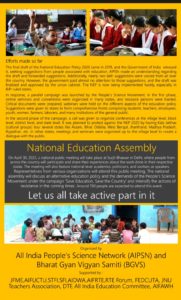
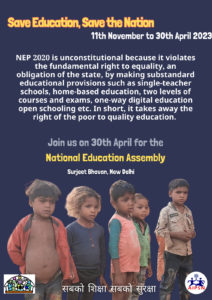
The Second National Education Assembly is being held on 27, 28 December at Chennai 

Click on the links below to read some of the Reference papers 


NEA2AipsnChennaiDeclaration


NEA2Chennai papers


CompilnHrEdnDeskpapers


AIPSN-AlternateNEPproposal


2023NEA-Paper-HrEdn-pamphlet


2023NEA-Declaration-HrEdn


English poster NEA

NEA2posterEnglish

NEA2 poster Hindi

NEA2 poster Hindi

Charter of Demands from First NEA held in 2023 at New Delhi English  Hindi

Declaration of First NEA held in 2023 at New Delhi   English   Hindi 

click here for Tamil Translation of speech by R. Bindu, Minister for Higher Education and Social Justice, Kerala on 30 Apr at NEA

Schedule of the NEA on 30th April


Dr. Narendra Dhabolkar Award for Science and Scientific Temper work of AIPSN

Dr. Narendra Dhabolkar Award for Science and Scientific Temper work of AIPSN

Click to read the pdf of the article  on Universalizing Scientific Temper from AIPSN published in the Maharashtra Foundation Souvenir in English and Marathi.

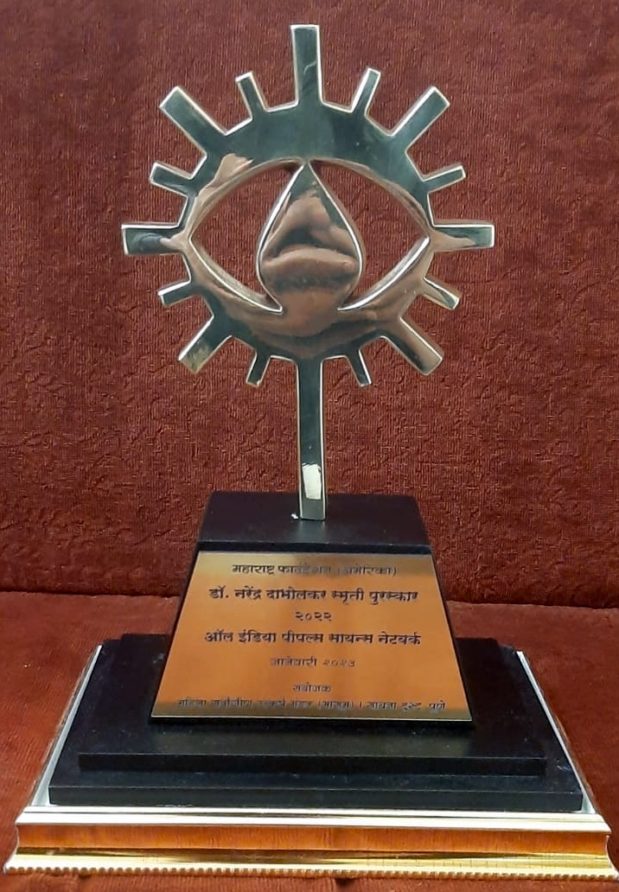
The award ceremony for Dr. Narendra Dhabolkar Award instituted by Maharashtra Foundation took place in Pune on Saturday 28th January 2023. President AIPSN Satyajit Rath and General Secretary AIPSN Asha Misha received the award on behalf of AIPSN. The EC of AIPSN was also represented by Convenor of Scientific Temper Desk Arunabha Misra  along with Vivek Monteiro, Geeta Mahashabde , others from BGVS Maharashtra and Samata Coordinator. The President AIPSN Dr. Satyajit Rath gave the acceptance speech. The article on Universalizing Scientific Temper from AIPSN was published in the Maharashtra Foundation Souvenir.  The EC of AIPSN had earlier decided to accept only the non-monetary part of the award. The memorial plaque shown in picture here was received.

AIPSN response to draft FHEI regulations from UGC

AIPSN response to draft FHEI regulations from UGC

click here to see the pdf file of the AIPSN response to UGC

click here to see the email sent to UGC 

                  AIPSN Response to draft FHEI regulations from UGC       

cover letter

18 Jan 2023

To

Prof. Rajnish Jain

Secretary UGC

secy.ugc@nic.in

ugcforeigncollaboration@gmail.com


Sub: Response on the draft FHEI regulations from UGC

                                    Ref: Yr Lr F.No 1-3/2022(NEP) dt 5 Jan 2023


Based on the request in your above referred letter from the UGC site, please find attached the response from AIPSN on the draft University Grants Commission (Setting up and Operation of Campuses of Foreign Higher Educational Institutions in India) Regulations, 2023


Do acknowledge the receipt of this document.

 Look forward to having all the inputs received made available publicly.

 AIPSN calls upon UGC to abandon this draft regulation to setup and operate campuses of foreign higher educational institutions in India and instead initiate an open discussion with the stakeholders in India to enable the higher education system in India to first function properly to achieve that Education Ambedkar wanted: “Education is what makes a person fearless, teaches him the lesson of unity, makes him aware of his rights and inspires him to struggle for his rights”.

Yours sincerely


Asha Mishra

General Secretary, AIPSN

Mobile: 9425302012


 18 Jan 2023

All-India Peoples Science Network

Response to draft University Grants Commission (Setting up and Operation of Campuses of Foreign Higher Educational Institutions in India) Regulations, 2023

Sub: Response on the draft FHEI regulations from UGC

            Ref: Yr Lr F.No 1-3/2022(NEP) dt 5 Jan 2023


The response from AIPSN is given in two parts: a) Procedural inconsistencies and b) Long term deleterious impacts

  1. Procedural inconsistencies
  2. A democratic exercise has once again been hijacked and made a mockery of in a process that has become familiar. Force a bill, act, ordinance, directive or regulation without any discussion to plead that it is good for the nation. This has happened, to mention a related few instances, in the case of NEP, UGC ABC, STIP and others. The same has now also happened with this UGC FHEI draft regulations being put up on 5th Jan 2023 on the UGC website with the last date to respond as 18th Jan 2023.
  3. The question naturally arises what is the urgency? There has to be more time given. As it is a scheme that is meant for students, the students need to be involved in the discussion. The time could be given till 30th April 2023 and then the responses can be made public before a new draft is circulated.
  4. There is no possibility of postal response. The online and internet access in India is not uniform across the country and in different social strata. Sufficient time is needed for postal responses also from students and others to respond offline also.
  5. It is surprising that UGC has chosen a gmail id for soliciting responses rather than use an official government email id or website for the responses. If UGC does not have this capability even, how is it going to interact with the FHEIs? Or is it an indication that this process will be outsourced to a private party?
  6. Long term deleterious impacts
  7. The entry of FHEIs will make higher education more elitist – increase the costs and reduce the access and quality of higher education that will be available to the socially and economically marginalized. It will lead to further commercialization of the higher education system.
  8. The draft regulations violate social justice. There is no mention even of Reservations and the FHEIs are given a free run in the appointments of faculty and staff as Clause 6.1 says “6.1.The Foreign Higher Educational Institutions shall have the autonomy to recruit faculty and staff from India and abroad as per its recruitment norms.”


  1. There is no provision for Reservation in the student admissions. Clause 5.4.only says “Based on an evaluation process, full or partial need-based scholarships may be provided by the FHEI from funds such as endowment funds, alumni donations, tuition revenues and other sources.” Moreover the FHEIs are given a free run in fixing the fees as mentioned in Clause 5.1 and 5.2 “5.1. The campus of Foreign Higher Educational Institutions may evolve their admission process and criteria to admit domestic and foreign students. 5.2. It shall decide the fee structure, which should be transparent and reasonable.”

Effectively socially and economically marginalised sections will not be able to get the benefits. The entry of FHEIs will further increase the access divide between the privileged from the historically and socially underprivileged.


  1. Clause 5.3 states “The Foreign Higher Educational Institutions shall make available the prospectus on its website at least 60 days before the commencement of admissions, including fee structure, refund policy, number of seats in a programme, eligibility qualifications, and admission process.”

Without getting the approval of UGC publishing the prospectus is favouring the FHEIs to fix their fees as high as is possible. FHEI is considered as like our new HEIs.


  1. 6.3.It shall ensure that the foreign faculty appointed to teach at the Indian campus shall stay at the campus in India for a reasonable period.

Since students may join on the basis of the foreign faculty and if they leave the students may be affected. This is also unreasonable. The foreign faculty must be retained till the students’ requirements are met.


  1. Clause 3.1 and 3.2 of the draft regulations states:

“3.1. If the applicant is a foreign university, it should have secured a position within the top 500 of overall / subject-wise global rankings, as decided by the Commission from time to time; 3.2.In the case of a foreign educational institution, the applicant should be a reputed institution in its home jurisdiction.”

There are several overall and subject-wise global rankings of Universities. Which of the ones is UGC talking about here? Saying that “as decided by the Commission from time to time” only suggests the room for favouritism and undue influence. Clause 3.2 provides a large leeway for accommodating foreign educational institutions as there is no objective way to decide “reputed institution in home jurisdiction”. Moreover, there is much debate about rankings’ interpretation, accuracy, and usefulness. The expanding diversity in rating methodologies and accompanying criticisms of each indicate the lack of consensus in the field. Further, it seems possible to game the ranking systems through excessive self-citations or by researchers supporting each other in surveys. UNESCO has questioned whether rankings “do more harm than good”, while acknowledging that “Rightly or wrongly, they are perceived as a measure of quality and so create intense competition between universities all over the world”. So clause 3.1 and 3.2 merely end up as fig leaves to give an air of quality to the FHEIs that are only intent on making money in India from Indian students.


  1. Clause 4.1 talks of “An Undertaking to the effect that- (i) the quality of education imparted by it in its Indian campus is at par with that of the main campus in the country of origin, (ii) the qualifications awarded to the students in the Indian campus shall be recognised and treated as equivalent to the corresponding qualifications awarded by the Foreign Higher Educational Institutions in the main campus located in the country of origin for all purposes, including higher education and employment;”. This is reiterated in Clause 7.2 and 7.4 “7.2.It shall ensure that the quality of education imparted by it in its Indian campus is at par with that of the main campus in the country of origin. 7.4. The qualifications awarded to the students in the Indian campus shall be recognised and treated as equivalent to the corresponding qualifications awarded by the Foreign Higher Educational Institutions in the main campus located in the country of origin.”

The question arises how will the “at par” and “equivalence” be determined and enforced. What happens if it is found that these are not there as in the undertaking given. We have a history of private educational institutions that are nothing but glorified shops selling qualifications and with no serious action being taken on them for their violations. It will be only the students and the families of the students that will pay the price and suffer for the violations.

  1. Clause 7.5. says “The qualifications awarded under these Regulations shall be equivalent to any corresponding degree awarded by the Indian Higher Educational Institution with the following stipulations: (i) there shall be no further requirement of seeking equivalence from any authority; and (ii) the degree shall have all benefits, rights, and privileges as obtained in the case of a degree awarded by an Indian Higher Educational Institution ordinarily.

The equivalence must not only be in India but also in other countries as is available when degree is from its parent country.

  1. Clause 4.3 mentions “4.3.The Commission shall constitute a Standing Committee to examine matters related to the Setting up and Operation of Campuses of Foreign Higher Educational Institutions in India.”

There is no specification of what will be the constitution of the Standing Committee. Will it involve representatives of student and teachers organisations? Will the civil society groups be represented? What is the level of openness and transparency that will be guaranteed in the constitution and functioning of the Standing Committee?


  1. Clause 7.7 glibly talks of “The Foreign Higher Educational Institutions should arrange for adequate physical infrastructure in terms of built-up space for their academic programmes.”

We know how many private universities operated and still operate from houses and shops. Many a time courses are offered without adequate infrastructure. How can the “adequate” referred to in this clause be decided and implemented? It should be defined on the basis of number of courses and students as surety to the students. Otherwise in effect, most FHEIs will come on fishing expeditions and wind up shop if not profitable.


  1. The worst crime in the Indian context against the marginalised sections that higher education has to empower is the regulation in effect allows for open profiteering in education. Previously under the garb of “non profit” the private higher educational institutions used to make money from students and their families. Now as Clause 8.3 tells “Cross-border movement of funds and maintenance of Foreign Currency Accounts, mode of payments, remittance, repatriation, and sale of proceeds, if any, shall be as per the Foreign Exchange Management Act (FEMA) 1999 and its Rules.” The FHEIs do not even have to put back the profits into India for education or other social purposes. They are allowed to send the profits out of the country. This amount will ultimately become more than the so-called drain of foreign exchange by students going abroad for studies.


  1. AIPSN calls upon UGC to abandon this draft regulation to setup and operate campuses of foreign higher educational institutions in India and instead initiate an open discussion with the stakeholders in India to enable the higher education system in India to first function properly to achieve that Education Ambedkar wanted: “Education is what makes a person fearless, teaches him the lesson of unity, makes him aware of his rights and inspires him to struggle for his rights”.

For Contact:

Asha Mishra

General Secretary, AIPSN

Mobile: 9425302012   Email: gsaipsn@gmail.com

Statement on GM Mustard Trials

Statement on GM Mustard Trials

8.12.2022

click here to read the AIPSN Statement in  English 


Statement on GM Mustard Trials 

The Genetic Engineering Appraisal Committee (GEAC) on 18th October 2022 permitted production and field testing of hybrid seeds of genetically modified (GM) Mustard named DMH II. Commercial release of the seeds has still not been allowed pending open field trials. The approval would be for 4 years extendable depending on compliance with various conditions. The current approval is the most significant step in India regarding GM food since a moratorium was announced on the release of Bt Brinjal in 2010.      AIPSN notes that many scientists and farmers organizations have expressed serious concerns on different grounds regarding the GEAC decision.Noting that the GEAC release also specifies that the field trials would study the impact on pollinators and other insects,AIPSN strongly suggests that such studies be conducted over a longer period and on a range of other ecological parameters as well.

Concerns have also been expressed about the herbicide-tolerance built-in to the GM hybrid. Whereas the GEAC release clarifies that the particular “bar” gene is a marker for herbicide tolerance only during“hybrid seed production… not for cultivation in the farmer’s field under any situation” it would have been better if seed production trials take place in a controlled rather than in an open environment so as to assess various risks before conducting open field trials.

AIPSN urges that open field tests if any be conducted with utmost precautions and in carefully selected locations to ensure strict isolation from neighboring fields of mustard. The trials should be conducted by public bodies such as ICAR or agricultural universities etc under supervision of an independent committee of experts from different relevant disciplines including ecologists, eco-toxicologists, pollination biologists, farmers’ organizations and concerned civil society organizations. The trials should be conducted with full transparency, and the data generated should periodically be placed in the public domain.

AIPSN welcomes exploration of different kinds of science-based solutions to the problems of agriculture including the present need to find solutions for low productivity of edible oilseeds and increasing dependence on imports in India. AIPSN urges the government to also explore a wide variety of diverse technological options including bio-technological solutions that are ecologically, socially and economically viable within the framework of innovation through the public sector research system. Further, in order to make an immediate dent on production and imports the government should encourage farmers to increase mustard production by announcing a higher MSP and include mustard oil in the items to be sold through public distribution system.

AIPSN notes that, in contrast to earlier releases by agri-business corporations, DMH-II has been developed by a public sector laboratory in Delhi University in collaboration with the National Dairy Development Board (NDDB). Nevertheless, DMH-II is a hybrid seed which has to be purchased by the farmer every season, not a variety which can be bred by farmers themselves. So there is concern whether the technology of seed production, or the production and distribution itself, would remain with PSUs or handed over to private entities, with possibly adverse effects on prices, availability and access by farmers. AIPSN urges the government to strengthen the contribution of the public sector in production of mustard seeds also.

Finally, AIPSN urges that any eventual decision on commercial release must be taken after thorough rigorous assessments of results of these trials and based on a detailed plan for regulatory systems and institutional framework governing modalities of seed production and distribution, including provisions for public scrutiny of the same.


For Contact:

Asha Mishra                                        Parthib Basu

General Secretary, AIPSN                    Convenor, Agriculture Desk, AIPSN

Mobile: 9425302012                           Mobile: 9831967500

Email: gsaipsn@gmail.com

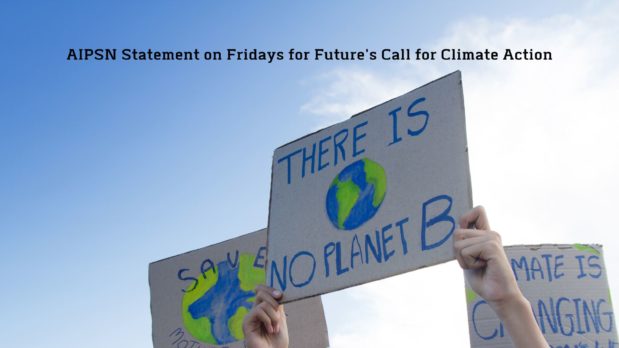
AIPSN Statement on ‘Fridays for Future’ Climate Actions: 23 Sept 2022

AIPSN Statement on ‘Fridays for Future’ Climate Actions: 23 Sept 2022

Click here to read the statement in  English , Hindi, Bengali, Ahomiya , Odiya

Climate Strike Actions, mostly involving students, youth and related movements, have been taking place all over the world as part of the global ‘Fridays for Future’ campaign initiated by Swedish teenage activist Greta Thunberg in 2018. This year the selected date is Friday 23 September, 2022. The All-India Peoples Science Network is organizing activities all over the country on that day along with climate campaigners in other countries.
‘Climate Strike’ actions this year have special significance because, perhaps more than in previous years, climate impacts have hit nations across the world like a sharp slap on the face, reminding us all of the serious consequences of ignoring climate change and the factors causing it. Heavy use of fossil-fuel based energy and other unsustainable economic activities have been releasing huge quantities of greenhouse gases (GHGs) into the atmosphere, particularly by the developed countries which are responsible for over 70% of accumulated atmospheric GHGs. There is mounting scientific evidence, notably in the 6th Assessment Report of the Inter-governmental Panel on Climate Change (IPCC) and in 3 Special Reports of IPCC in the past two years, that global average temperature rise is climbing steadily and that, even at the present level of 1.2 degrees C higher than in the industrial era, changes in climate and other impacts are occurring mush faster and with much greater intensity than earlier expected. As things stand today, despite all the emission reduction promises made by all countries in the landmark Paris Agreement in 2015 and as updated at the Glasgow Summit in 2021, the world is nowhere near limiting global temperature rise to 2 degrees C, leave alone the raised ambition of 1.5C. The world, especially people in particularly vulnerable island nations, least developed countries and developing countries in general, face an uncertain, bleak and dangerous future.

Many countries, including several developed countries, experienced severe climate impacts last year and then again, this year.   There have been rare and heavy rains and floods in northern Europe over Germany, Belgium and stretching to the Balkans and Italy last year, completely taking by surprise the entire region which incurred huge losses in both property and human lives, as well as prolonged and severe heat waves and forest fires in the past two years, along with severe drought in Spain, Portugal and Italy. Scorching heat waves, long droughts and forest fires have also ravaged the US and even Canada, which saw temperatures touching 50C, and now experiencing prolonged drought and resultant water crisis in the South-Western USA.

We have all seen the horrendous floods in neighbouring Pakistan caused by what people have termed a “super monsoon” or “monsoon on streroids” with extreme rainfall, in some regions 3-5 times average rainfall, compounded by glacier melt resulting from an earlier heat wave, all together displacing over 33 million people and virtually inundating the whole country.

India, over the past several years, has been experiencing erratic monsoons, extreme rainfall events, severe flooding in Kerala and this year also in the Godavari and in the Brahmaputra badly affecting Assam. Extreme rainfall, often 300mm-500mm in a single day or, put another way, a whole month’s quota of rainfall in a few days, has caused complete inundation even of metropolitan cities such as Mumbai, Chennai, Hyderabad and, at the time of writing, India’s cyber-capital of Bengaluru apart from other towns and cities, exposing the thoroughly inadequate drainage system and the haphazard urbanization allowed hitherto which has blocked natural drainage lines and rivers such as the Mithi in Mumbai, the Adyar and Cooum in Chennai and so on.

Himachal Pradesh and Uttarakhand have been ravaged by extreme rainfall resulting in floods, landslides and destruction of infrastructure such as smaller dams and hydro projects, as well as large parts of small towns. These disasters have been compounded by unplanned and badly implemented construction of roads, dams and hydro projects, and expansion of urban settlements far beyond their carrying capacity, magnifying the impact of climate change.

In peninsular India, several States are experiencing serious coastal erosion, which will only worsen with the anticipated sea-level rise, and various harmful infrastructure and commercial projects on the coasts, destroying natural protective barriers such as mangroves. Unfortunately, even the Coastal Zone Regulations have been diluted, allowing such economic activities even as near as 50m from the coastline!

Latest data predict that large areas of all major coastal cities such as Mumbai, Kochi, Chennai, Vizag, Puri, Kolkata etc are in danger of being submerged under rising sea-levels made worse by high tides and storm surges. Numerous villages in the Sunderbans in West Bengal are facing sea-level rise, submergence and land subsidence, threatening people’s lives, habitat and livelihoods.

Through its ‘Climate Strike’ actions this year, the All India Peoples Science Network and its affiliated organizations seek to highlight these threats and rally the people to demand urgent action by the union and State Governments to combat climate impacts. It is notable that the government has devoted much attention to the international negotiations and has promised to reduce emissions from India as part of global efforts to combat climate change. However, the Government has not paid sufficient attention to climate impacts in India and has so far failed to initiate any serious effort towards adaptation and building resilience to climate impacts. It is widely known that many such actions would need to be taken up by the States. But given the imbalance between the Centre and the States in finances and in human resources and capabilities, it is imperative that the Union Government urgently launch a National Action Plan on Adaptation and Climate Resilience with full participation of State Governments, S&T Institutions and civil society organizations.


Regressive and Unconstitutional NCERT’s Textbook changes

Press Release

11 July 2022

click here to get the press release pdf in English

AIPSN Resists

Regressive and Unconstitutional NCERT’s Textbook changes


All India Peoples’ Science Network (AIPSN) is concerned that the National Education Policy 2020 implementation in respect of the content of school education at the NCERT having wider academic, educational, political and social implications is already underway. Changes have been made without any academic considerations or academic logic. No consultation with the SCERTs and the education departments of the state governments, School teachers, and the wider academic community having been done before deletions and revisions in the content of social sciences text books used at the school level. All the changes have been done in a hasty ad hoc manner. Academics, teachers and the Peoples’ Science Movements have earlier also made their apprehensions clear about the National Education Policy (NEP), 2020, to the Union Government and the State Governments who have the responsibility and decision and policy making power.

As the things stand, the Indian Express investigations done recently in this regard have brought out that NCERT is involved in making sweeping changes undertaken in the most opaque manner possible in respect of the social sciences textbooks used at the schools involving crores of students. Since NCERT is a specialized apex institution of the Government of India the process required should have involved the authorities and educationists working at the state level. The reach of NCERT is very wide and not limited to any particular state.  Since school level education textbooks utilized in elementary and secondary education in the domain of social sciences can impact on the society as a whole the process should have been democratically undertaken in consonance with the academic requirements and the school education related provisions enshrined in the Indian Constitution as it stands today.

The revisions touches on some vital points about the state-citizen relationship, the vision of democracy, secularism and the constitutional vision of education as enshrined in the Indian Constitution as it stands even today. The revisions have been undertaken in a non-transparent manner as reported in the IE 4 part investigation. Chopping off sections, making revisions and undertaking deletions amount to rewriting the books of social sciences. The revisions in social science textbooks include the content related to the violence against Muslims in Gujarat in 2002 and the discussion on Emergency in 1975-77.  The apex agency of education is suggesting politically and ideologically motivated changes in the history text books, for example, deleting content related the Delhi Sultanate and the Mughal Empire. The revisions will also impact how school students learn about the inequities of the caste system and the impact of social and protest movements such as the Narmada Bachao Andolan.

From the changes made it is clear that the school textbooks are being rewritten. Rewriting has been motivated by the push for the politics and ideology of a regressive nature. The intention is to completely stem out the critical thinking from the society through the highly questionable and repressive indoctrination process. This is what is reflected in the changes recommended to the school education textbooks. It does not want the students to learn about caste as a system of injustice. The deletions would end up in establishing an education system wherein the students will be actively prevented from understanding the actual functioning of institutions like caste, community, class and political-bureaucratic apparatus and the real reasons for the emergence of social protests in India.

Without involving the wider academic community and the social scientists who edited the earlier books on Social Sciences-history, political and social domains of knowledge changes have been made by those individuals who are not known for their academic contributions in the social sciences domains. The process followed at NCERT has the full support from the Ministry of Education. Changes reflect the Hindutva agenda to turn education at the school level into the creation of an illiberal political-bureaucratic, academic apparatus and society which is communally charged in which protests of citizens would be, if not impossible but looked upon as social aberrations that need to be disapproved.

While the PSMs apprehended at the stage of the National Education Policy of 2020 formulation and announcement that the changes in education expected would be regressive, but the direction of these changes portends even a more dangerous trend. The ruling party led state governments are actively undertaking the same process in various states. Karnataka government is very much determined to make similar types of changes. The government is going ahead with these changes despite the resistance mounted by the leaders of opposition parties and social movements active at the state level. This means that the ruling party is not interested in following the Constitutional Obligations.

The political-bureaucratic apparatus is using the NCERT to make changes that will impact quite adversely on the state and direction of democracy, education and social change. The people’s science movement urges the union government to stop this kind of irrational tampering in the textbooks with non academic intention and with communal objective. Before making any changes in the existing text book develop the national curriculum frame work with the leadership of academics who have strong conviction towards our constitution and constitutional values and also having deeper understanding regarding content and pedagogy. Any changes in the textbook shall be done with academic logic and pedagogical understanding. And people’s science movement also urges the public to come together and resist the hasty, regressive, unconstitutional and nonacademic changes in the textbooks undertaken by NCERT.


Contact:

General Secretary Ms. Asha Mishra

9425302012


Corbevax for 12-14 year-olds: arbitrary decision-making on Vaccines continues in India

All India Peoples Science Network (AIPSN) Statement

 click here to get the pdf of the statement 


click here to get the pdf of the press release


Corbevax for 12-14 year-olds: arbitrary decision-making on Vaccines continues in India


22 Mar 2022

             The Union Health Ministry announced through a press release on March 14, 2022 that vaccinations against Covid-19 for children in the age group of 12 to 14 years would start from March 16, 2022 using the Corbevax vaccine manufactured in India by Biological E. Limited, Hyderabad, with license from BCM Ventures, USA, set up by the vaccine developer Texas Children’s Hospital. Corbevax is a protein subunit vaccine where the spike protein of SARS-CoV-2 is directly injected with stabilising chemicals and adjuvants in order to raise antibody levels in the recipient. This is different from Covaxin which uses full inactivated virus or Covishield which uses an adenoviral viral vector to introduce the DNA coding for the spike protein into cells. The vaccine is open-source and offered to manufacturers without patent but with a small fee for BCM. Government is being charged Rs.145 per dose whereas Rs.990 would be charged by private hospitals. While Corbevax undoubtedly expands the basket of vaccines available in India to combat the pandemic, the modalities of its approval, deployment and related decision-making processes raise many disturbing and recurring questions which have plagued India’s vaccine policies and the integrity of its regulatory institutions and mechanisms.

The Government statement said the decision to initiate vaccinations for the 12-14 years cohort was taken “after due deliberations with scientific bodies.” However, it is known that the National Technical Advisory Group on Immunisation (NTAGI) was not consulted, nor was any recommendation obtained from the National Expert Group on Vaccination Administration for Covid-19 (NEGVAC) either regarding vaccination for this age-group nor for deployment of Corbevax as the sole vaccine for this cohort.  It appears that the Government itself does not have confidence in its own expert bodies, which calls into question the very credibility of the decisions being made. Unfortunately, it is precisely such non-transparent decision-making which contributes to vaccine hesitancy, as had happened earlier with Covaxin for similar reasons.  It may be noted that, once again, approvals in India for Corbevax for this age group have been granted without peer reviewed or even pre-published data and clinical trial data pertaining to this age group is not available in the public domain, whereas approval for adults were granted based on interim trial results. The difficulties and delays faced by Covaxin in obtaining WHO approval due to inadequate data are well-known, as are the world body’s statement that it could not be expected to “cut corners” in well-established approval procedures. The Government risks repetition of this international embarrassment by once again resorting to short-cuts in India’s domestic scientific approvals and regulatory systems.

India’s vaccine policy has been characterized by poor planning, arbitrary and non-transparent decision-making based on extraneous considerations rather than scientific evidence. The Government is arbitrarily dividing up the market amongst different vaccine manufacturers by approving only specific vaccines for different age-groups, rather than adopting a more equitable public vaccination programme. As a consequence, vaccine production and exports have not kept pace with requirement and demand despite tall claims of being the “vaccine capital of the world,” and this has in turn impacted on vaccine deployment strategies and choices.

AIPSN calls upon the government to strictly follow laid-down regulatory procedures and scrutiny by scientific and expert bodies, then formulate and implement evidence-based policies with transparent decision-making rationale. Only this will restore public confidence in India’s vaccination policy and obviate vaccine hesitancy.


For clarifications contact:

V.R. Raman 9717107878 D. Raghunandan 9810098621; T. Sundararaman 9987438253

P.Rajamanickam, General Secretary, AIPSN gsaipsn@gmail.com, 9442915101 @gsaipsn