Instagram Astronomy Reels Contest 2026

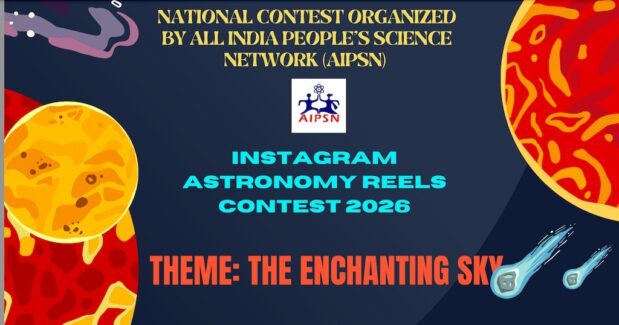
Instagram Astronomy Reels Contest 2026

Click here to see the Google form for submission


Click here to see the document for rules


National contest organized by All India People’s Science Network (AIPSN)

Instagram Astronomy Reels Contest 2026


Theme: The enchanting sky

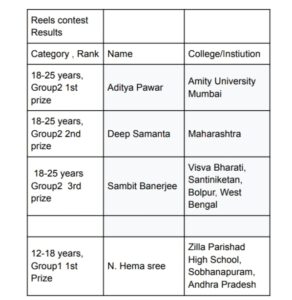
AIPSN invites submissions on this theme. The contest is open to all between 12 to 25 years of age and there is no submission fee. Winners will be announced on National Science Day, 28th February 2026. There will be five prizes in both categories given to the best 5 reels in each, and e-certificates of participation will be given to all participants.

Please read the rules and guidelines carefully before submission. You will not be able to edit your submission.


Rules:

Each participant can submit a single entry.

All entries must be published on instagram and the link of the post should be submitted through the Google form shared by AIPSN.

The contest is open to Indians living in India only.

Deadline for submissions: 17th February 2026 11:59 pm.

Incomplete submissions will not be considered for judging.

The reels should adhere to the theme of the contest.

The decision of the panel of judges will be final.

Use of AI should be duly declared in the instagram post, and is not preferred.

Plagiarism will be checked and plagiarized content will be disqualified.

Reels that hurt the sentiments of any ethnic or religious community will be disqualified.


Submission guidelines:

The reels can be of the duration from 15 sec (min) to 60 sec (max).

The reels should be in instagram friendly format and should be published / republished on instagram between 31 Jan 2026 to 17 Feb 2026.

Instagram reel description should clearly tag @aipsnmedia and include #astroreels2026 as a hashtag.

Submissions can be in English, Hindi or other Indian languages. For reels created in any language other than Hindi or English, it is mandatory to submit the transcript of the reel as a separate file through the form as directed.

The contest is open to participants from the following two categories:

A) 12 to below 18 years of age (posted on instagram by their parents / teachers / legal guardians).

B) 18 to 25 years of age.


How to Submit:

Click on the link: Google form or scan the QR code

 

Fill the form, upload the necessary documents and your submission.


Click on the Submit button.
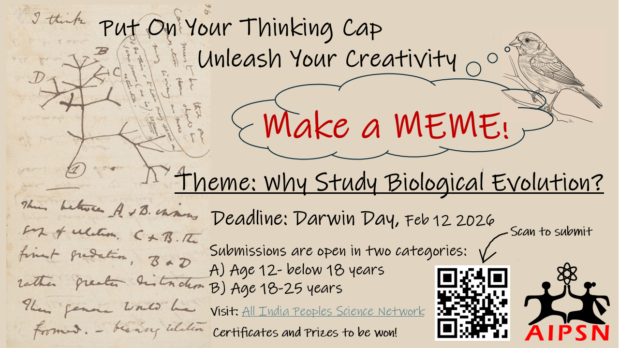
 

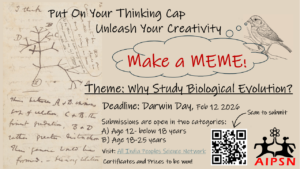
Darwin Day 2026 Meme making contest

Darwin Day 2026 Meme making contest

National meme making contest organized by

All India People’s Science Network (AIPSN)

On the occasion of Darwin Day, 12 Feb 2026


Click here to download the Rules, Regulations and how to submit the meme


 Click here to download  png    pdf  of the flyer 


 Theme: Why Study Biological Evolution?

AIPSN invites submissions on this theme. The contest is open to all, and there is no submission fee. Winners will be announced on National Science Day, 28th February 2026. There will be five prizes in both categories given to the best 5 memes in each, and e-certificates of participation will be given to all participants.

Please read the rules and guidelines carefully before submission. You will not be able to edit your submission.

Rules:

  1. Each participant can submit a single entry.
  2. All entries must be submitted through the Google form shared by AIPSN.
  3. The contest is open to Indians living in India only.
  4. Deadline for submissions: 12th February 2026 11:59 pm.
  5. Incomplete submissions will not be considered for judging.
  6. The memes should adhere to the theme of the contest.
  7. The decision of the panel of judges will be final.
  8. Use of AI should be declared at the bottom of the meme submission, and is not preferred.
  9. Plagiarism will be checked and plagiarized content will be disqualified.
  10. Memes that hurt the sentiments of any ethnic or religious community will be disqualified.


 Submission guidelines:

  1. The memes can be hand drawn or digitally created.
  2. The memes should be in the Square (1080X1080 pixels) or Rectangular (1080X1920 pixels) format only.
  3. Only jpeg/ jpg/ gif/ png/ pdf format submissions will be accepted. Please name the file with your_name_date before submitting so it is clearly identifiable.
  4. Submissions can be in English, Hindi or other Indian languages. For memes created in any language other than Hindi or English, it is mandatory to submit the text of the meme as a separate file through the form as directed.
  5. The contest is open to participants from the following two categories:
  6. A) 12 to below 18 years of age.
  7. B) 18 to 25 years of age.


How to Submit:

Click on the link: Google form or scan the QR code

Fill the form, upload the necessary documents and your submission.

Click on the Submit button.
Note: The maximum file size allowed is 10 MB for the meme and 1 MB for other documents.

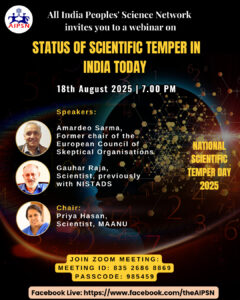
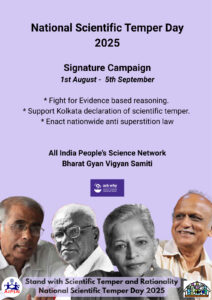
National Scientific Temper Day 2025 August 20 : Ask Why?

NSTD 2025 Appeal is here  Please visit and endorse the appeal.

Click here to read English, Malayalam, Assamese, Odiya , Tamil versions

AIPSN is releasing videos on the occasion of NSTD 2025 in which scientists and others go into the some aspects related to scientific temper. They are available on AIPSN YouTube channel @aipsnmedia

https://youtu.be/JekBsVdy6eM?si=Az5vrYNFaUl0rFnC


80 Years After Hiroshima & Nagasaki: Need Total Nuclear Disarmament

Click here to read the full version 

Click here to read a short version


6 Aug 2025

80 Years After Hiroshima & Nagasaki: Need Total Nuclear Disarmament

 The All India People’s Science Network (AIPSN) strongly condemns the development, use, and continued deployment of nuclear weapons. It calls for the rebuilding of a global people’s movement dedicated to peace, against war and militarism, and in particular for complete nuclear disarmament. In a significant move, a gathering of Nobel Laureates issued a declaration in July 2025 calling for the prevention of nuclear war—the first such unified statement from that community.

Eighty years have passed since the United States dropped atomic bombs on Hiroshima on August 6, 1945, and Nagasaki on August 9, 1945, during the closing stages of World War II. Japan was looking for ways to surrender, having already been decisively defeated. Still, hundreds of thousands of civilians, including children and the elderly, were killed when the bombs were used. About 350,000 people had perished as a result of the bombings by the end of 1945, and both cities were completely destroyed. The extent of the damage to civilians was never seen before in human history.

Following the war, the world entered a prolonged arms race. By the 1980s, the global nuclear arsenal had ballooned to nearly 70,000 weapons. Since then, arms control agreements have reduced this number to an estimated 12,000. However, the threat has not diminished. India and Pakistan became nuclear-armed states by the end of the 20th century. Iran’s alleged pursuit of nuclear weapons has led to decades of sanctions and, more recently, direct military attacks by Israel and the U.S.—despite the fact that Israel itself is the only nuclear-armed country in the Middle East.

The nuclear weapons of today are far more potent than those of 1945. Delivery systems are more accurate, faster, and lethal, including submarine-launched missiles and intercontinental ballistic missiles (ICBMs). A new level of uncertainty and possible risk is introduced by the use of cutting-edge technologies like artificial intelligence in command, control, and targeting systems, which have the potential to further enhance nuclear arsenals’ destructive potential. Some contend that “nuclear deterrence” is effective because there haven’t been any nuclear weapons deployed in the previous 80 years. However, the threat of widespread civilian casualties and complete devastation is what deterrence is based on. It is against international humanitarian law, unethical, and morally repugnant. The International Court of Justice has already ruled that the threat or use of nuclear weapons is incompatible with this body of law, which has been ratified by most United Nations member states.

Moreover, nuclear deterrence has not prevented wars between nuclear-armed states. Ukraine, backed by NATO, is fighting a long war against Russia, which has nuclear weapons. Similarly, there have been several small-scale battles and military stalemates between India and Pakistan. A nuclear war could result from any one of these disputes. Proponents of deterrence claim that it only functions between “responsible” states. However, this argument is useless in the current unstable geopolitical environment, which is marked by increasing instability, a disrespect for international norms, and provocative rhetoric from world leaders. Diplomatic solutions are jeopardized when superpowers like the US and Russia flagrantly breach international organizations and agreements.

The promises made by the Nuclear Non-Proliferation Treaty (NPT) have not been fulfilled. Under Article VI of the NPT, nuclear-armed countries pledge to pursue disarmament through sincere negotiations. This obligation has largely been ignored. Instead, nuclear powers, like the US, continue to upgrade their arsenals. They also oppose other international agreements and undermine institutions like the United Nations. The existence of non-NPT nuclear-armed states, such as Israel, emphasizes the NPT’s shortcomings even more. New risks have emerged as a result of recent events. Strikes have occurred close to nuclear or radioactive sites during conventional military conflicts, including the Dimona facility in Israel, the Kirana Hills in Pakistan, the Zaporizhzhia plant in Ukraine, and the Fordow, Natanz, and Isfahan facilities in Iran. Attacks near such sites risk catastrophic radioactive contamination and raise the threat of inadvertent nuclear disaster.

The only way to durable peace is to rebuild a people’s  campaign for complete nuclear disarmament .The campaign should seek to revive the McCloy-Zorin Accords of 20 September 1961 signed between the United States and the Soviet Union at the instance of the appeal issued by 25 Heads of State or Government, who attended the first NAM summit which was held in Belgrade from 01 to 06 September 1961.” (https://nuclearfamine.org/solutions/no-first-use-of-nuclear-weapons/)
The campaign should also incorporate the essence of Rajiv Gandhi’s “Action Plan for Ushering in a Nuclear Weapon Free and Non-Violent World Order” of 1988. In addition, it should have enough inputs from the revised “Model Nuclear Weapons Convention” submitted by Costa Rica and Malaysia to the UNGA in 2008.
Another development in this regard is the 2017 Treaty on the Prohibition of Nuclear Weapons (TPNW). The TPNW, which went into effect in January 2021, is the first legally binding international agreement to completely ban nuclear weapons with the aim of eradicating them. Notably, none of the present nuclear-armed states have signed it, despite the fact that more than 100 nations have. Nuclear weapons development, testing, possession, use, threat of use, and transfer are all prohibited by the treaty, as is aiding and abetting those engaged in such activities

In order to eliminate the nuclear threat, AIPSN urges the adoption of measures that will reduce risk and lead to disarmament:

1. Recognize the threat of nuclear weapons to humanity: Declare that the use or threat of use of nuclear weapons constitutes a crime against humanity; Prohibit all threats or uses of nuclear weapons until they are abolished.

2. Implement measures to build confidence such as: A “no first use” policy among nuclear states; Remove deployed nuclear weapons; Remove nuclear warheads from delivery systems; Revive the 1972 Anti-Ballistic Missile Treaty; Prohibit militarization of outer space; Ban the development of new nuclear weapons or delivery systems.

3. Challenge legal and moral justifications: Reassert that Article 51 of the UN Charter (Right to Self-Defence) does not permit genocide or mass destruction; Reject the idea that nuclear states have any special right to possess or use such weapons; Expose the myth of deterrence – nuclear weapons do not protect life but they only guarantee mutual destruction.


A world under the shadow of nuclear weapons is not a world at peace. The suffering endured in Hiroshima and Nagasaki must never be repeated. AIPSN renews its call to end the nuclear threat by abolishing all nuclear weapons and rebuilding a powerful people’s movement for peace, disarmament and saving lives.


Condolence Resolution for Dr. Jayant Narlikar

Click here to download pdf in letter head

ALL INDIA PEOPLE’S SCIENCE NETWORK (AIPSN)

Condolence Resolution for Dr. Jayant Narlikar     

With the passing of Dr. Jayant Narlikar on May 20th 2025, the world has lost an outstanding Astrophysicist and Relativist, and India, one of its most eminent scientists . In addition to his important research contributions, Prof. Narlikar made outstanding contributions in the area of scientific outreach. He authored numerous popular books and articles on Astronomy, Cosmology, History of science, science fiction, in Marathi, English and Hindi. In the field of science and mathematics education, he along with his life partner Dr. Mangala Narlikar, played leadership roles in curricular and textbook development at both the national level and at the Maharashtra state level. He was the founder Director of the Inter-University Centre for Astronomy and Astrophysics, which developed under his leadership as a world renowned centre for scientific research as well as public outreach in science.

In his preface to his book ‘The Scientific Edge: The Indian Scientist from Vedic to Modern Times’, Prof. Narlikar writes “ When as a young lad of twenty-two I enrolled myself as a research student in science my aim was to restrict my attention and career to research in astronomy. More than four decades later, I see that aim as confining myself to the proverbial ivory tower.

Indeed it was fortunate that my research supervisor was Fred Hoyle, a man hailed as the most original astronomer of the twentieth century and a distinguished popularizer of science and a writer of science fiction. A close association with him gradually introduced me to the wider vista of the interaction of science and society as well as the subject of the historical evolution of science. Hoyle’s example showed me that it is possible to maintain a satisfactory level of research productivity while enlarging one’s interest in these wider issues. In fact these interests provided a more mature background to my research.

So it was that while in the UK and later after having returned to India I continued and expanded these interests through writing and lecturing. I discovered that the evolution of science in the subcontinent has followed a different track from that in the West. While interacting with the public one runs into two different viewpoints. On the one hand there is awareness that for various reasons India mounted the bus of science and technology rather late and has to make up for this. On the other hand , there is the feeling that in our ancient past we led the world in knowledge. More often than not these views are stated with undue vigour”

In his writings and speeches , Prof. Narlikar consistently articulated a critical view of undue or ahistorical glorification of the past and stood unambiguously with those promoting scientific temper. Together with Dr, Narendra Dabholkar and two others, he authored a research paper which clinchingly demolished any claim of astrology to being scientific . A few weeks after the martyrdom of Dr. Dabholkar in 2013, he presented these ideas and explained the importance of scientific temper, secularism and the values of the Indian constitution as the keynote speaker to a mass public meeting organised in Pune to protest the murder.

When the AIPSN resolved in 2018 and joined hands with MANS to initiate observance of August 20th as National Scientific Temper Day, Prof. Narlikar was the first signatory to the joint AIPSN-MANS appeal for schools , colleges and organizations to publicly observe NSTD each year. He was the main speaker the first NSTD public meeting held on the eve of NSTD 2018 in Pune in which he spoke eloquently and movingly about his association with Dr. Narendra Dabholkar.

The scientific work and writings of Prof. Narlikar will continue to inspire coming generations of young scientists. The AIPSN pays respectful homage to this great scientist, science publicist and promoter of scientific temper.


Asha Mishra                            Satyajit Rath

General Secretary, AIPSN     President, AIPSN



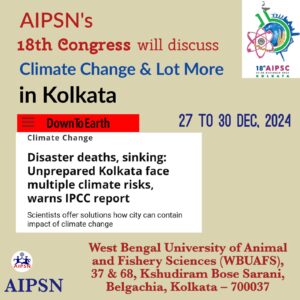
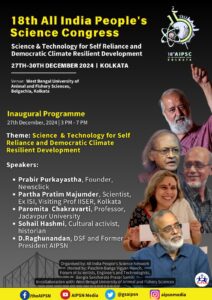
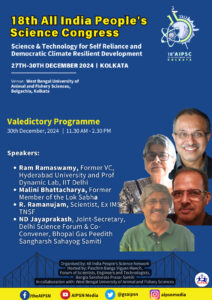
18th All India Peoples Science Congress 27 Dec to 30 Dec @ Kolkata

Click here to see a You Tube video showing glimpses of the 18 AIPSC 

QR code for 18AIPSC photos

QR code for 18AIPSC photos Click here for the URL

QRcode for 18AIPSC presentations

QRcode for 18AIPSC presentations                            Click here for the URL
 

Click here for the Abstract book of the 18 AIPSC 

Click here to see the Kolkata Declaration booklet released at 18 AIPSC

Click here for the theme paper of 18AIPSC

Click here to see the program brochure 

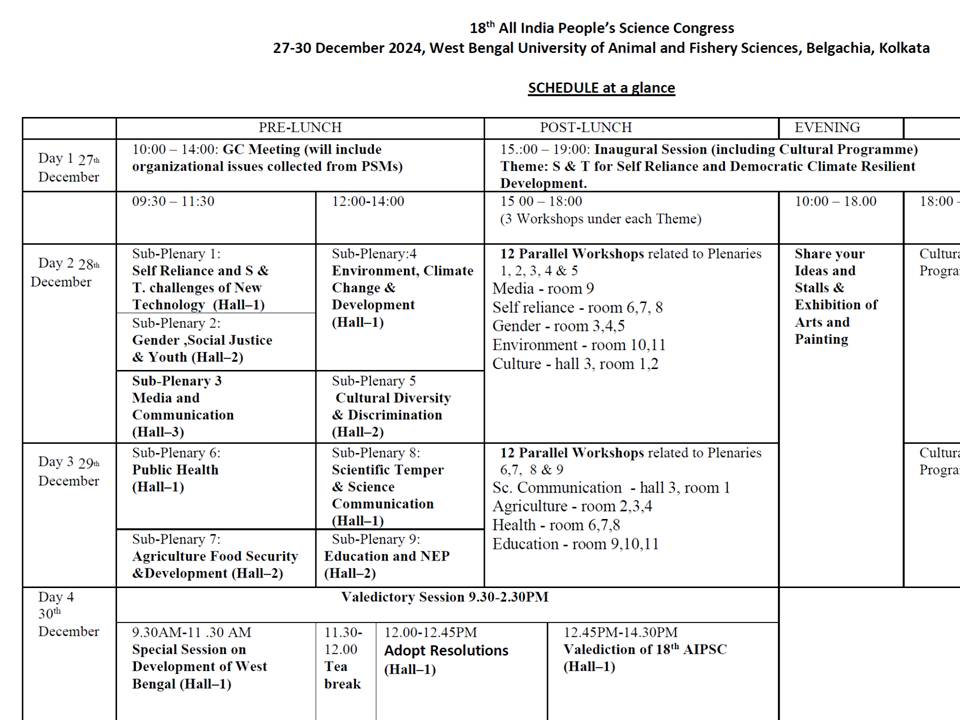
Click here for quick schedule view


National Scientific Temper Day 2024: Advocating Scientific Integrity and Unhindered Rational Inquiry

Click here for the press release of this statement 

Click here for the statement 


19  Aug 2024

National Scientific Temper Day 2024

Advocating Scientific Integrity and Unhindered Rational Inquiry


The 7th National Scientific Temper Day (NSTD 24) will be observed across the nation on August 20, 2024, to honour Dr. Narendra Dabholkar, a notable proponent of science and rational thought, who was tragically killed on this day in 2013 by anti-science extremists. His assassination was followed by the murders of others equally vocal and of similar thinking – Govind Pansare, M.M. Kalburgi, and Gauri Lankesh – who were also murdered. In 2018, the All India People’s Science Network (AIPSN), in collaboration with the Maharashtra Andhshraddha Nirmulan Samiti (MANS), established National Scientific Temper Day (NSTD) as an annual event to commemorate these individuals and to promote a scientific mindset.

Upholding Constitutional Values:

Since its establishment, NSTD has received considerable support from a variety of groups and individuals throughout India, with events occurring in numerous regions. This year’s emphasis is on the Kolkata 2024 Declaration on Scientific Temper, which underscores the urgent need for a renewed commitment to evidence-based reasoning and critical analysis in India. This is especially crucial in light of emerging socio-political movements that challenge scientific inquiry and the generation of universal knowledge. The Kolkata Declaration highlights three primary areas for focus: the role of government, the responsibilities of scientific and educational institutions, and the necessity to combat the erosion of academic freedom and the proliferation of pseudo-science. It calls upon scientists, intellectuals, and advocates promoting evidence-based thinking and upholding constitutional values, thereby fostering a scientific perspective.

NSTD also includes the “Ask Why?” campaign, which aims to advance scientific temper and promote Article 51A (h) of the Indian Constitution. This initiative seeks to reinforce the constitutional right to scientific inquiry and to enhance investment in employment; people centred development, education for all, science, technology, humanities, and the arts.

Interplay of Politics and Education:

Concerns are mounting regarding the influence of Hindutva-related initiatives within research institutions and universities, reflecting a significant political agenda that deserves condemnation. A contentious aspect of the New Education Policy (NEP) 2021 was the introduction of Indian Knowledge Systems (IKS) into educational curricula at all levels. The policy proposed integrating IKS content into existing subjects and introducing specialized IKS courses at both undergraduate and postgraduate levels.

It is essential to recognize that the foundations of modern knowledge are rooted in various ancient and modern cultures, including India, which also encompass oral traditions from marginalized groups such as tribal communities and unwritten knowledge related to agriculture, livestock, and local practices.

The implementation of IKS into educational curricula has been fraught with contention at the school and UG/PG levels. The NCERT’s recent introduction of new textbooks for Class VI, particularly in social science, gives an inaccurate and biased sanskritised representation of Indian knowledge traditions. Scholars and Ayurveda experts have noted that the NCERT Class XI textbook’s portrayal of Ayurveda includes exaggerations and inflated claims of Ayurveda as being codified 4000 years ago. In reality evidence points to around 6th century BCE.

At the higher education level, guidelines issued by UGC for incorporating IKS are unrealistic. Moreover, due to lack of faculty who understand that IKS even in earlier times has been evidence based, many HEIs are implementing courses that misrepresent, simplify and distort its rich history. Thus, the introduction of IKS has opened the door for individuals with naive or pseudoscientific views on Indian science and mathematics to gain influence. For instance, the director of IIT Mandi has faced widespread criticism for making outrageous claims that have circulated on social media, yet he represents only a small part of a much larger issue.

Haunting the System:

This year, IIT Mandi has introduced controversial topics such as “reincarnation” and “out-of-body experiences” into its IKS curriculum for B.Tech students, eliciting mixed reactions. Similarly, Banaras Hindu University (BHU) has established an entire unit within the faculty of Ayurveda dedicated to Bhoot Vidya. This six-month certificate course aims to educate doctors holding BAMS and MBBS degrees in psychotherapy, treatment of psychosomatic conditions, and paranormal activities as part of their Ayurvedic practice.

It is essential not to entirely dismiss Ayurveda and other ancient or folk medicines as irrational, as they were based on empirical practices of their times. India has a long legacy of Ayurvedic medicine grounded in experience and trial and error formulations. However, these need to undergo rigorous randomised clinical trials, which are considered the gold standard in contemporary evidence-based medicine. It has been shown that it is possible to evaluate ancient practices using modern scientific methods while maintaining their cultural significance. There is a need for rigorous research and evidence-based approaches to ensure their credibility and relevance in contemporary health practices. Consequently, AIPSN continues to emphasize the necessity of adhering to evidence-based medicine, where healing and wellness are founded on published and verified evidence.

These regressive IKS-related incursions into research institutions and universities have become commonplace, creating a persistent challenge for rational thinkers to issue statements in response. Nevertheless, in this ongoing struggle, AIPSN cannot remain silent simply because the government is a repeat offender.

Academic Freedom:  

In a separate development, South Asian University recently raised concerns regarding a PhD student’s research proposal on Kashmir, which was labelled as ‘anti-national’ by university authorities. The university’s actions led to the resignation of the student’s supervisor, Professor Sasanka Perera, raising alarms about the diminishing space for unbiased research in society.

The situation at South Asian University pertains to academic freedom and the international character of the institution, rather than being an Indian institution where the directives of the government, however misguided, may be viewed as “legitimate.” If this is how South Asian University is to be operated, it may be more prudent to relocate it outside of India, shut it down, or place it under the oversight of a completely independent body comprising South Asian representatives.

Importance of NSTD 2024:

The issues related to IKS outlined here exemplify a broader agenda that necessitates critique. Similarly, the coercive influence exerted at institutions like South Asian University poses a significant threat to academic freedom and demands vigilant oversight.

These developments highlight the critical importance of NSTD 2024, which is anchored in the Kolkata Declaration on Scientific Temper, serving as a vital advocate for scientific integrity and unhindered rational inquiry in India.


Contact:

General Secretary AIPSN – Asha Mishra 9425302012  gsaipsn@gmail.com @gsaipsn

Arunabha Misra, Convenor, Scientific Temper Desk,  AIPSN 9831105979



AIPSN brief to the political parties for consideration in their election manifesto

AIPSN brief to the political parties for consideration in their election manifesto

Read the manifesto from JVV Andhra Pradesh in Telugu


Click here to read the pdf of the AIPSN brief for Political Parties 

28 Mar 2024

AIPSN brief to the political parties for consideration in their election manifesto

The All India People’s Science Network (AIPSN) – a platform of people’s science movements across the country has the following positions on various critical issues e.g., propagation of scientific temper, S&T policy and process, Environment and Water resources, Health and Agriculture. As the country gears up for the 18th General Election, we would like to present these positions to be considered for inclusion in the electoral manifesto of the secular, democratic political parties of the country.

  1. On Scientific Temper

Article 51A (h) of the Constitution of India speaks of the duty of citizens to promote scientific temper. Recently, new challenges have emerged in the country in the form of strong socio-political narratives, backed by the State power, that seek to oppose any scientific approach, evidence-based reasoning or, indeed, any perspective that acknowledges universal scientific knowledge. We demand:

  • Promote the separation of State apparatus from religion.
  • Promotion and support of campaigns for popularization of science and its methods, and for promotion of scientific temper, evidence-based reasoning and critical thinking.
  • Reversal of the present government’s various methods and measures to undermine scientific temper, critical thinking and evidence-based reasoning in governance, education and among the wider public
  • Reconstitution of text-book committees to reverse the present. government’s anti-science revision of NCERT textbooks so as to promote critical thinking among students; re-write these textbooks to address deletion of Darwin’s theory of evolution and various chapters/ sections on India’s natural resources, forests, environment, mineral resources etc, and rectify the distorted picture of ancient Indian civilization projected in these texts.
  • A thorough revision of the now compulsory UG/PG Courses and reading material on so-called “traditional Indian knowledge systems;” revise teaching material for new optional Courses on Science, Technology and other Knowledge Systems in Ancient and Medieval India based on the vast body of historical evidence-based material already available on the subject.
  • Correction of the unscientific view being projected in educational institutions and among the wider public of imaginary achievements in S&T in ancient India, and the primacy and superiority of only one stream of cultural-religious-linguistic knowledge, as against the diverse sources and streams of knowledge in the Indian civilization including bi-directional exchanges with other civilizations for a true picture of the growth of science.
  • Restoration of autonomy of academic and research Institutions in both natural and social sciences; pay due regard to research/survey-based data as basis for evidence-based policy-making; correct retrospective manipulation of data to suit ideological narratives; defend and restore academic freedom and pluralism of opinion in universities and research institutes; restore the confidence of the people in scientific institutions
  • Strict monitoring and regulation of the dissemination of “magical remedies,” pseudo-science and superstitious beliefs through commercial activities and in the media, including through Anti-Superstition legislation in the Centre and States.
  • Resumption of population census driven public policy framing.
  1. On Science and Technology (S&T)
  • Enhancement of public funding of indigenous research in S&T to at least 2 per cent of GDP, with due importance to basic research.
  • Strengthening of the university system in research and development (R&D).
  • Decentralization of systems and processes for research funding; scrap the highly centralized National Research Foundation (NRF) set up under the NEP, which also burdens State governments without according to them equitable participation in decision-making; enhance research in state-level universities and collaborations with Central universities and national S&T institutions.
  • Allocation of funds for state-level initiatives for S&T interventions to tackle people’s problems e.g. drought, water resource management, rural livelihoods, issues faced by marginalized communities.
  • Provision of requisite mission-mode R&D funding for identified sectors of the “4th Industrial Revolution” such as Artificial Intelligence (AI), Internet of Things (IoT), bio- and nano-technology etc towards self-reliance in advanced technologies expected to dominate the “knowledge era,” but in which India is in danger of being left behind in pursuit of externally-dependent and false “atma-nirbharta”; also focus on agricultural research to break monopolies of MNCs and enable climate-resilient agriculture/horticulture.
  • Increase in number of research fellowships especially for first generation students; increase number of faculty research positions in institutes; increase quality and quantity of PhDs in which India lags behind.
  • Systematic measures to increase participation of women in STEM (science, technology, engineering and mathematics) research and jobs
  • Initiation of measures to reduce bureaucratism in S&T Institutions, and encourage academic freedom and culture of research towards reversing brain drain; reverse current trend of sycophancy, fear and discouragement of pluralism in universities and research institutes.
  • Regulation of AI, genetic engineering, data-mining and IT-based surveillance so as to ensure the public good.
  • Review of decision to close down many government-funded S&T Institutions; resuming government support for a restructured Indian Science Congress.
  • Promote free and open source software (FOSS) and other new technologies, free from monopoly ownership through copyrights or patents; “knowledge commons” to be promoted across disciplines e.g. like biotechnology, AI and drug discovery.
  • Recognition of digital infrastructure as public infrastructure to be used for public good.
  • Investment in public communication networks and free knowledge access to scientific and other academic publications without copyright barriers.
  • Ensuring all public funded research is made accessible to all.
  • Rigorous double-blind clinical trials with publication of data for open review for approval of new medicines, vaccines etc.


  1. Environment

Various dilutions of regulatory provisions for environmental protection have taken place in the recent past that would have serious impact on our natural resources and climate and will affect people’s livelihoods and wellbeing. There will have to be reversals of these changes. The specific demands are the following:


  • The system and processes of Environmental Impact Assessment (EIA) and Environmental Clearances at State and Central level be made effective, time-bound, transparent, accountable, and free of conflict of interests. EIA is to be conducted preferably through an independent Environmental Protection Agency; repeal EIA Notification 2020 and issue revised guidelines.
  • Economy-wide measures be planned and initiated to reduce greenhouse gas (GHG) emissions under the UNFCCC framework as applicable to developing countries, through effective policies, regulation, de-carbonization, energy efficiency in all sectors of production and consumption, while providing for a just transition from fossil fuels; promotion of renewable energy such as solar and wind; reducing energy inequality and promoting energy access for economically weaker sections such as in public transport; India’s updated Nationally Determined Contribution (NDC) required to be submitted to UNFCCC in 2025 to be re-cast through a participatory process involving all stakeholders.
  • A National Adaptation Plan (NAP) should be evolved through a participatory process involving all stakeholders especially States to tackle climate impacts such as on agriculture, extreme rainfall and related landslides and urban flooding, heat waves and urban heat islands, coastal erosion and sea-level rise; streamline systems to tackle natural and climate-related disasters; evolve and implement climate resilient development strategies especially addressing the needs of vulnerable populations; provide adequate funds from the Centre and build capabilities of States and local governance structures for the above.
  • Sustainable and environment/climate-friendly development strategies should be evolved for the fragile Himalayan region and eco-sensitive regions of Western Ghats and the North-East; undertake comprehensive review of infrastructure development and urbanization in hill areas, especially in the Western Himalayan region.
  • Thoroughly revise National Clean Air Programme (NCAP) towards rapid and goal-oriented reduction of air pollution in urban areas especially through promotion of public mass transportation in preference to personal vehicle use, and effective regulation of polluting industries and construction activities; strengthen Central and State regulatory authorities.
  • Urgently initiate measures to prevent degradation and destructive development of riverbeds and flood plains, including in urban areas.
  • Undo different provisions of the Forest (Conservation) Amendment Act, apart from the modified definition of Forests struck down by the SC, especially 100 km from international boarder and LAC/LOC being exempt from any regulatory measure; ensure protection of rights of tribals and other forest dwellers under Forest Rights Act, 2006.
  • Repeal provisions of biodiversity Amendment Act 2023 which permits transfer of knowledge regarding bio-diversity resources to corporate without permission of National biodiversity Authority, and also denies local communities of due compensation or share of these benefits.
  • Scrap the environmentally disastrous and pro-corporate islands Development Plan for Andaman & Nicobar and Lakshadweep Island chains, without due consultation with local population in Lakshadweep, and endangering the tiny remaining populations of mostly isolated tribes in the Andamans; re-examine feasibility and location of proposed naval base in A&N.
  • Scrap environmentally dangerous National Oil Palm Mission with highly inflated claims of yields and focusing on eco-sensitive North-East and Andaman Islands.
  1. Water Resources
  • Re-formulate National Water Policy treating water as a scarce public good; tackle the growing water crisis; enhance equitable water availability for optimized domestic use, irrigation and industry through effective protection of rivers, expansion of water bodies and increased groundwater recharge; appropriate legislation, effective regulation and demand management of water; water audits and measures to conserve, treat and recycle water especially in urban areas.
  • Ensure equitable provision of WHO-standard piped potable drinking water to all households
  • Halt privatization of water resources and water distribution utilities in urban areas and recognise the right to water as part of the right to life.
  • Check pollution of rivers and other water bodies through effective legislation, regulation and enforcement of sewage and other waste-water treatment and recycling policies; withdraw provisions of Water (Prevention and Control of Pollution) Amendment, 2024 allowing Centre to override State Pollution Control Boards (SPCBs).
  • Undertake comprehensive review of the programme and projects for inter-linking of rivers.
  • Plan and urgently implement measures to protect and improve catchment areas of major rivers especially in the Himalayan region; also take all steps possible to check glacier melting rates such as through regulation of fossil-fuel powered vehicular movement and air pollution in mountain regions.
  1. Health
  • Make right to free health care justiciable through enactment of appropriate legislations at both Central and State levels.
  • Retain health services as a state subject with strong emphasis on federalism.
  • Public expenditure on health to be raised to at least 3.5 per cent in the short term and 5 per cent of the GDP in the long term, with at least 1% and 2% respectively coming from the Centre.
  • Out-of-pocket expenditure on health to be brought to below 25% of health spending expand and strengthen the public healthcare system to ensure free availability of quality health care at all levels, including entire range of medicines, diagnostics and vaccines, and accountability to local communities.
  • Scrap the government-funded PMJAY/Ayushman Bharat health insurance scheme and replace it with a Public-centred Universal Health Care system.
  • Reverse the privatisation of health care services and outsourcing of services through PPPs.
  • Reverse the re-branding of Health and Wellness Centres as ‘Arogya mandirs’.
  • Extend and reform the ESI scheme to effectively protect workers’ health in both organized and unorganized sector, and also covering occupational health.
  • Effectively regulate the private health care sector, especially corporate hospitals which should be brought under the Clinical Establishment Act. Modify the National Clinical Establishment Act, 2010 ensuring implementation of the Patients’ Rights Charter and standardization of reasonable rates and quality of various services.
  • Ensure right-based access to comprehensive treatment and care of persons with mental illness through integration of the revised District Mental Health Programme with the National Health Mission.
  • Adopt a people-centred, rational pharmaceutical policy with effective cost-based price controls, elimination of irrational and hazardous formulations, and a comprehensive generic medicines policy covering labelling, prescription and availability at all retail outlets; ensure availability of essential drugs free of cost at all public health care facilities.
  • Initiate programs to break monopolies of pharmaceutical multinational companies in critical areas.
  • Revive public sector pharmaceutical units to harness them for production of essential drugs and vaccines, and reverse privatization trends; reinstate Open-Source Drug Discovery (OSDD) programmes and collaborative R&D for affordable medicines; remove GST for life-saving and crucial medicines.
  • Strictly control and regulate clinical trials and prohibit unethical clinical trials; develop a justiciable charter of rights for clinical trial participants
  • Remove US government’s drug law enforcing agency USFDA’s offices and officials from India.
  • Resist dilution of India’s Patent of Laws and reject provisions in Free Trade Agreements that obstruct domestic production low-cost generic drugs.
  • Ensure effective, appropriate regulatory oversight of AYUSH system of medicine, while supporting evidence-based use of such systems.
  • Give priority to the setting up of new public colleges to train doctors and nurses, especially in underserved areas such as in the North East and in poorer States. Training institutes to be set up for health workers.
  1. Agriculture

            Right to land, water and commons for all

  • Provide equitable access to land and water: legislate for homesteads for the rural poor; grant land rights to landless for cultivation; promote kitchen gardens, backyard poultry, cattle sheds and group farming.
  • Place all above-ceiling land presently held by public or private entities under control of the state and union government for the redistribution to the landless.
  • Create a register of tenants and provide smallholders with secure tenancy. Give tenant farmers statutory support, recognise tenants as beneficiaries of schemes announced for individual benefits, and access to benefits from sector wide schemes financed through public investment.
  • Recognize women as farmers and grant them land rights, secure their tenancy rights over leased lands.
  • Recognize land rights of Adivasi farmers, implement Forest Rights Act (FRA), review all rejections under FRA, and roll back pro-corporate amendments to Indian Forest Act, 1927.

            Right to Food, Employment, Education, Health and Social Protection

  • Ensure job security and minimum wage by extending the number of workdays from 100 to 200 workdays in rural areas @ Rs. 800 wages per day, implement existing provision of 100 days of MGNREGA without creating digital hurdles.
  • Introduce a provision of 100 days of labour support for the SC, ST, and other small and marginal farmers for land development and for the adoption of integrated farming systems (IFS) including natural farming, thus 200 days of rural employment @ Rs. 800 wages per day.
  • Enact old age pensions.
  • Provide childcare and crèche facilities in agricultural workspaces.
  • Provide for separate courts for protection against caste, ethnic, religious, gender-based oppression.
  • Introduce Urban Employment Guarantee Act, guarantee employment for graduates from rural households in nearby towns.

            Right to public and bank finance, production inputs, knowledge and market

  • Guarantee extra budgetary resources to states from the 15th finance commission for raising the level of gross capital formation in agriculture as a percentage ford from the current level of 15.7% to 30%.
  • Guarantee primary producers’ freedom from debt by implementing complete(formal and informal) loan waiver, restore the right of primary producers to priority lending, stop co-lending to delink farmers from the high-cost economy in agriculture; reduce the risks faced from climate change in respect of pursuing agriculture & allied sector occupations.
  • Create a single-window loan facility for small holders to promote integrated farming, strengthen SHGs and Kudambashree-type of institutions to enable women farmers to access agriculture credit from public banking.
  • Guarantee remunerative prices for agricultural commodities establish an effective system of public procurement of all farm produce declared as essential produce/value added products by rural households through cooperatives for the promotion of sustainable rural livelihoods and for the creation of a universal public distribution system.
  • Guarantee access to publicly regulated markets purchasing the primary produce at the minimum support price (MSP) not lower than C2 costs plus 50 % for the products declared as essential commodities for production by state legislatures.
  • Take agriculture out of WTO, no more free trade agreements (FTAs), and no more patent like intellectual property rights (IPRs) on seeds.
  • Withdraw from the agreements signed by ICAR with Bayer, Amazon and otherness, guarantee research, advice, testing and extension through public sector undertakings, and pave the way for national ownership and control of infrastructure required for agri-digitalization and agri-tech delivery.
  • Reintroduce sectoral reservation through legislation for the products attracting AGMARK label to encourage value addition through cooperatives, micro and small businesses & PSUs in order to keep big business out of local markets.
  • Ensure agro-ecologically coupled integration of primary, secondary and tertiary industries, and restore state/district level planning by establishing statutory boards for scientific and equitable land use, area planning, market development, and promotion of value addition to co-products and by-products through group enterprises.
  • Separate Fisheries Ministry in Central and State Governments with the mandate to protect and promote sustainable fisheries and the livelihood of small-scale fish workers including fishers, fish farmers, fish vendors and other ancillary fish workers.
  • Establish a National Commission for Fisheries to look after policy implementation, inter-state disputes, protection and promotion of the rights and entitlements of small-scale fishing communities.
  • Create in every state “State Commissions for Agriculture and Farmers’ Welfare”.
  • Stop entry of private Dairy Corporate Companies and import of foreign dairy products that threaten existence of India’s Dairy Cooperatives.
  • Abandon plan to open the Indian market by permitting Free Trade on milk and milk-based products.
  • Ensure remunerative prices for milk and milk products.


For clarifications contact:

Asha Mishra, General Secretary, AIPSN  gsaipsn@gmail.com, 9425302012, Twitter: @gsaipsn